Nebraska – Sunday, June 30
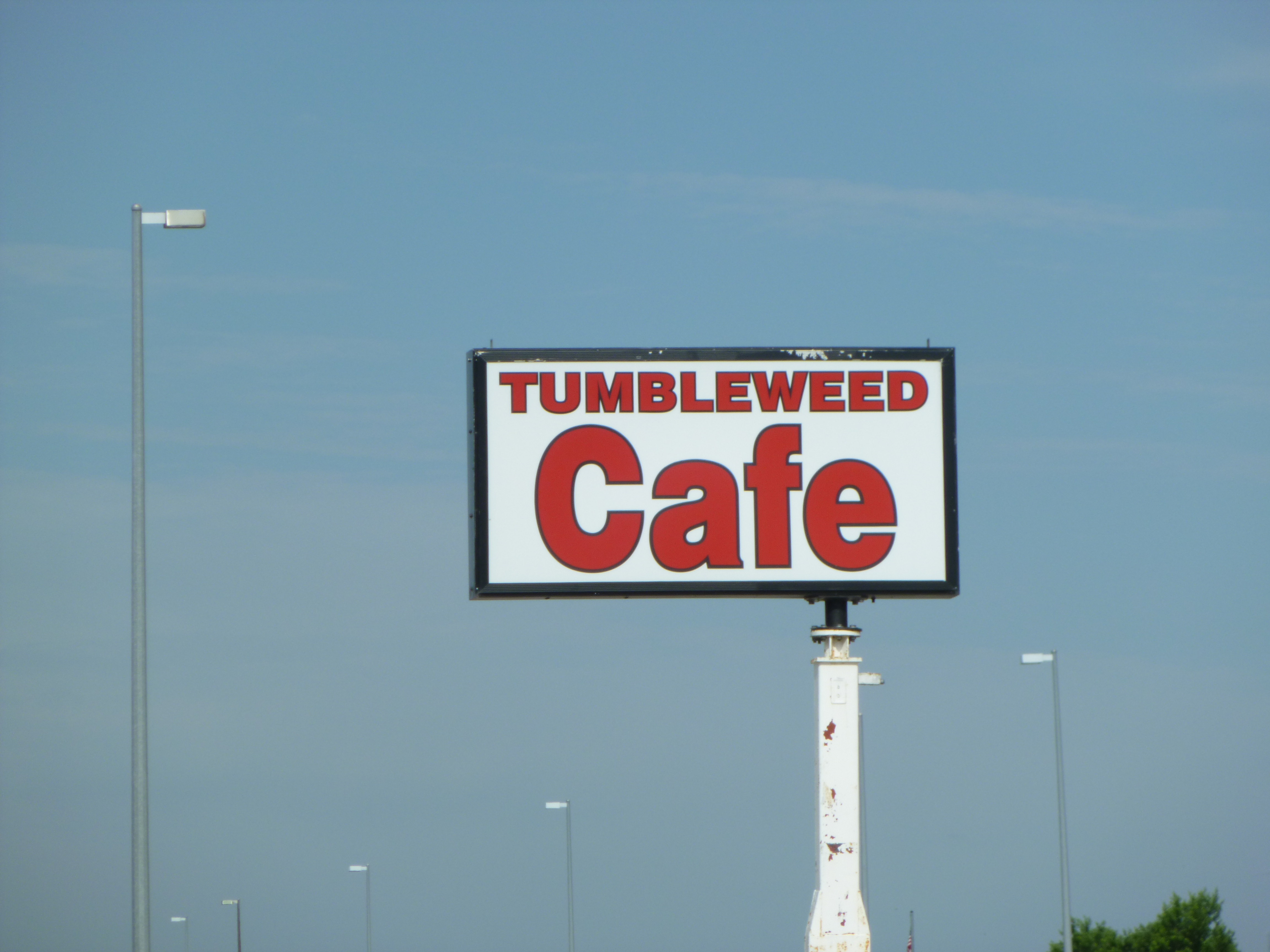
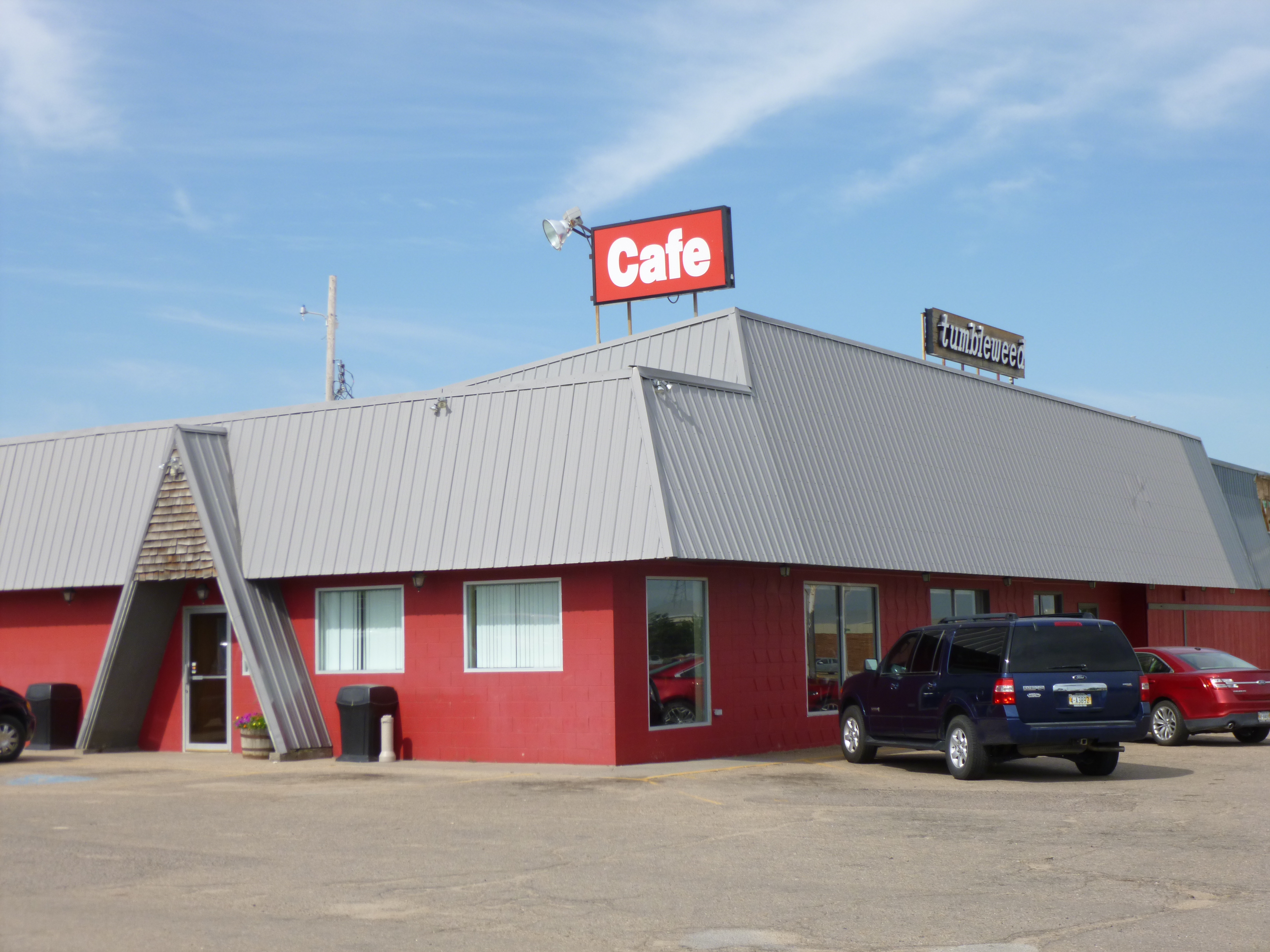
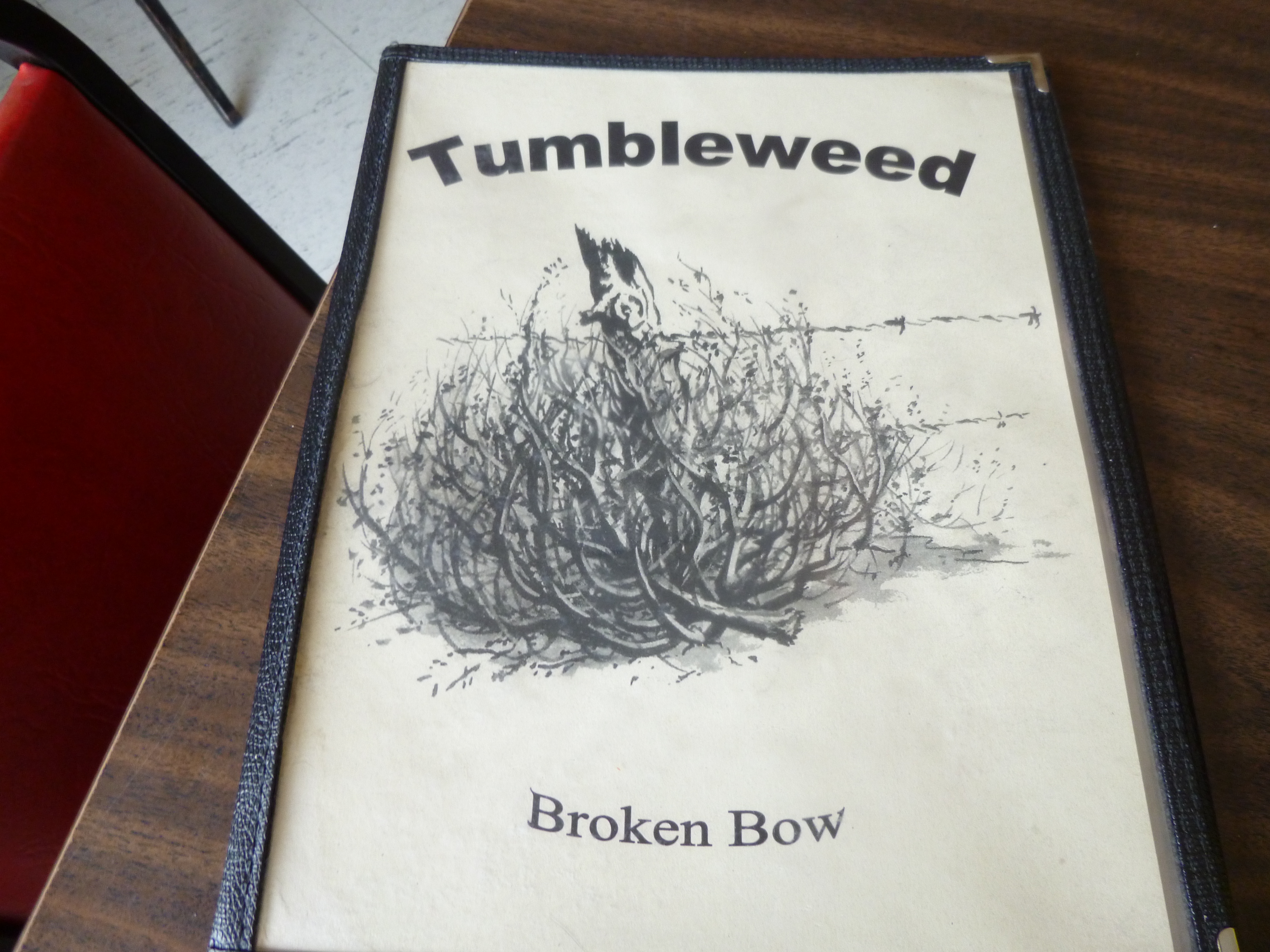
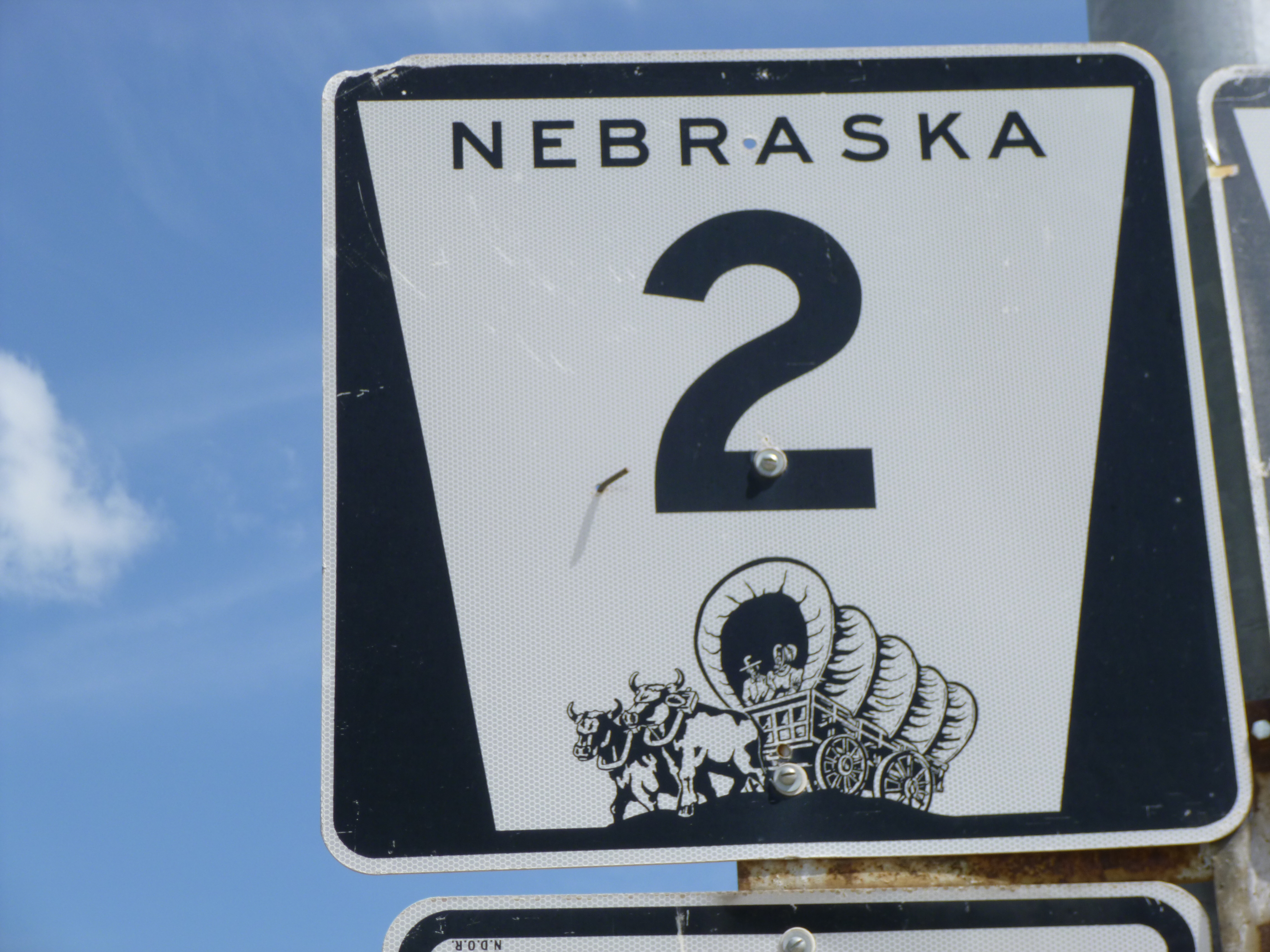
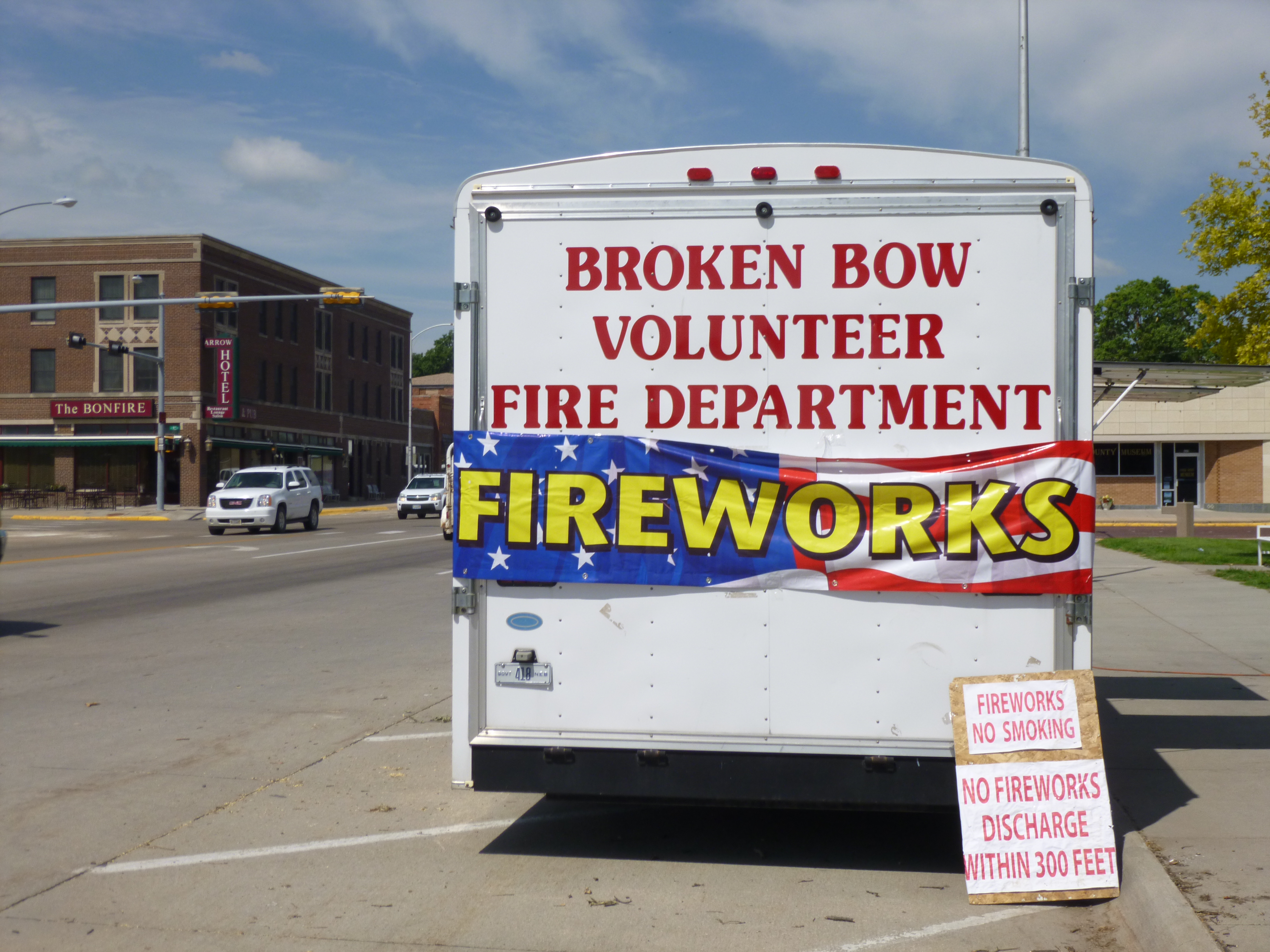
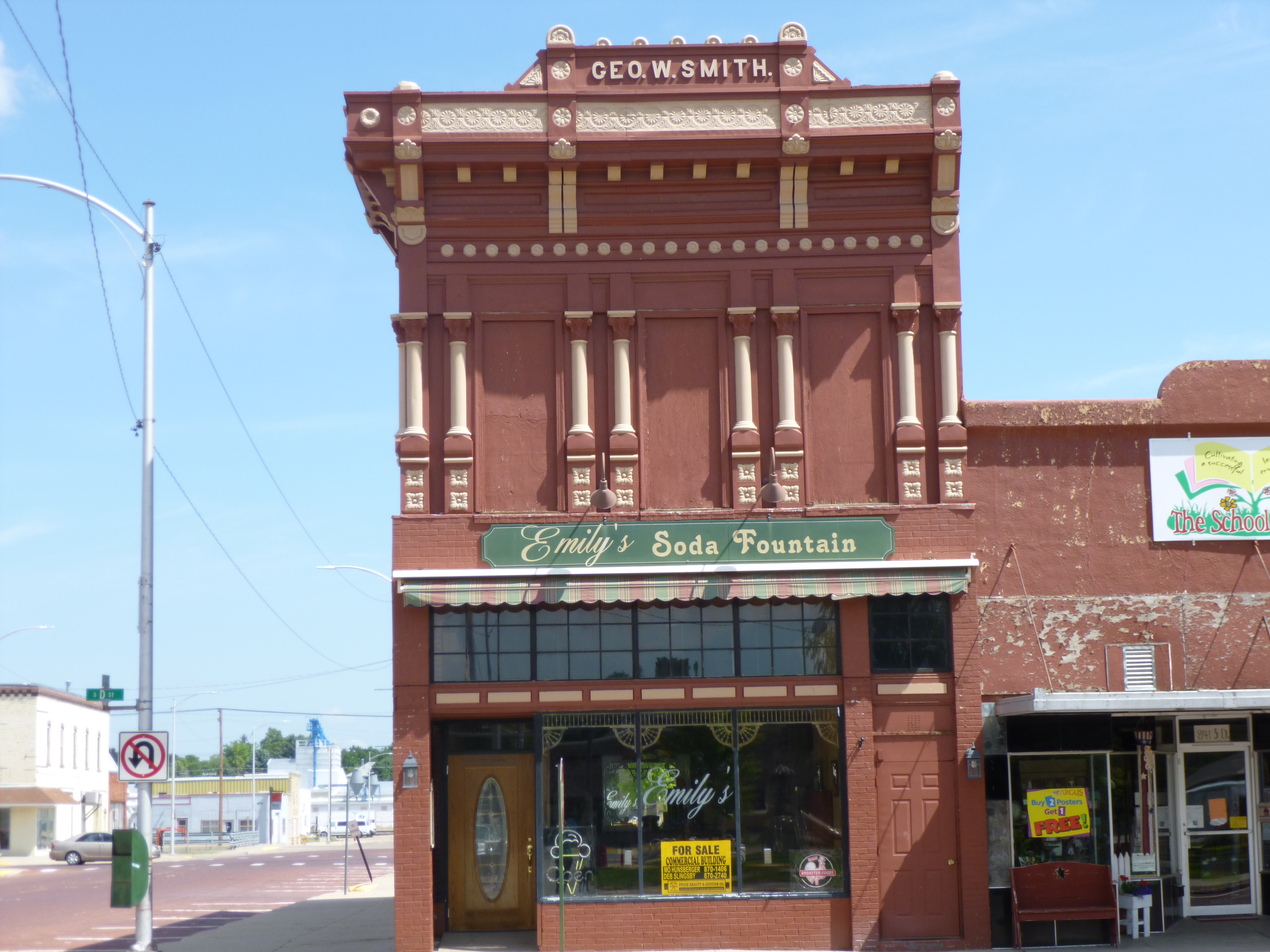
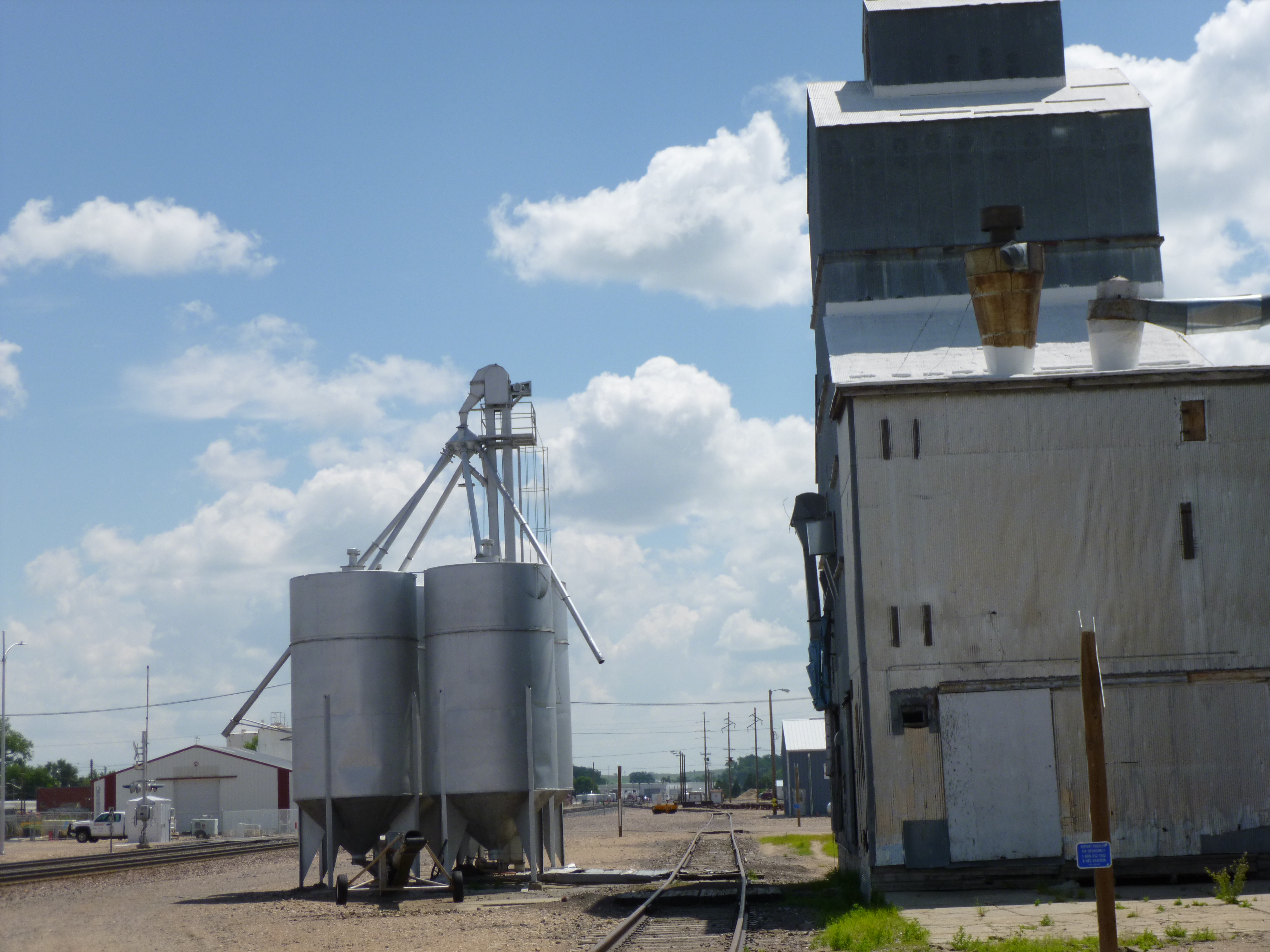
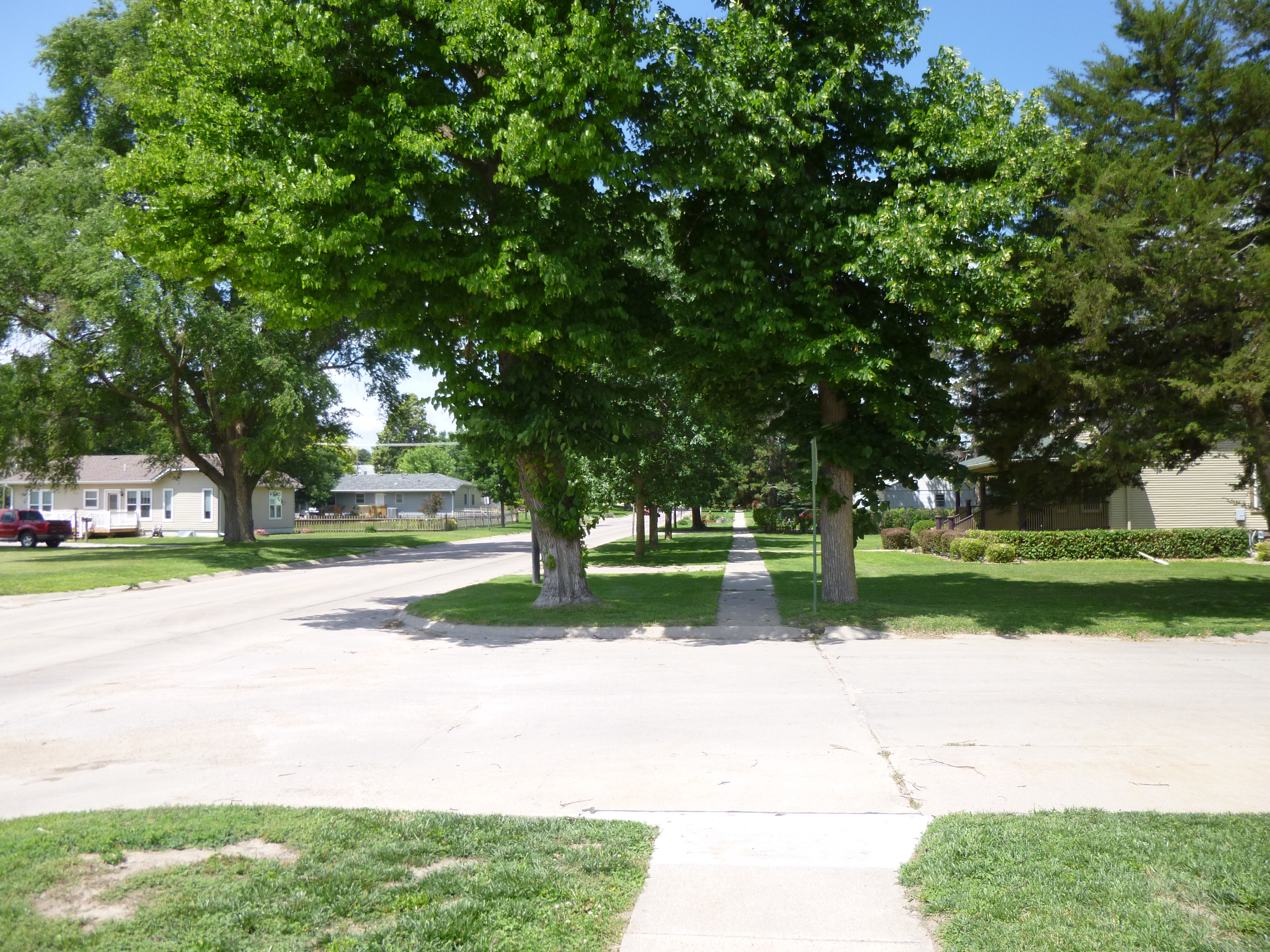
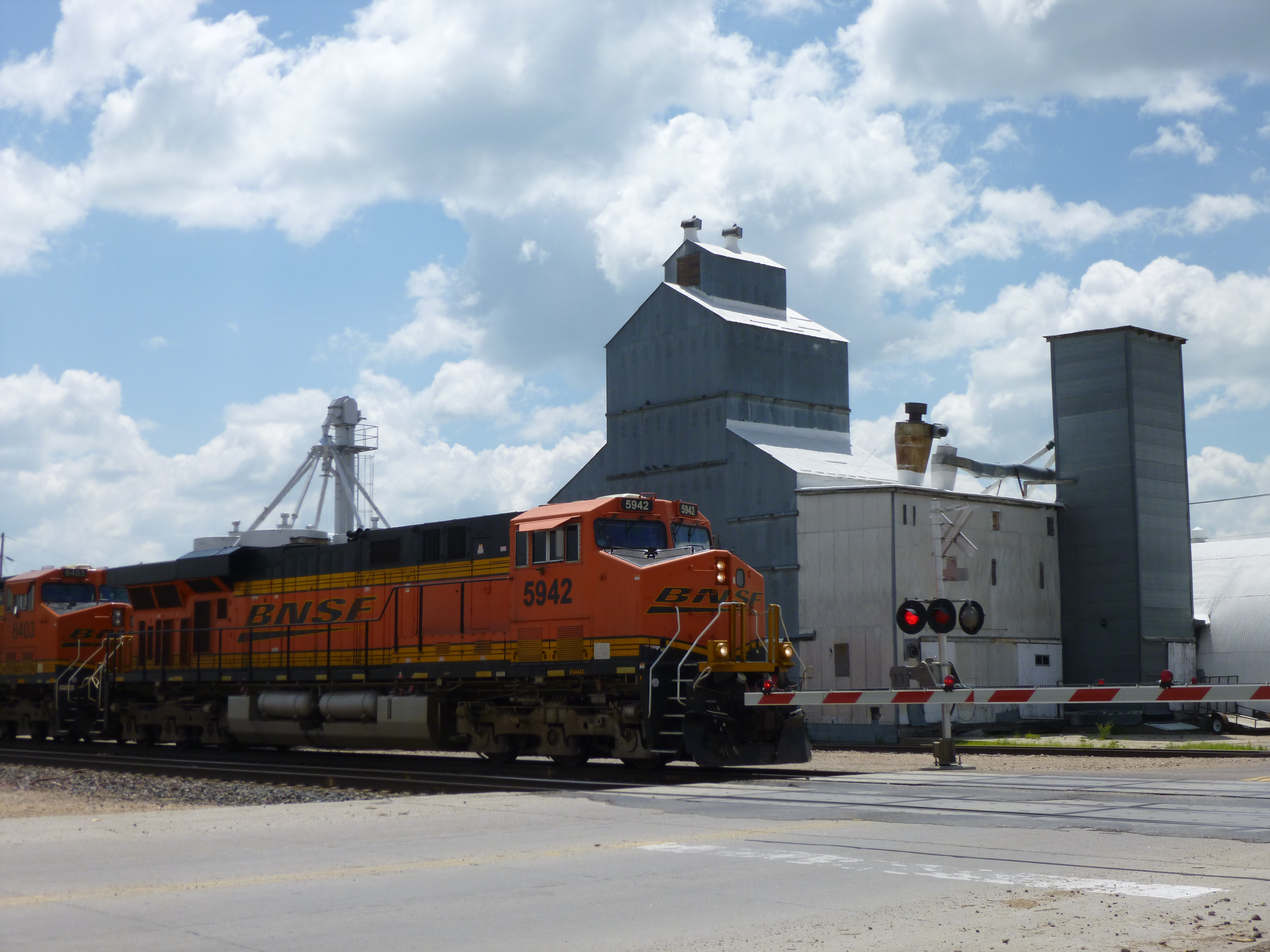
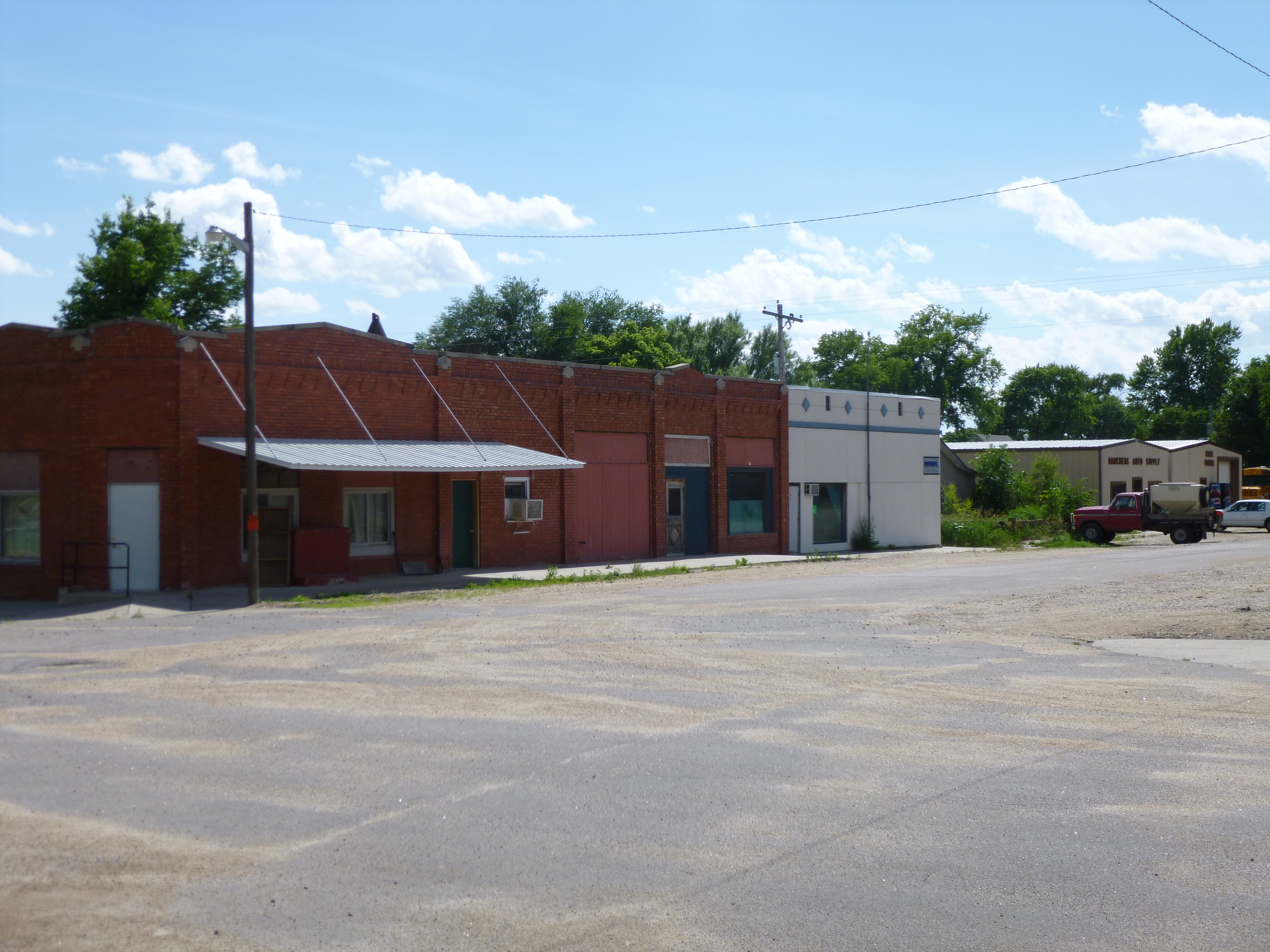
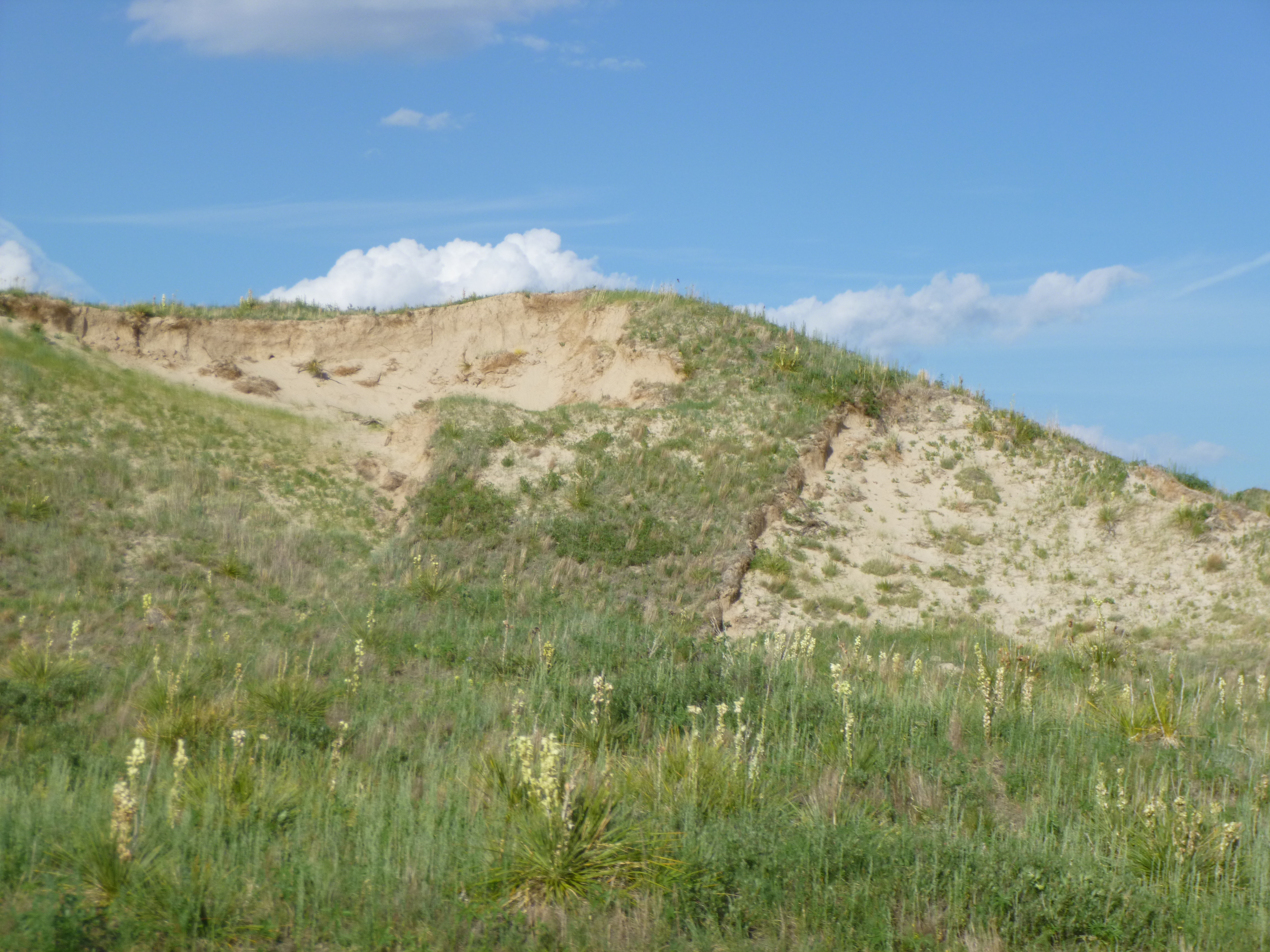
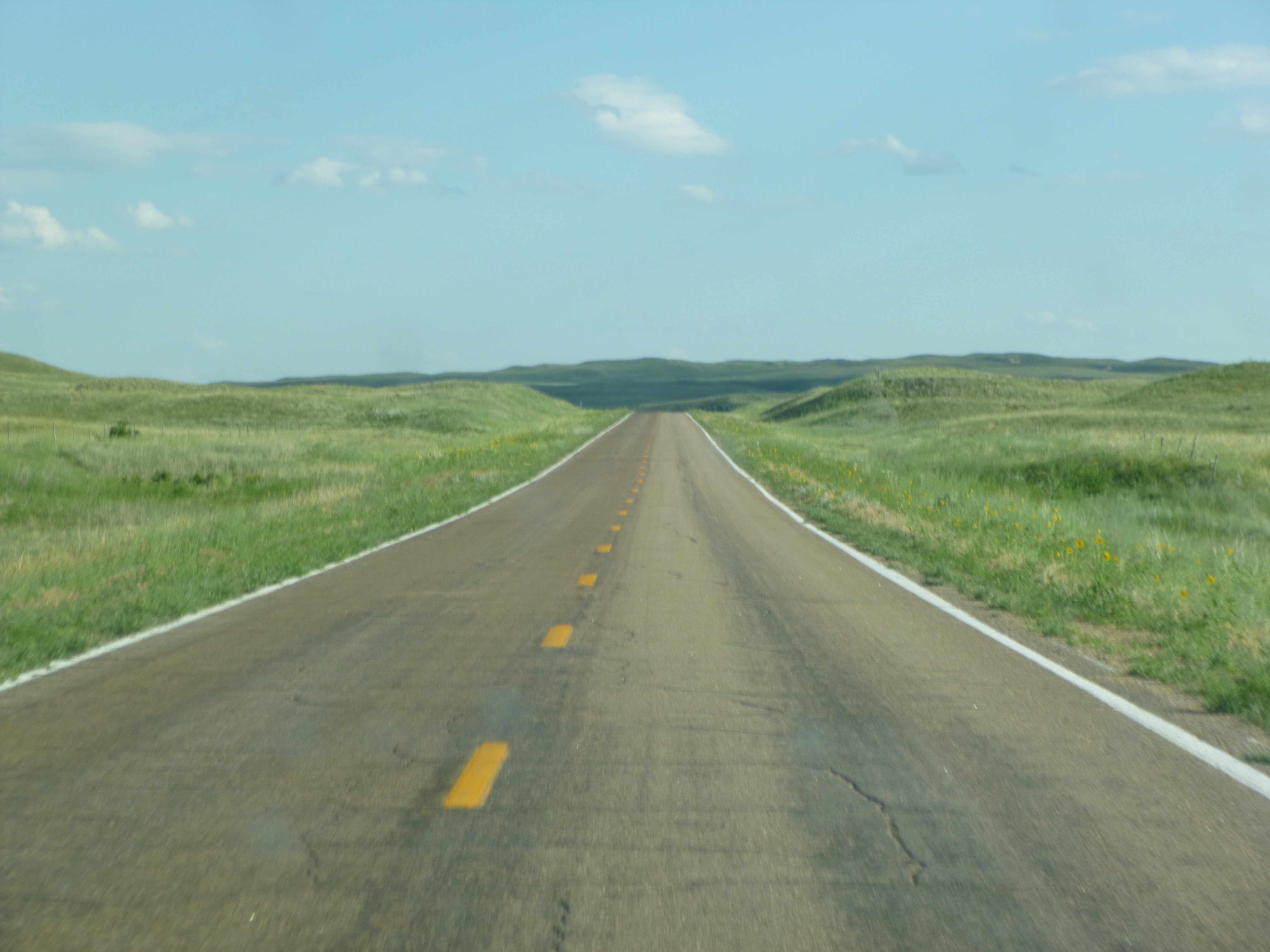
I got packed up from my impromptu camping spot and hit the road again toward Broken Bow. These sandhills are so pretty, I’m glad I didn’t drive through part of them in the dark. When I got to Broken Bow (so named because the town’s founder had found an Indian’s broken bow on the land, and the first 3 names for the town were rejected) the first thing I saw was the Tumbleweed Cafe, and I was in the mood for a good breakfast. So I stopped to eat before Tula and I did some walking around town. It amazes me that little fireworks stands are springing up all over the place – even the smallest of cow towns seems to have at least one fireworks stand – whether it’s a trailer, a tent or simply the back of a semi! They’re all over the place! Broken Bow was a little bigger than a lot of the little towns that aren’t much more than an intersection with a store and a gas station and the grain elevators, so I did a lot of walking and covered over 4 miles.
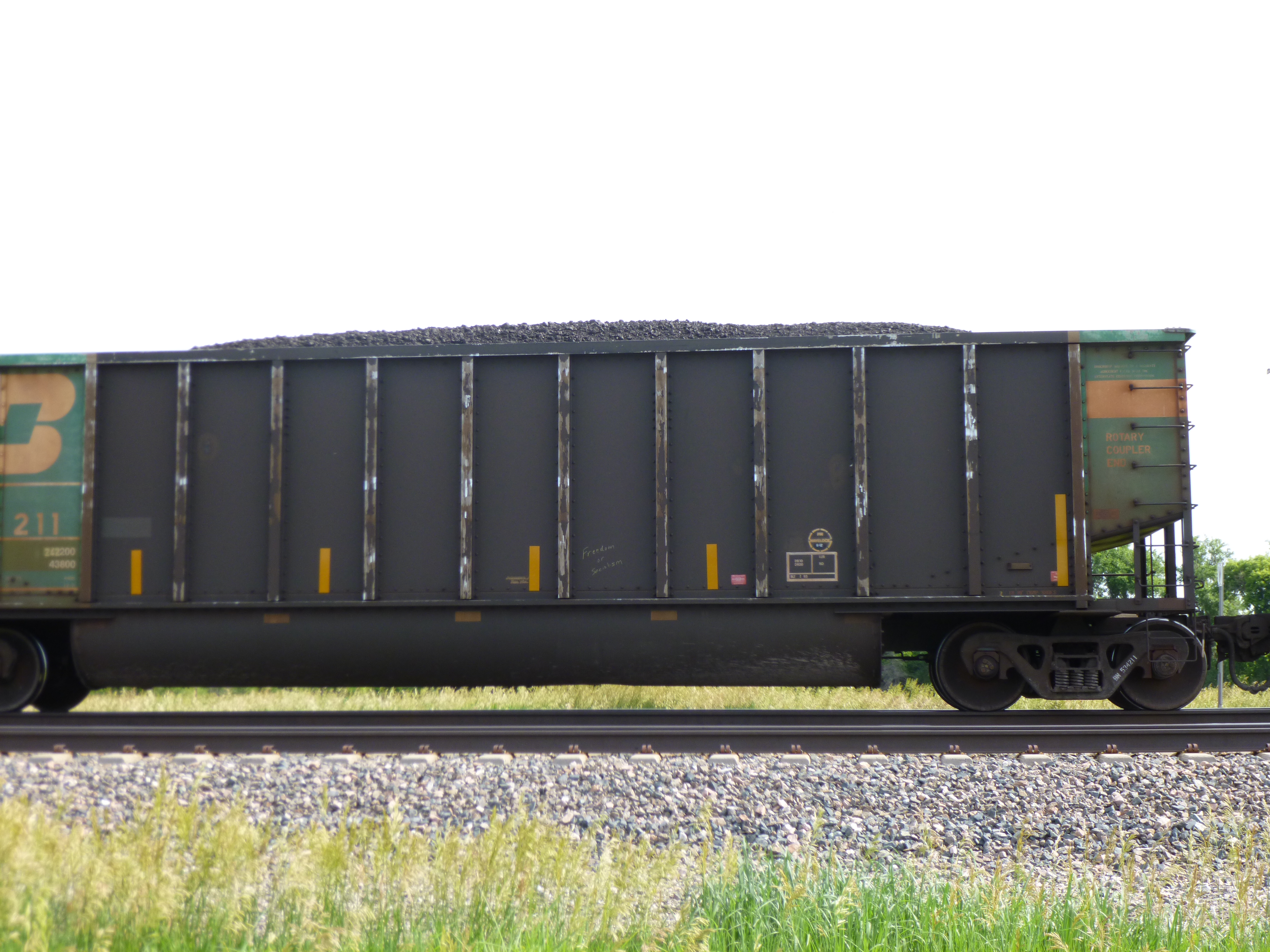
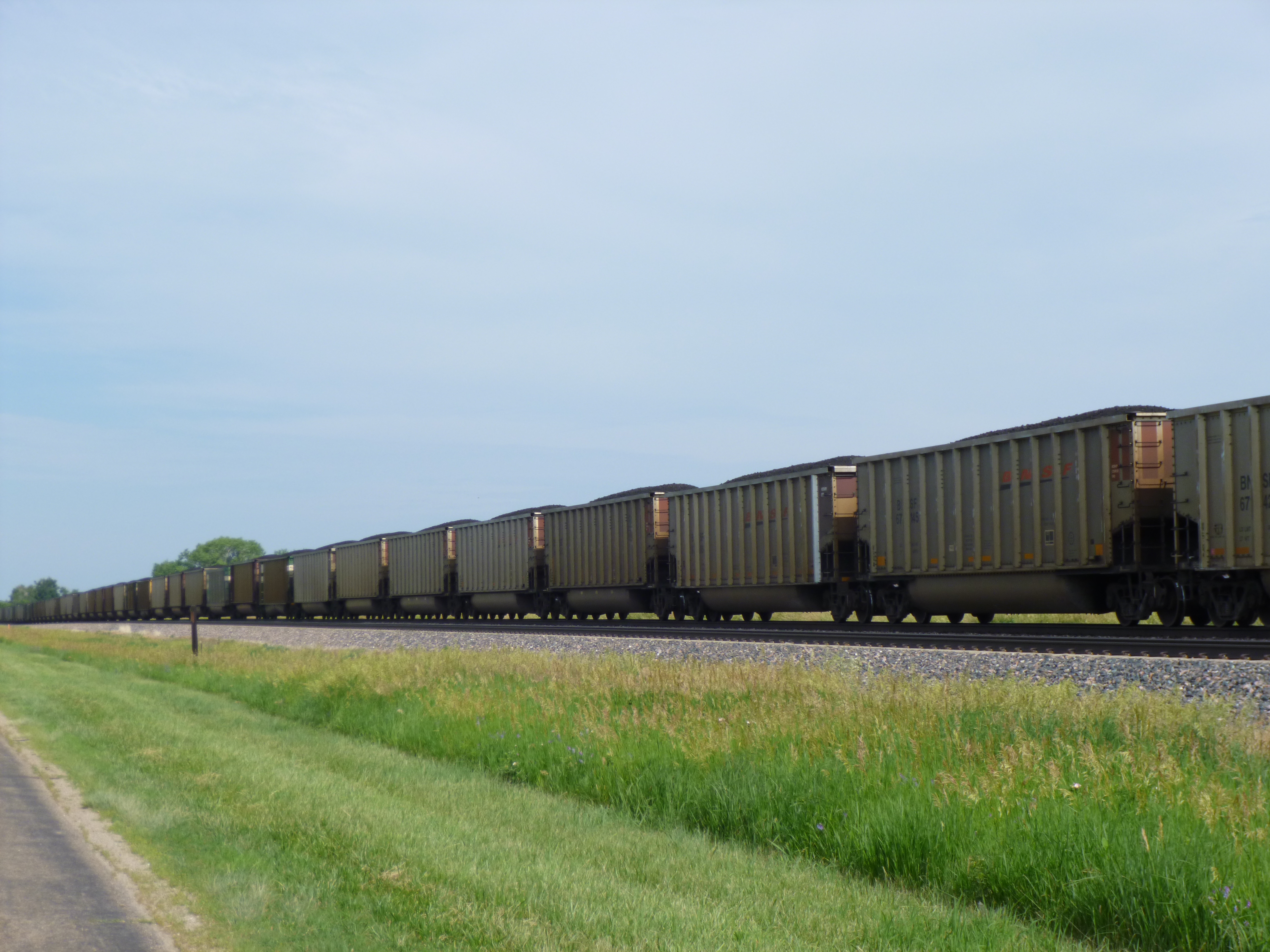
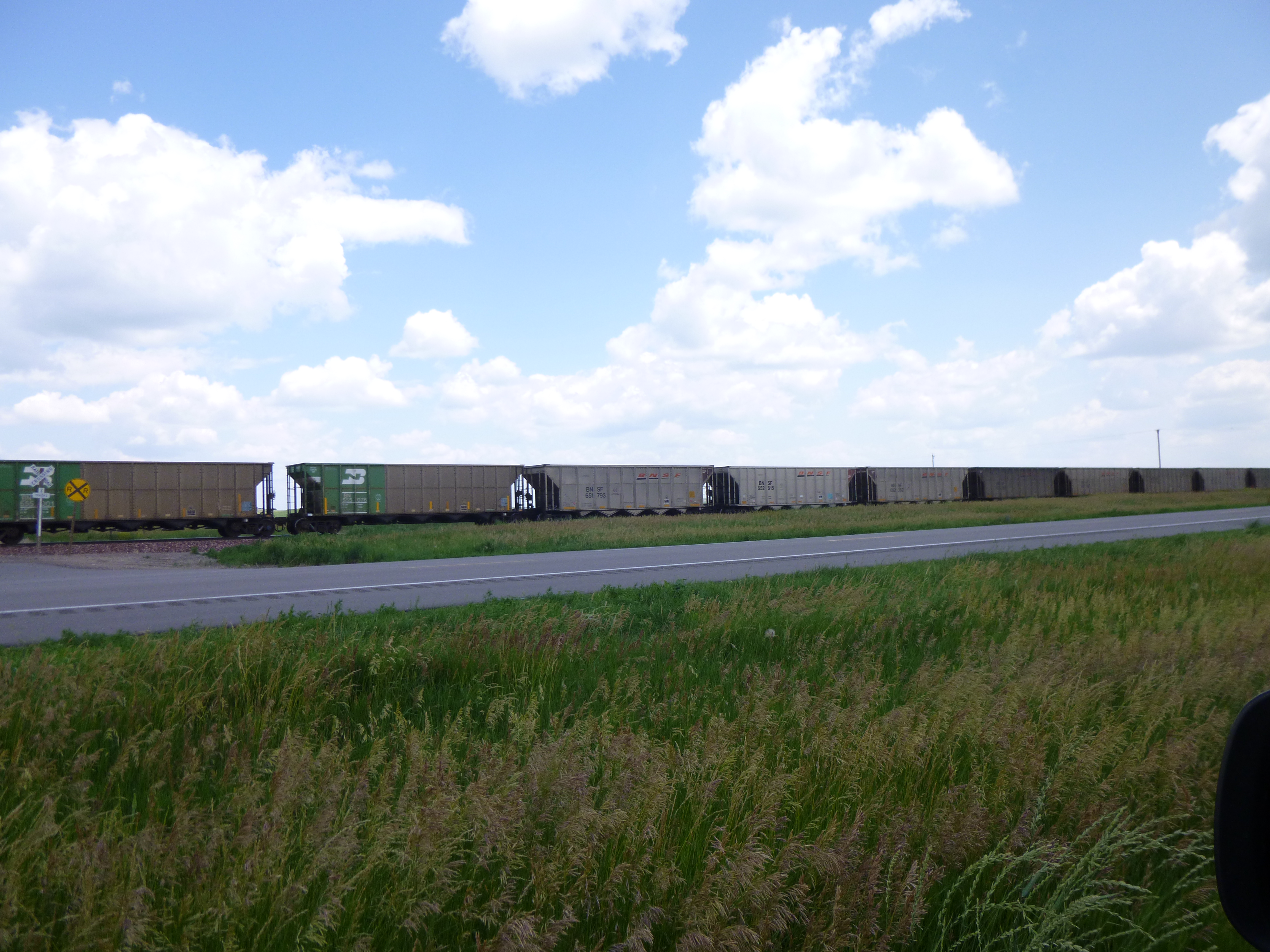
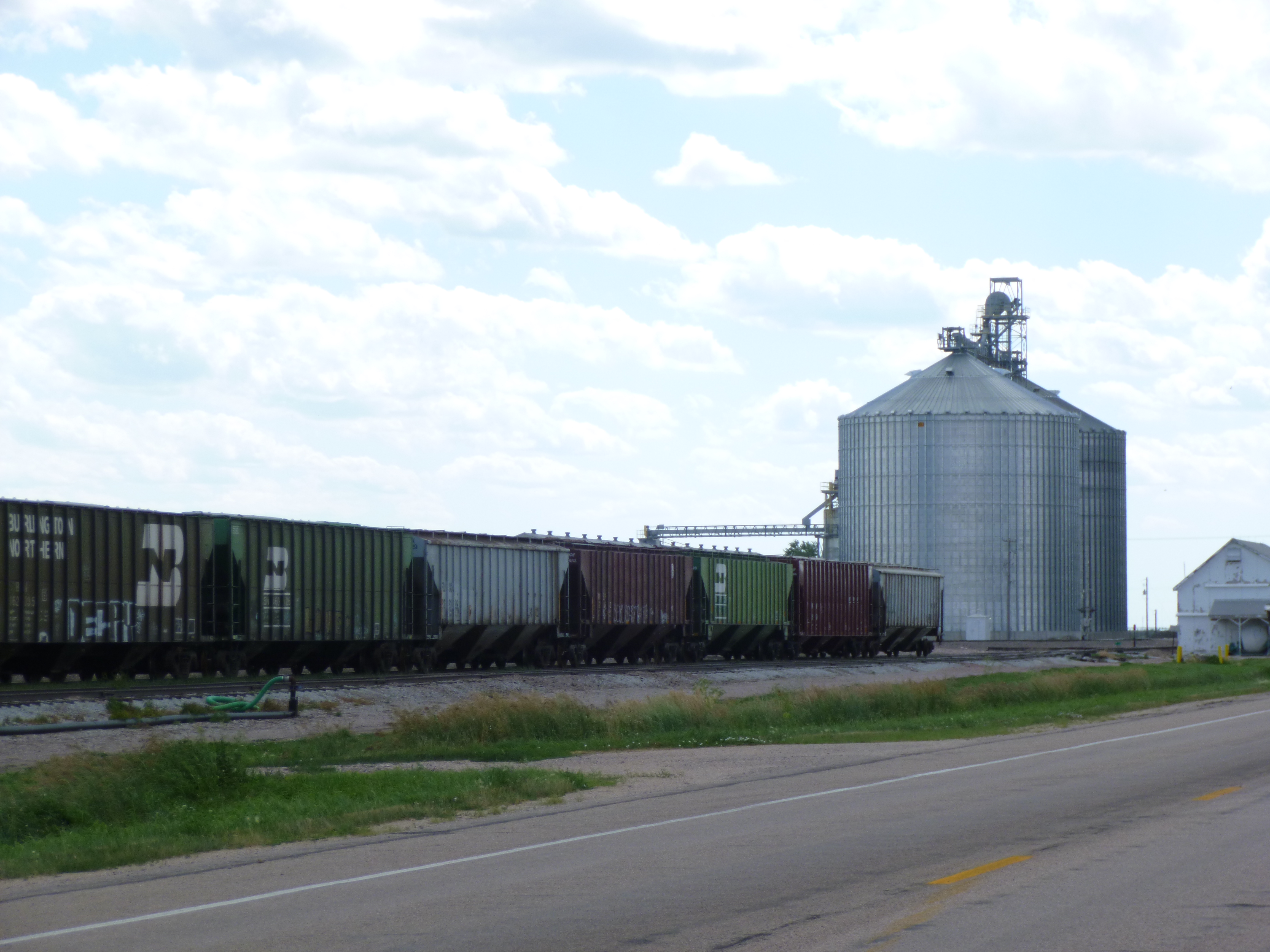
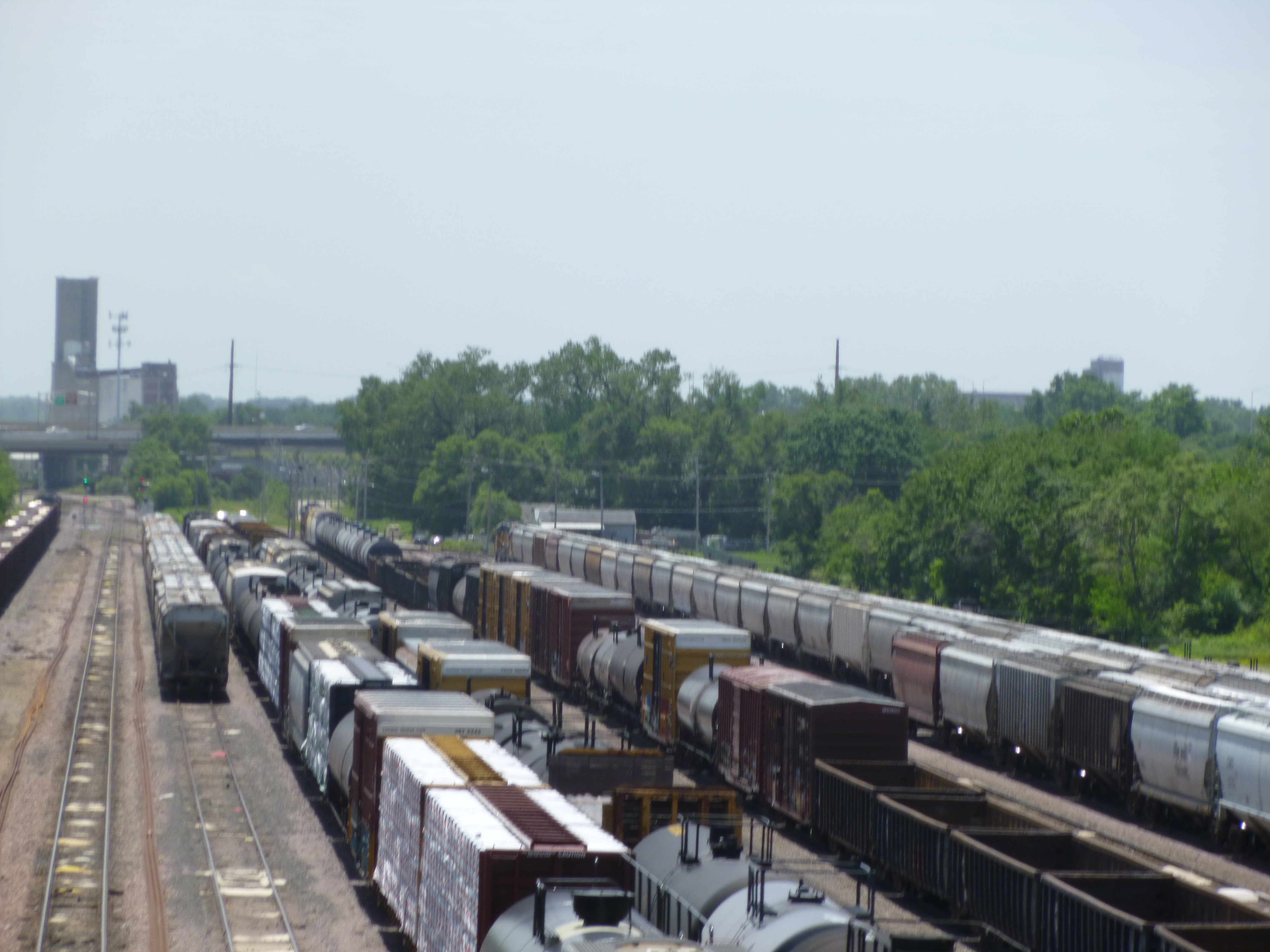
The other thing that was a constant presence in my drive west across the sandhills was trains – mostly long trains of coal and the tracks were right by the road. The coal trains were all heading east – I began to wonder where all that coal was coming from and where it was going. A few trains were stopped on the tracks and I could use my odometer to measure their length – consistently about a mile and a quarter. And I counted cars in a couple trains – 138, and they all had 2 engines in the front and one in the back. I lost count of all the trains I saw – such an enormous quantity of coal being transported!
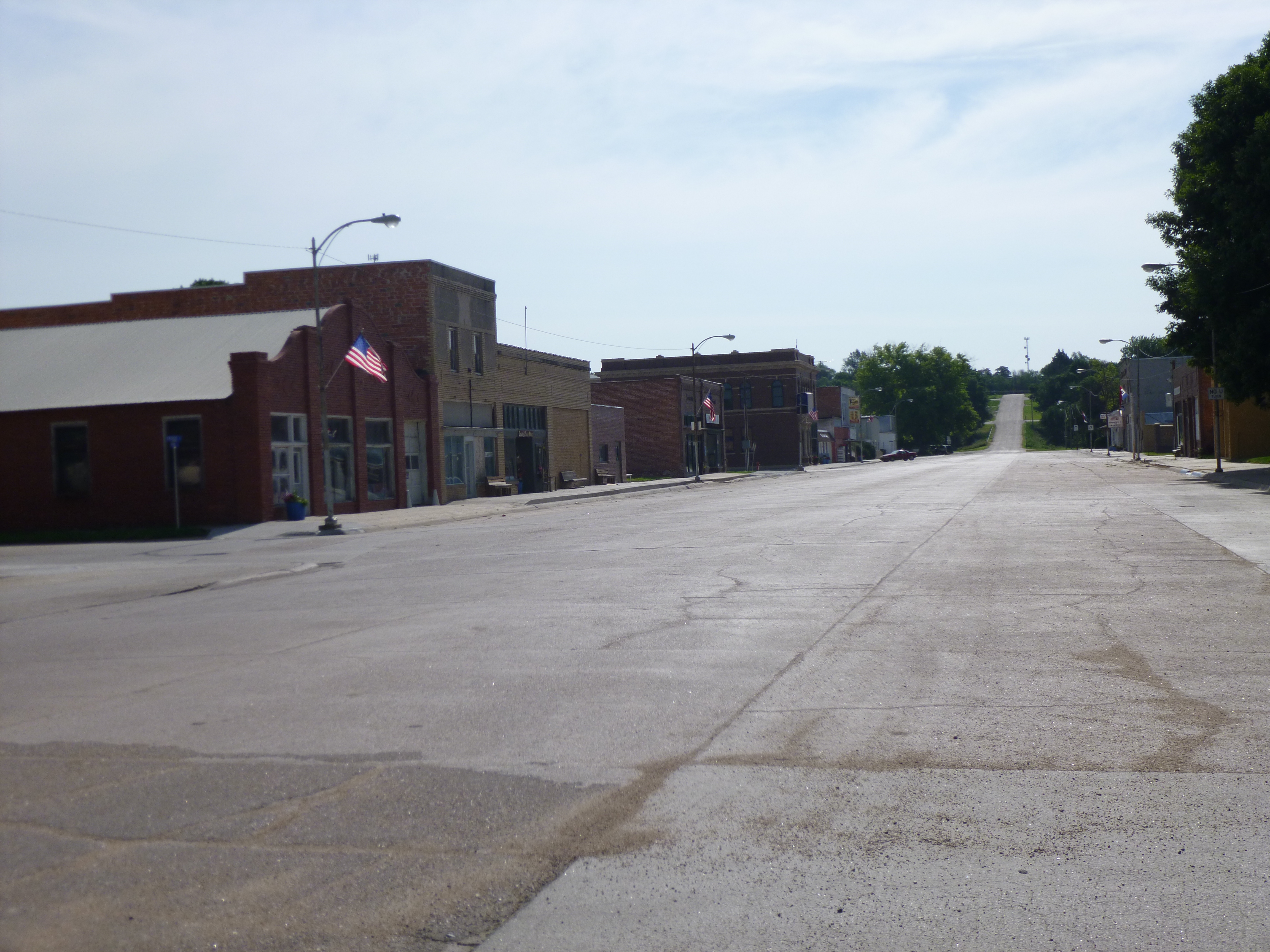
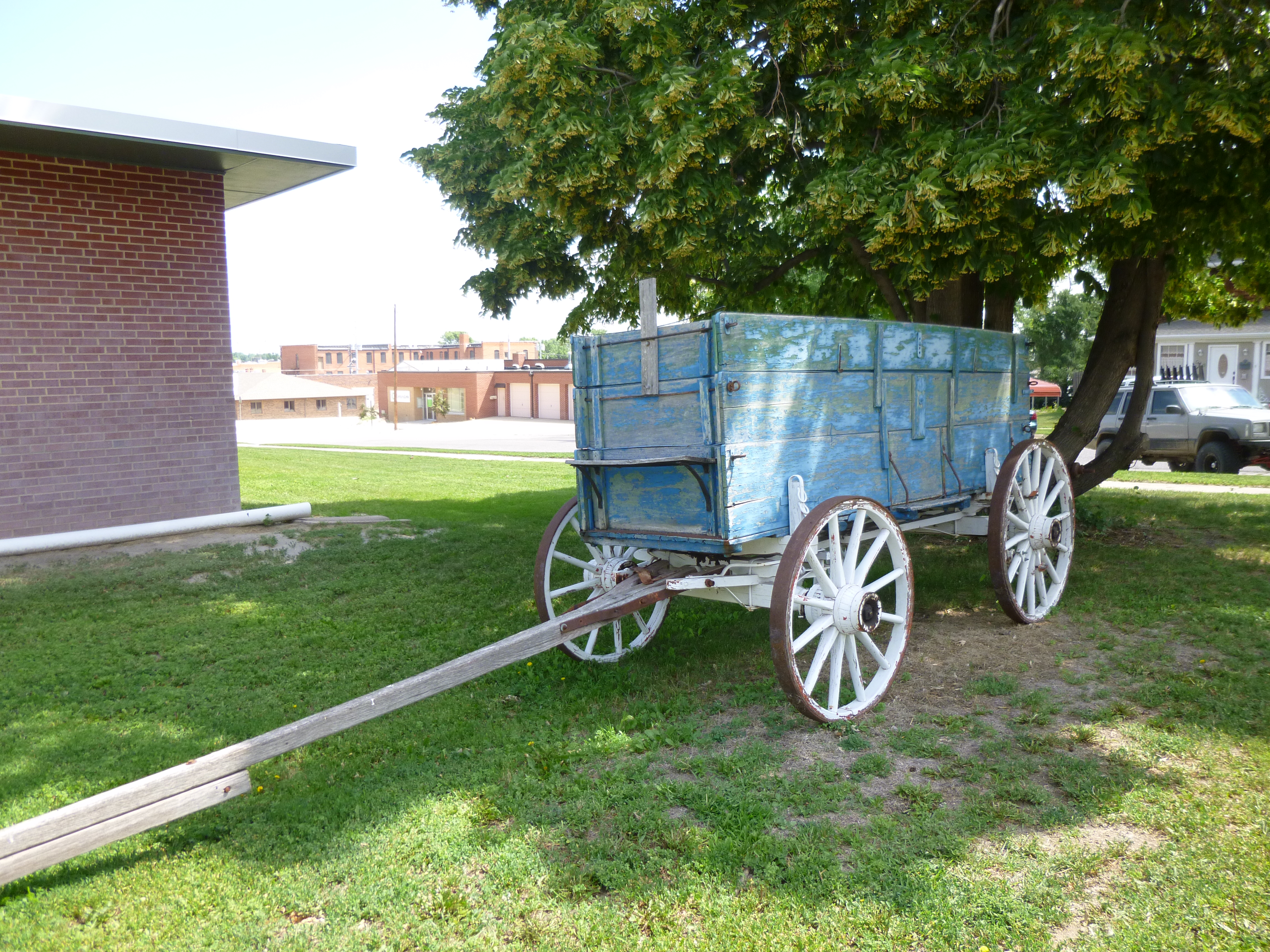
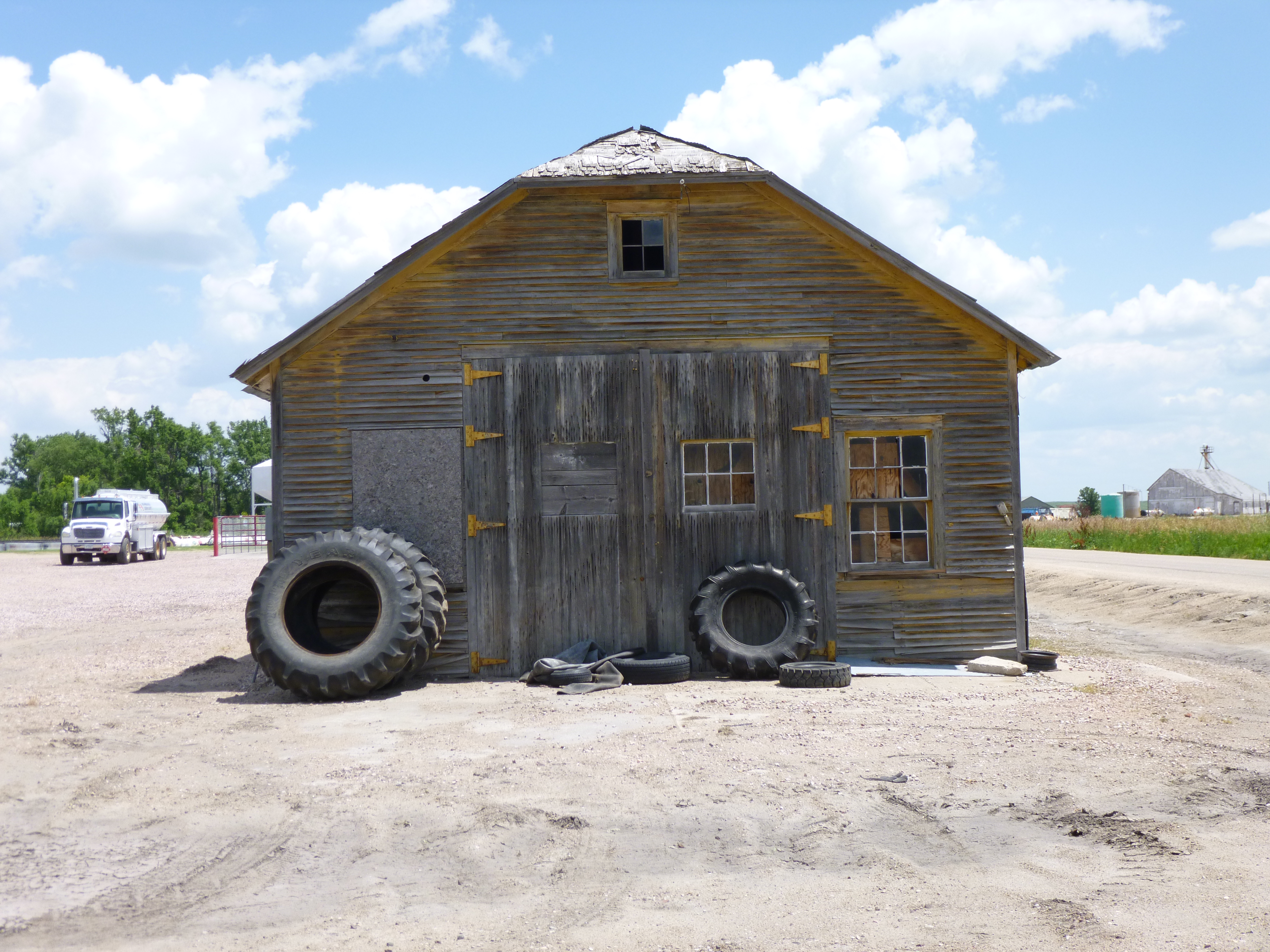
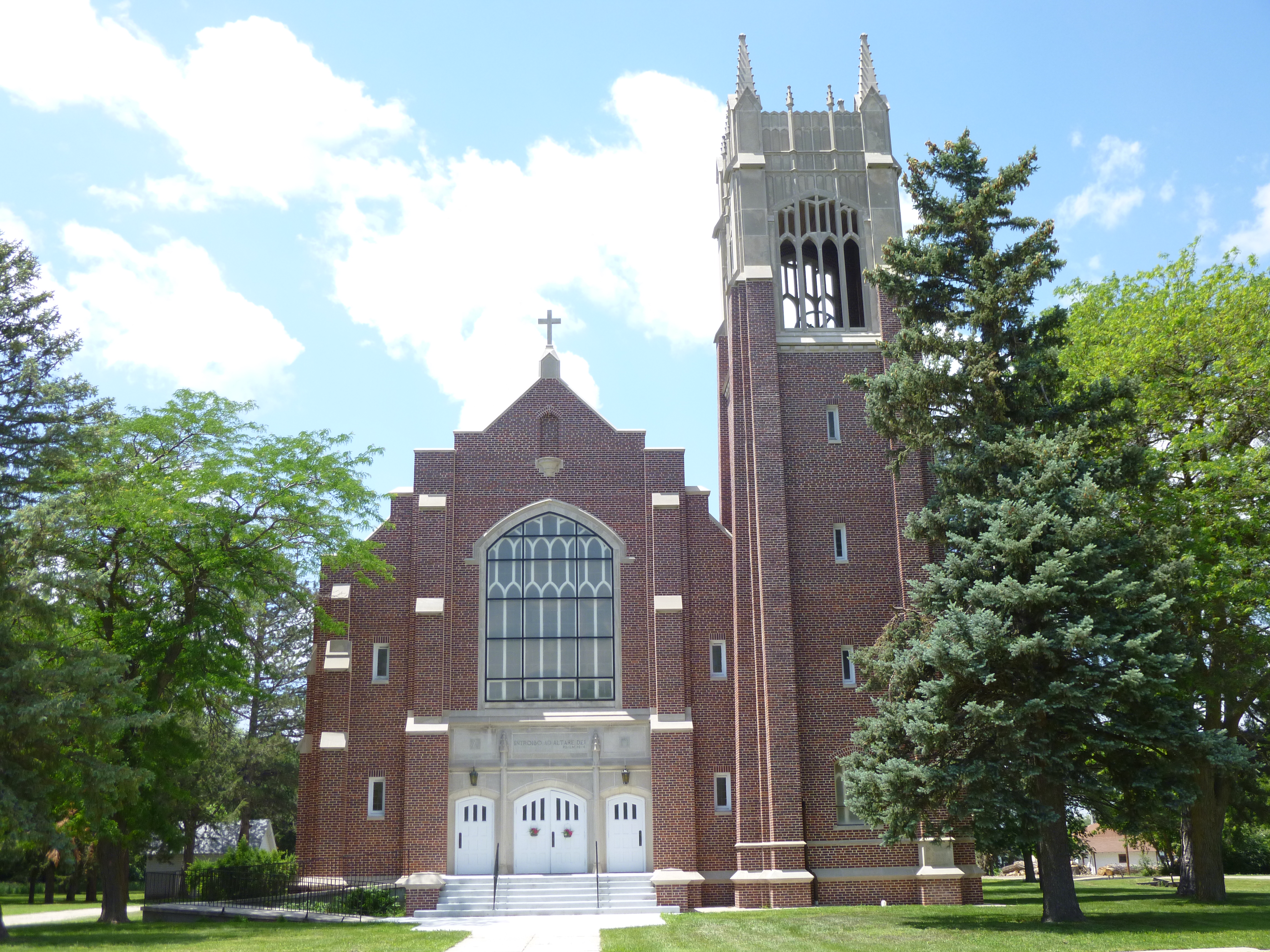
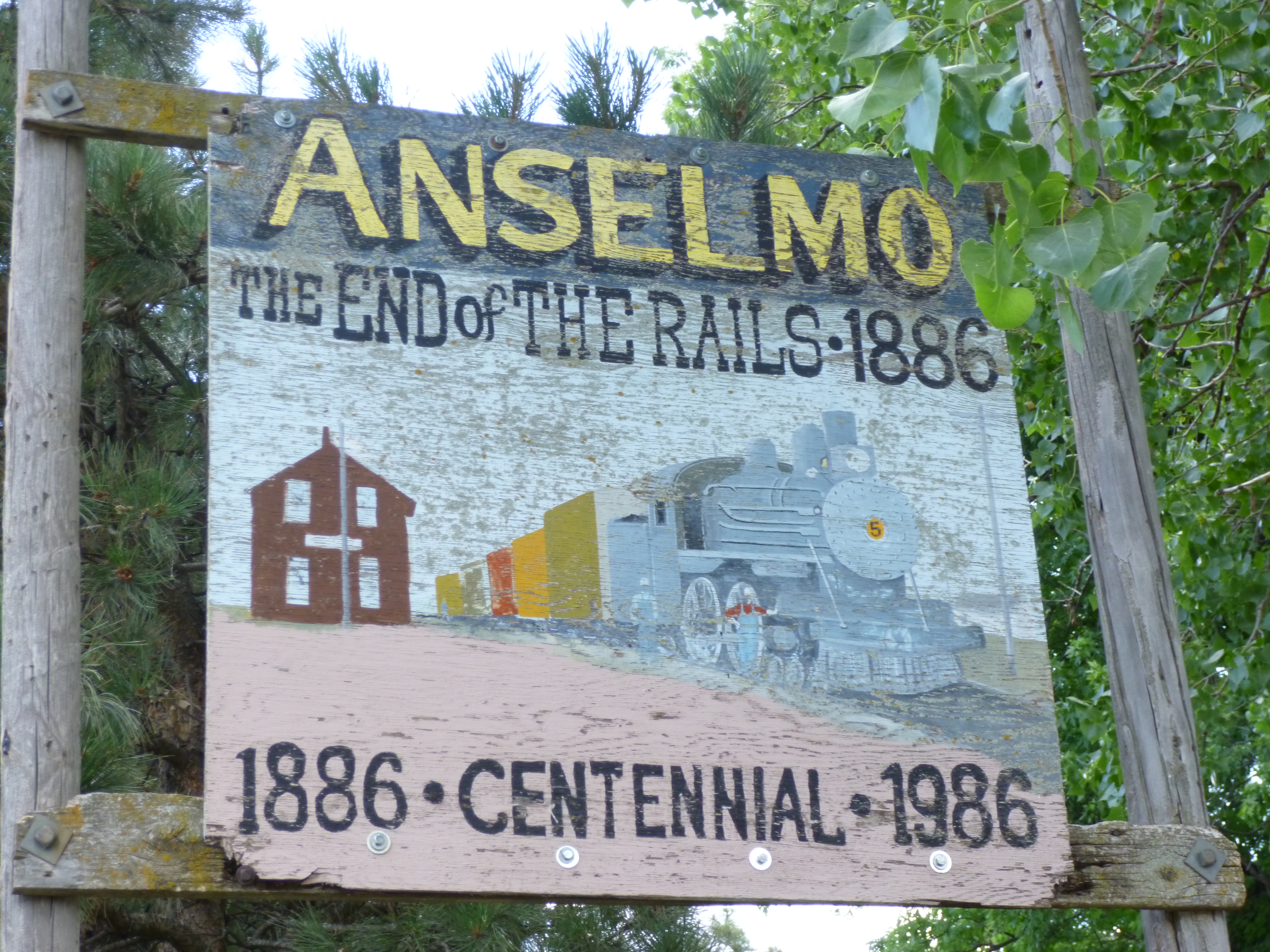
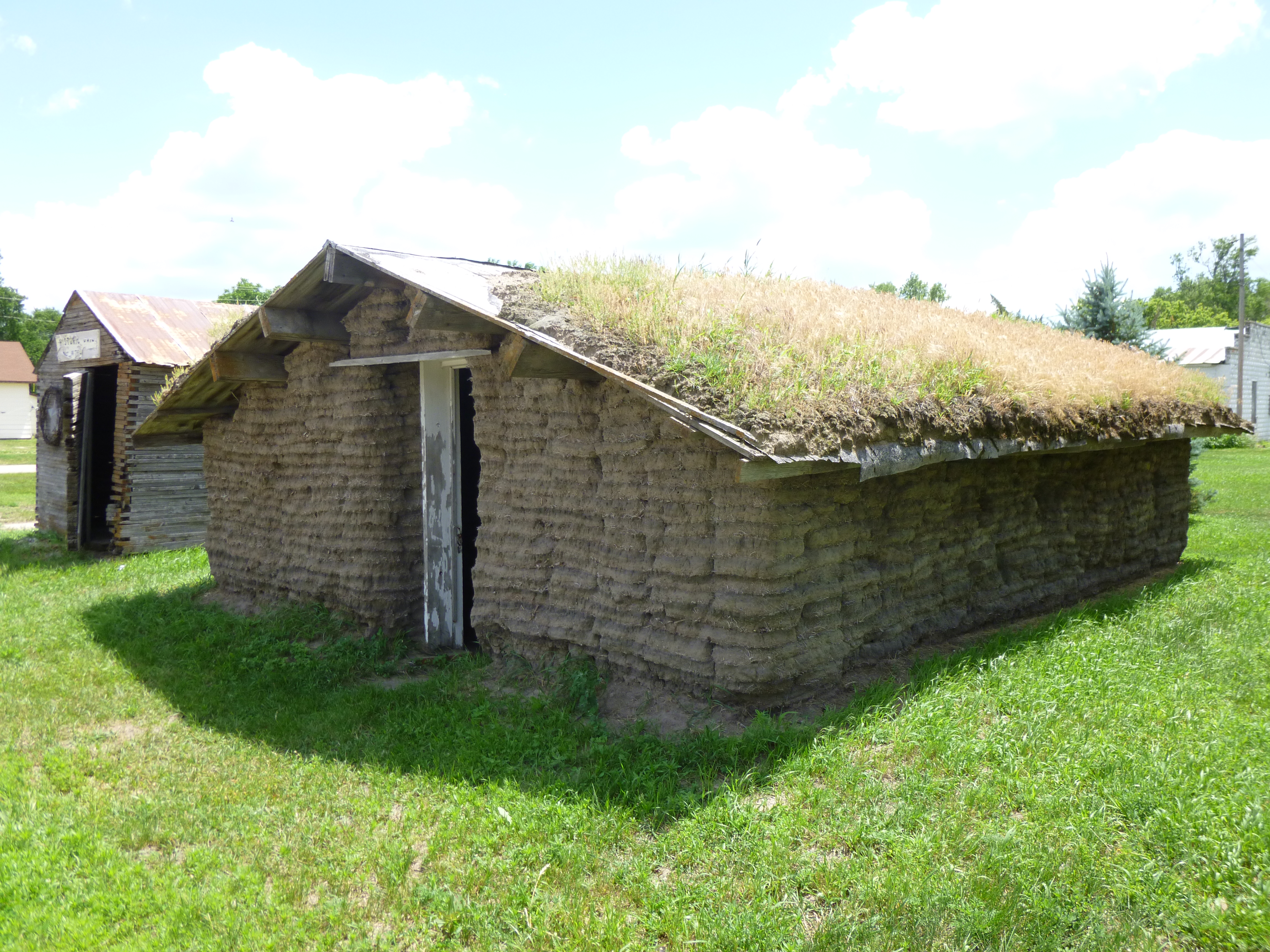
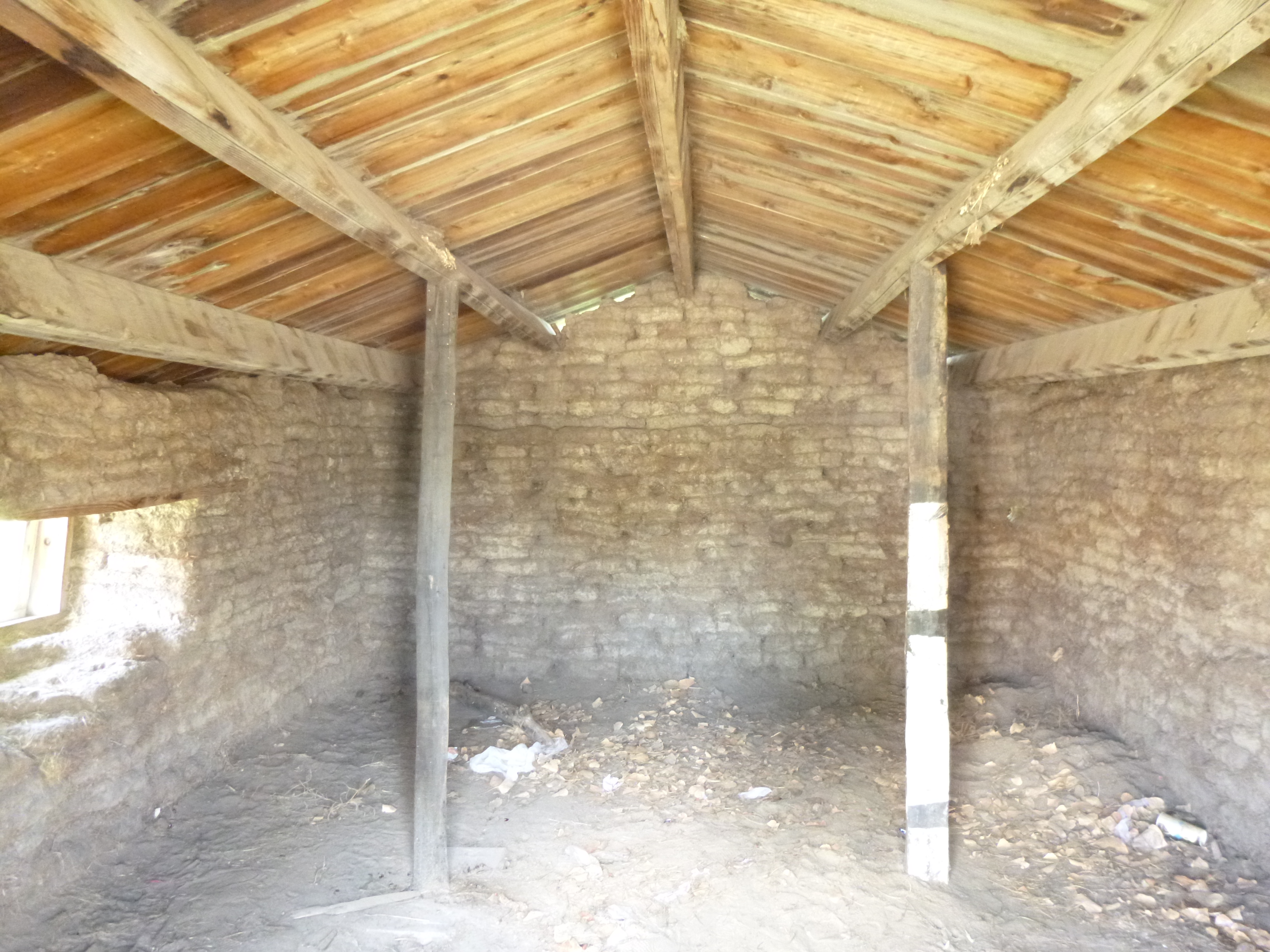
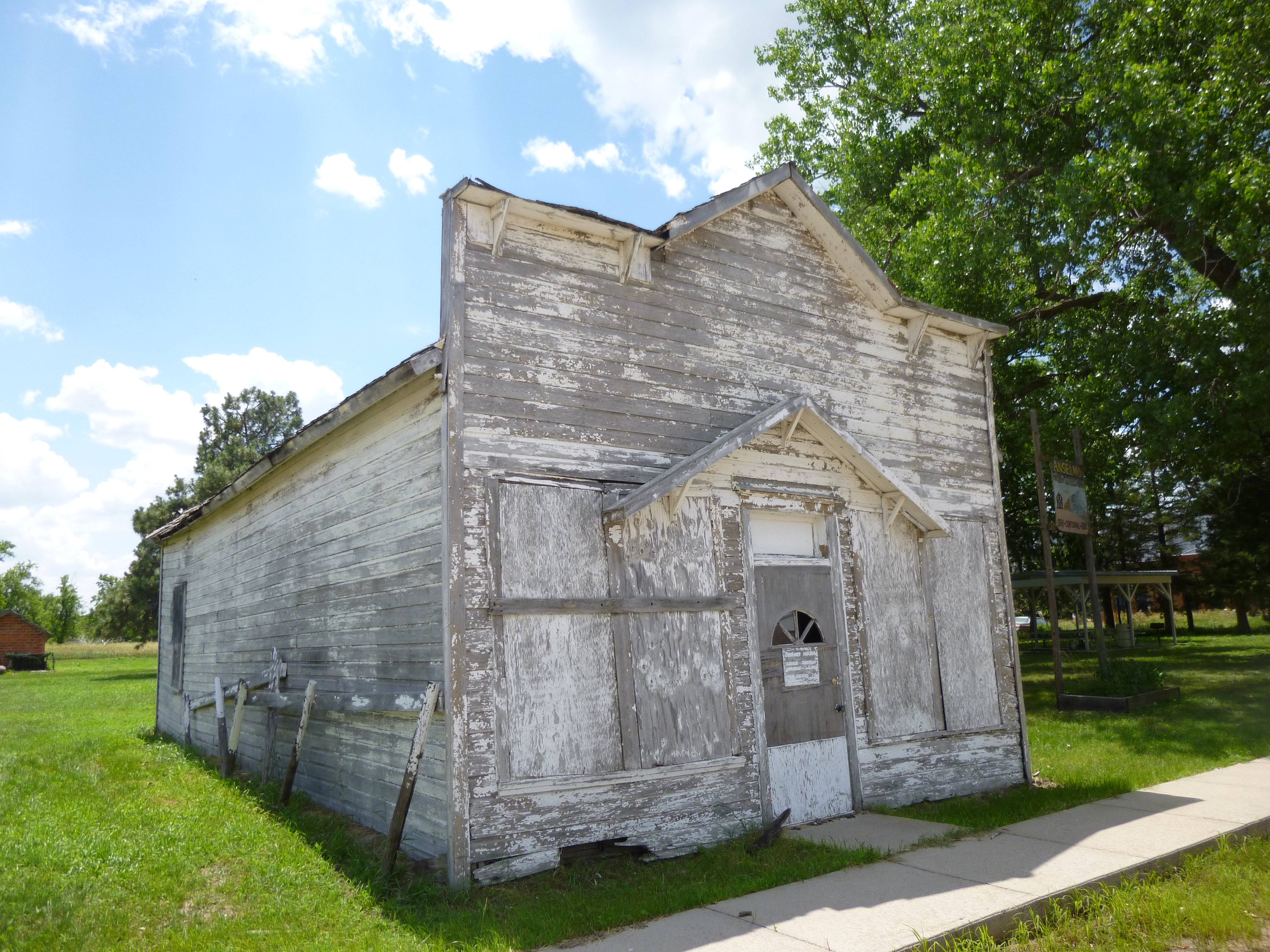
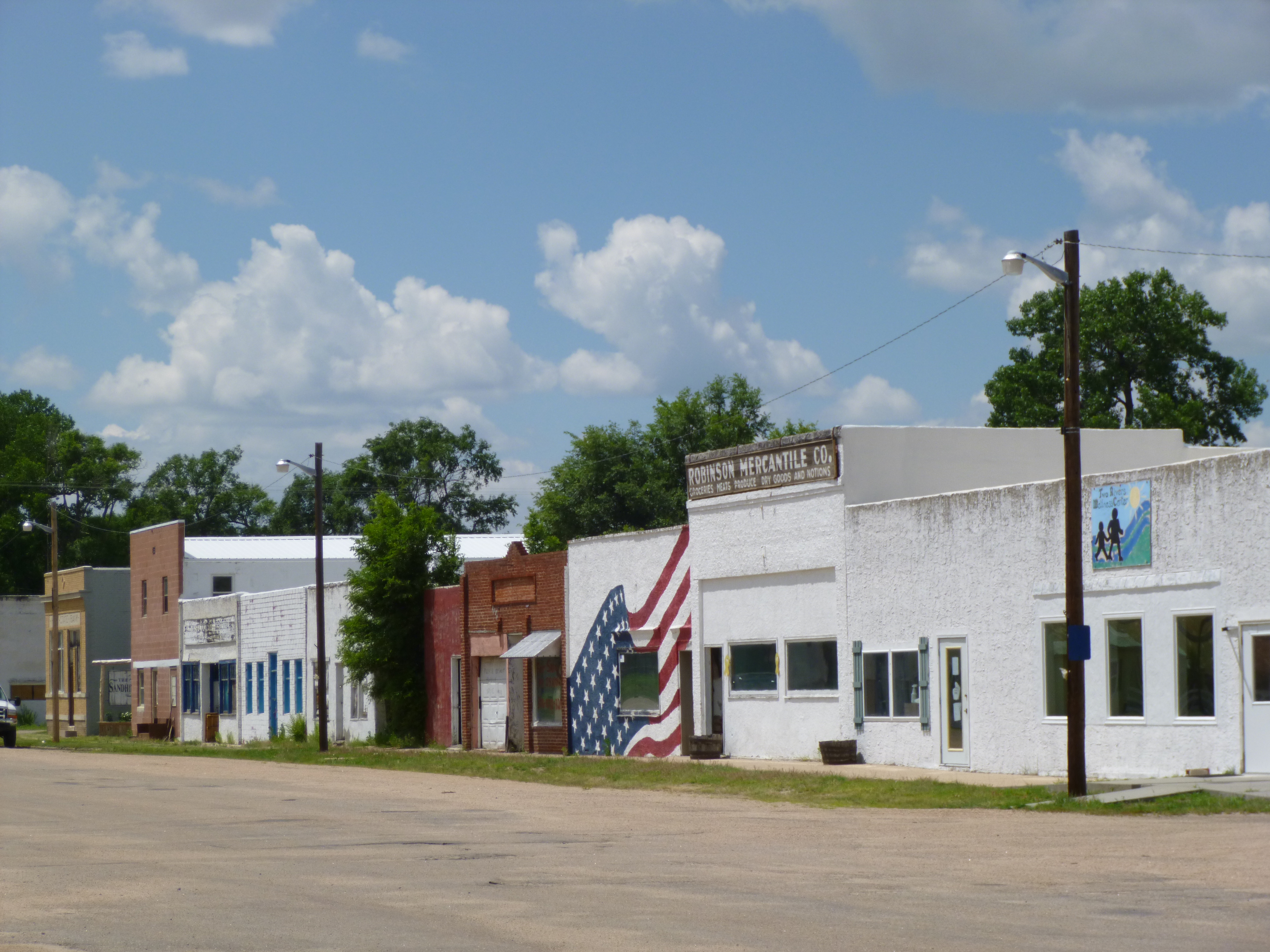
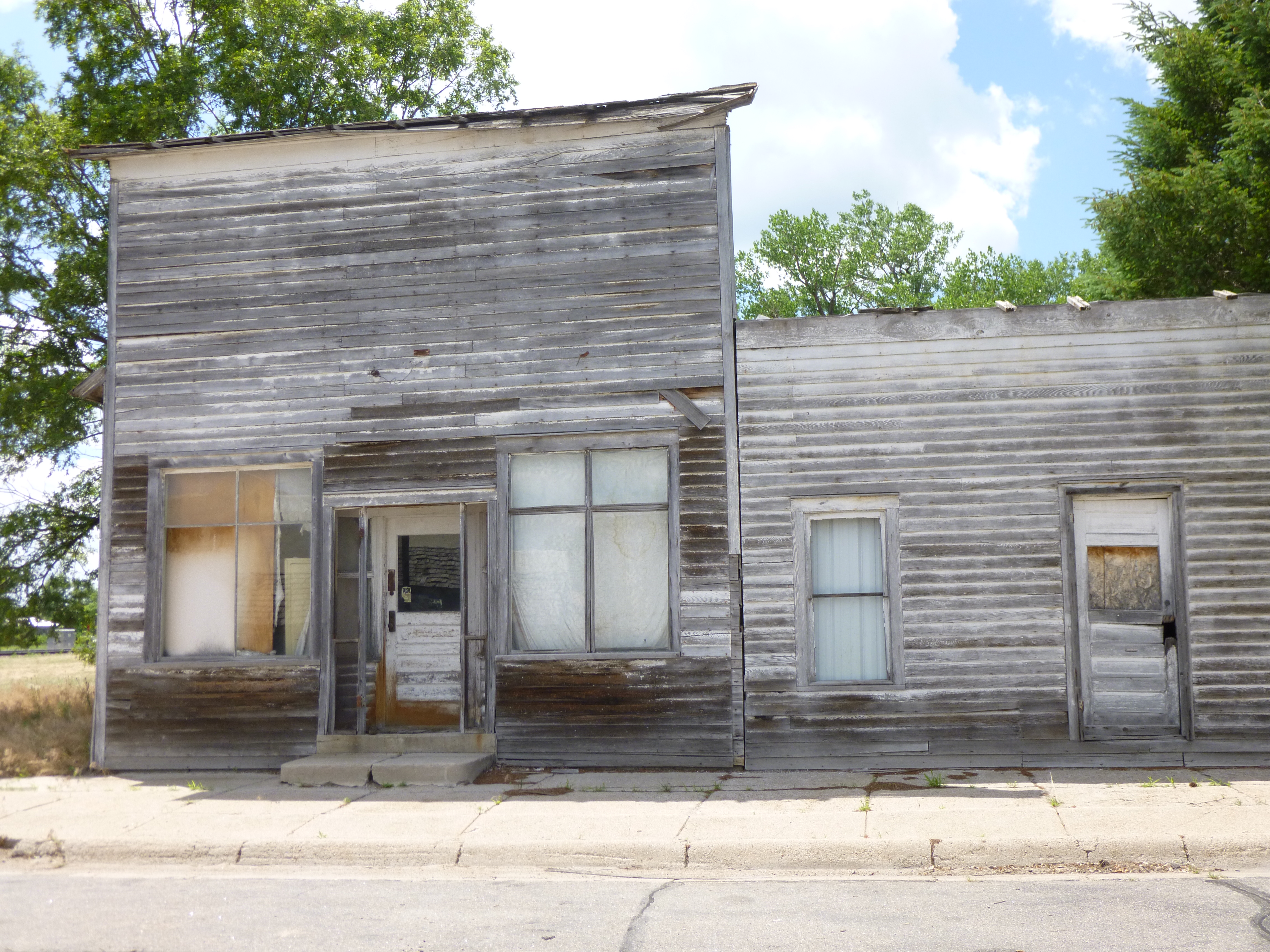
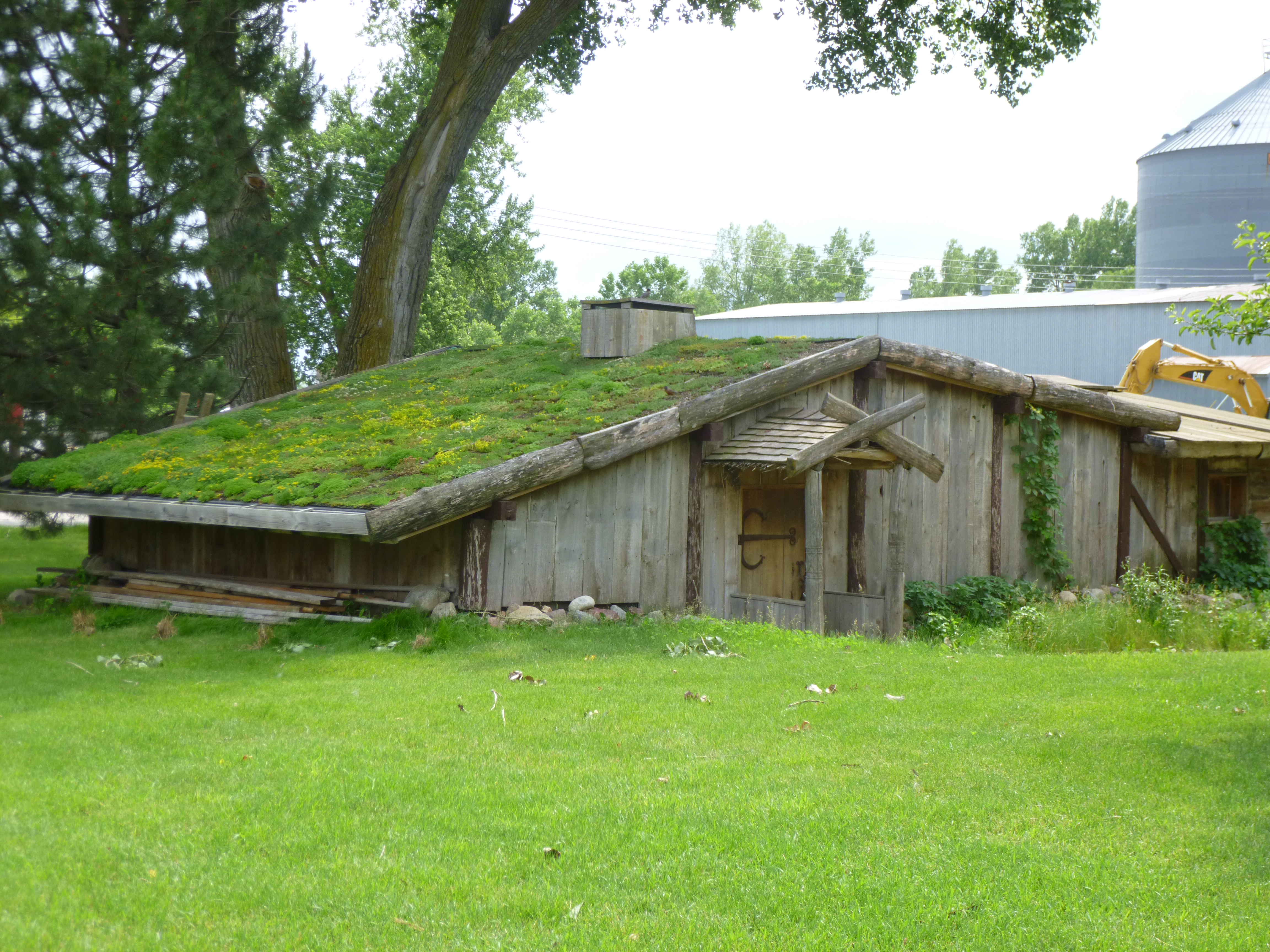
I passed another tiny little town named Anselmo, and turned down the main street just to have a look. Some of these old towns look like ghost towns – especially on a Sunday morning. There’s nothing going on and no one in the streets – just the wind blowing through an old town which has seen better times. They’re pretty in their own desolate way. But Anselmo had an old sod house and a couple other buildings as part of a little historic display. Since there weren’t many trees on the prairie, the pioneers built sod houses – using strips of sod about 12 inches long and 4 inches wide, and piling the sod bricks one atop the other – always grass side down (don’t know why). I guess sod was a fairly good insulator because it helped keep the place cool in the summer and warm in the winter, but one never knew what creepy-crawlies (or snakes) would come crawling out of one’s walls! And they were dark inside. Whenever I drove past, or through, these little towns, there was usually a sign saying “Welcome to _____” and it would list the population – 109, or 76 or 223! Like I said – tiny towns! And then I passed the Sandhills School, and not for the first time I wondered about the kids on the ranches around here, and where they went to school and if buses ran – it’s such a big, sparsely populated part of the state that I wondered about school, and grocery shopping and all that.
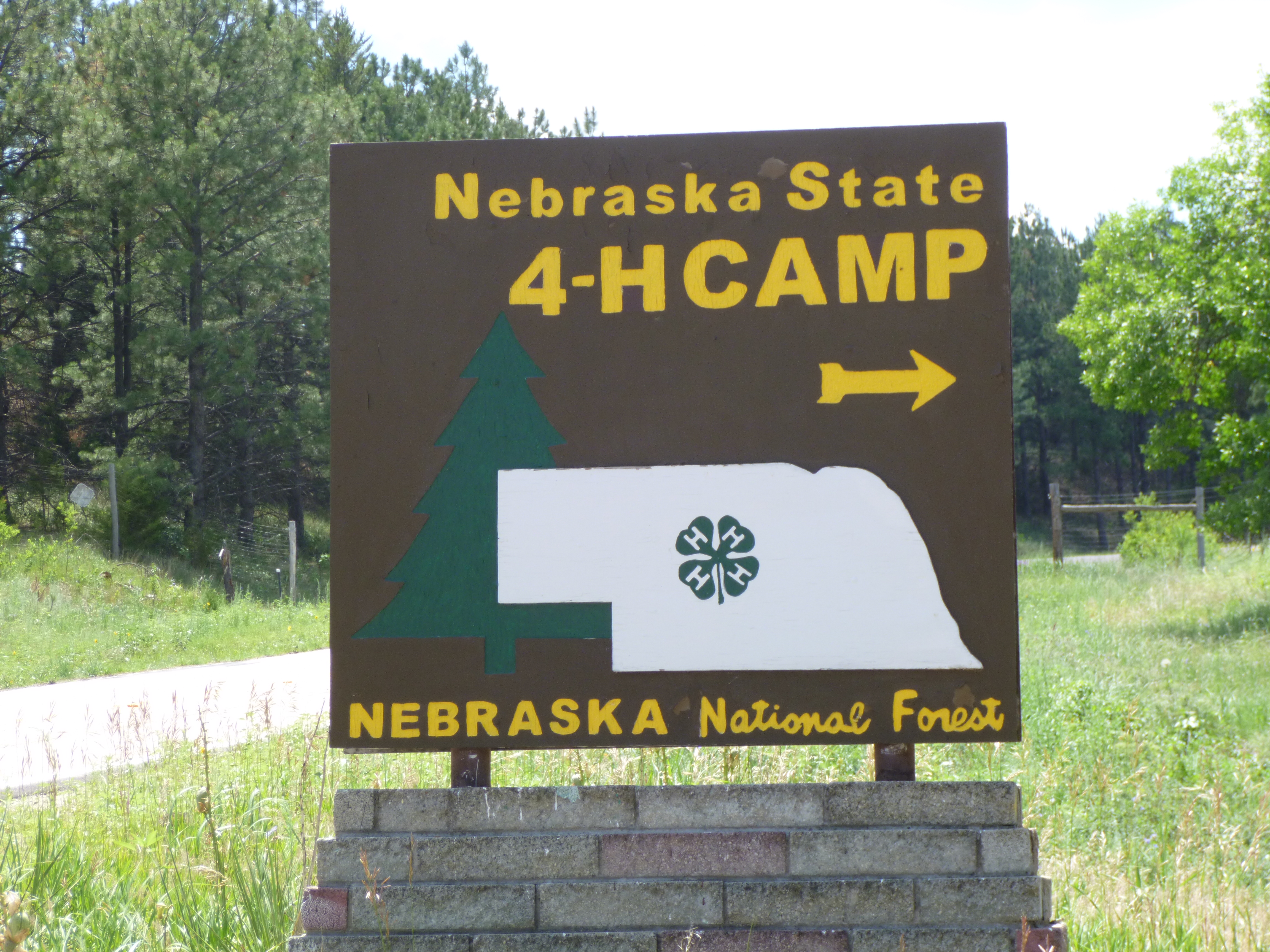
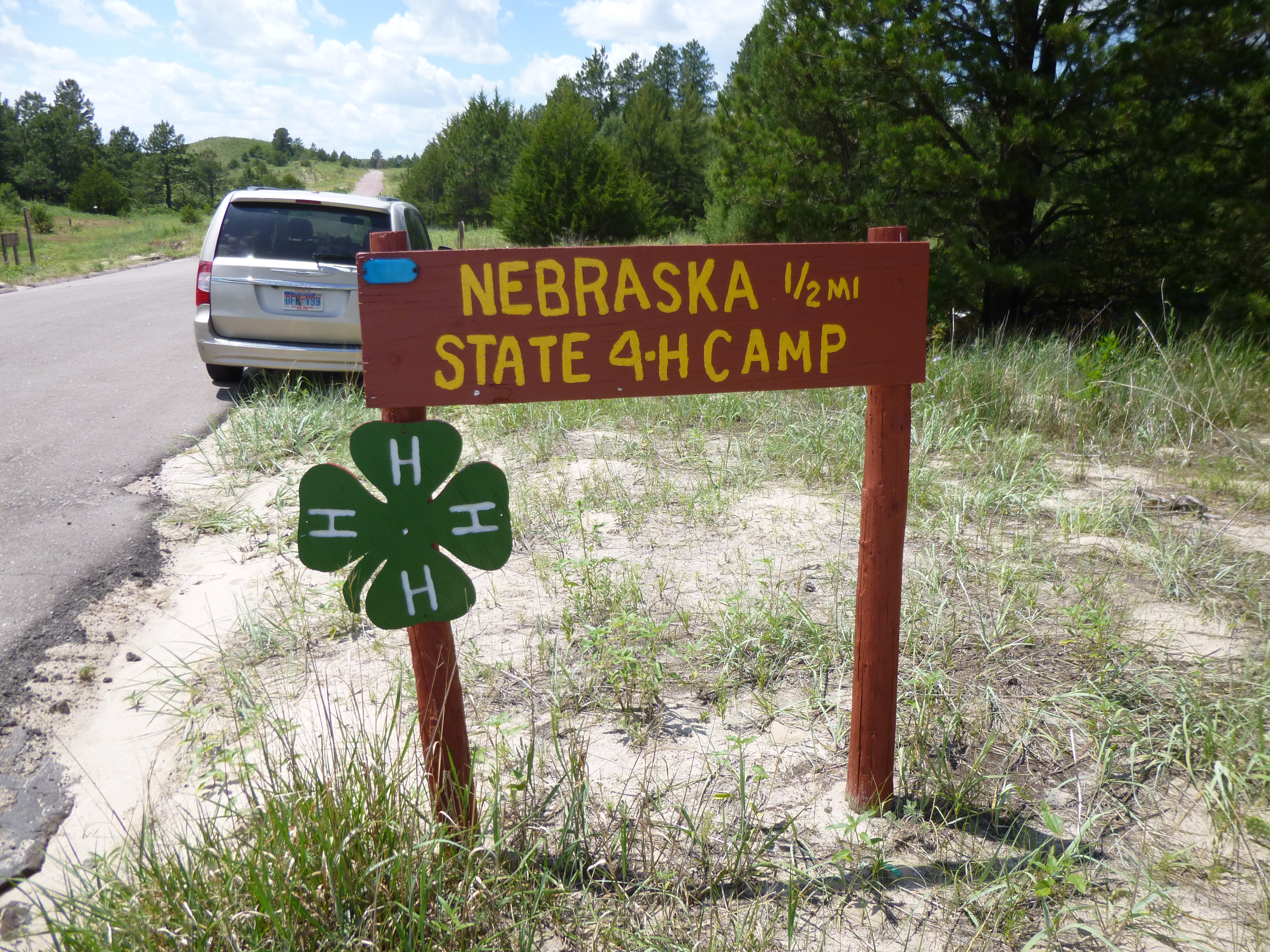
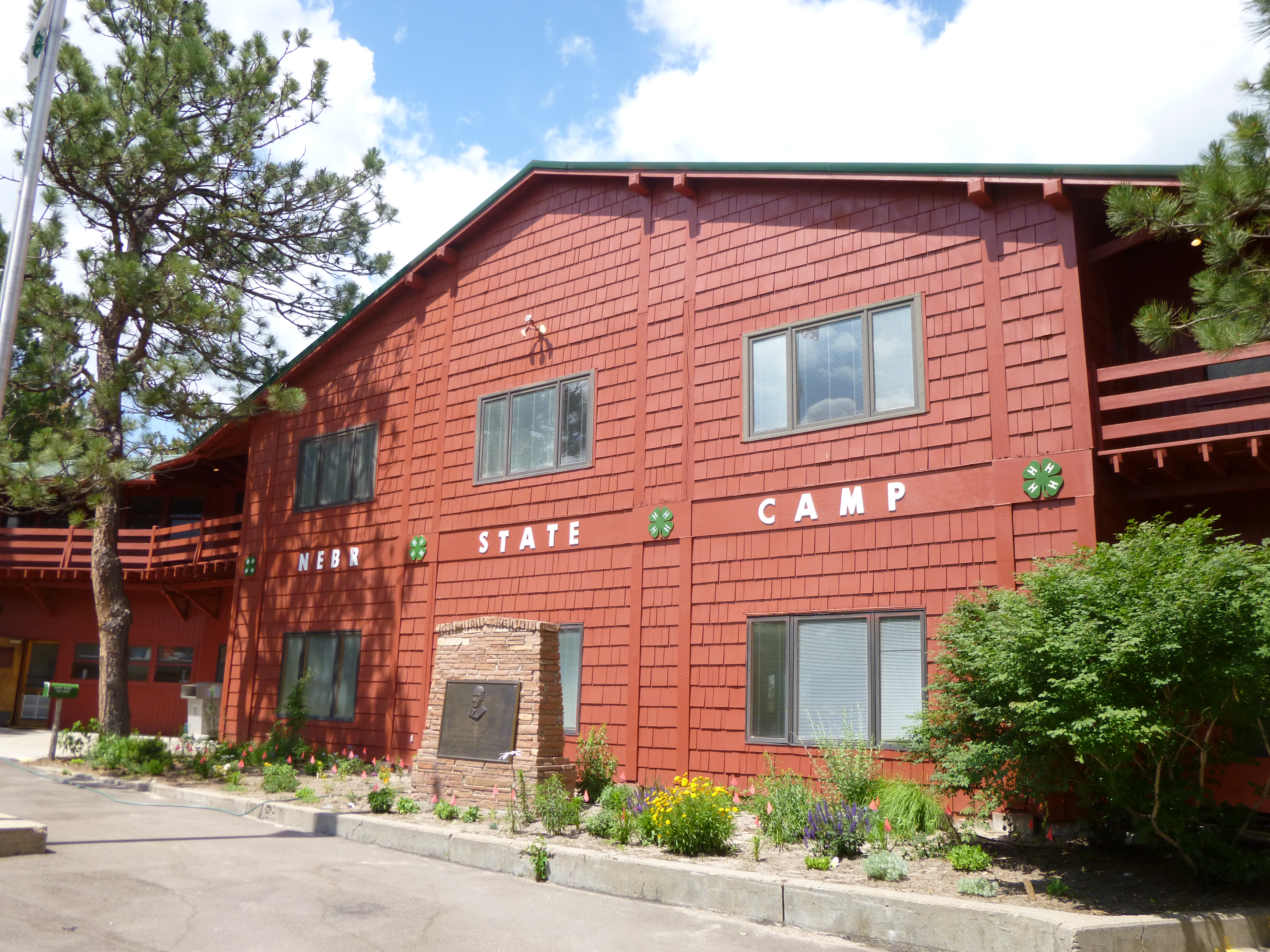
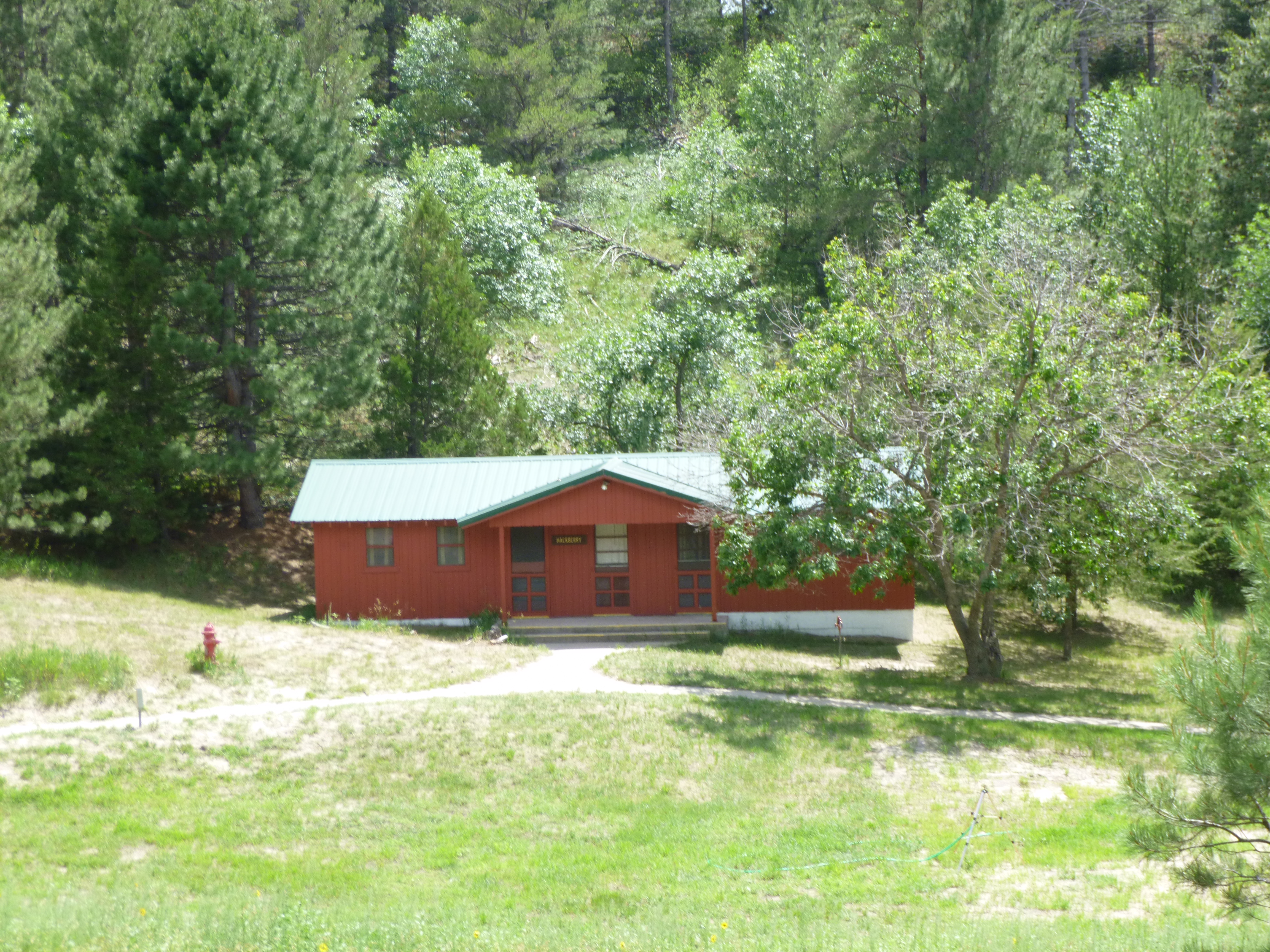
And then, as I was driving along, pretty much in the middle of nowhere, I saw a sign about a turnoff for a 4-H camp. I was curious about it, so I turned to go see what it was like, and I was surprised to see traffic on that road. It turned out I had arrived right at the tail end of camper check-in time for a new session of camp! Some stragglers were showing up, and kids were being assigned to their cabins (and one girl was accidentally assigned a boy’s cabin so they had to make a quick change.) There were 2 different groups of kids starting a session, and it brought back a lot of fun memories. This part of Nebraska was hilly and there were a lot of trees (part of a hand-planted forest) and the cabins were tucked in the trees, and there was a big lodge. I wanted to see inside the lodge, but it certainly wasn’t the time to ask to do that! I had been wanting to make a 4-H donation somewhere along the way, and this was absolutely perfect. I waited until the head counselor, Katie, was free and told her about my journey and that I’d be happy to make a donation if they could use it, and she was surprised and happy to be able to take a donation. I’m assuming it will go toward supplies or something, but she would be passing the check on to the directors. It was really fun to see the place.
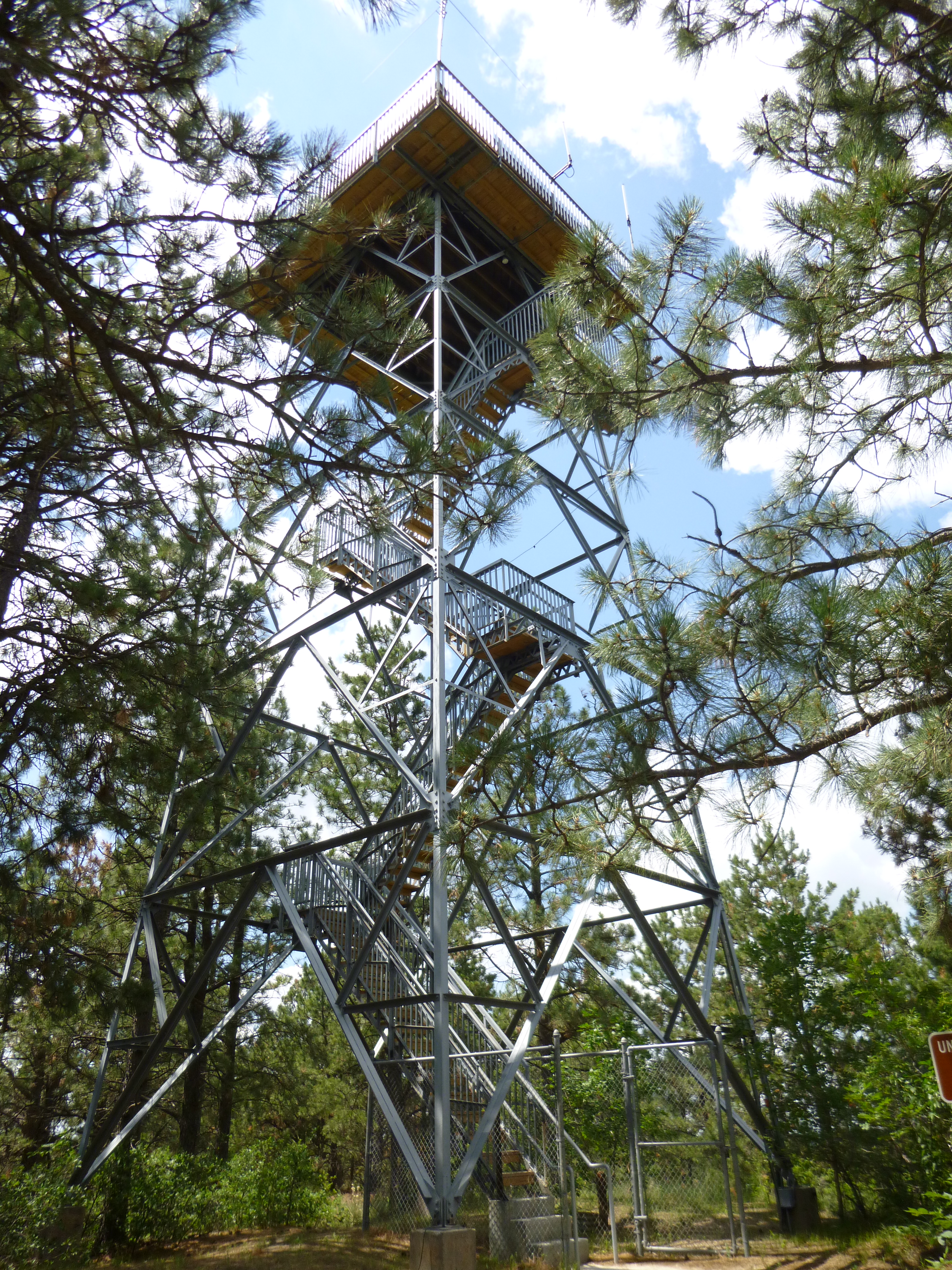
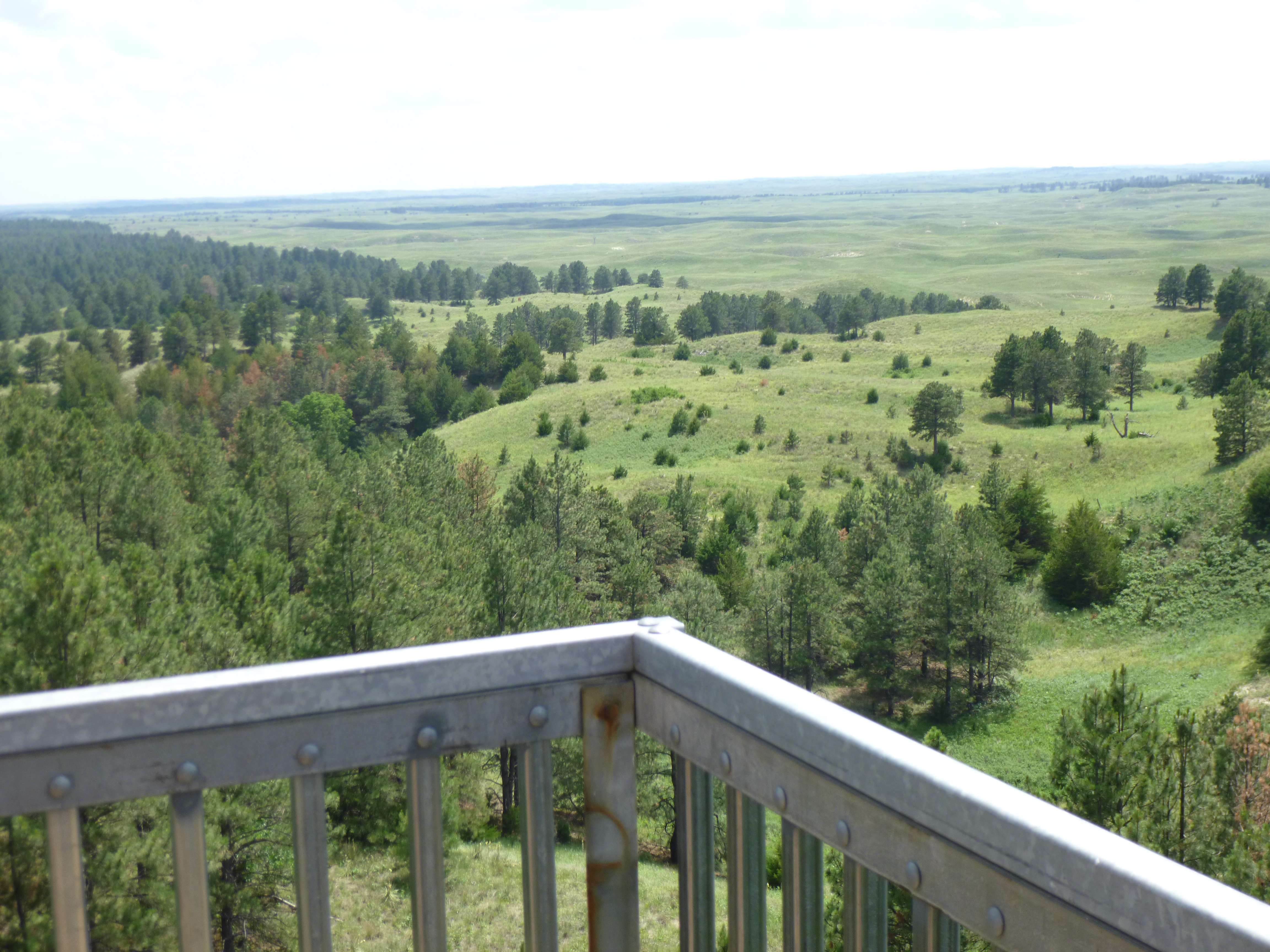
And then just a short distance down the road, I came across a fire tower, and decided to climb it. Sometimes heights bother me just a bit, especially when I’m climbing open steps, but I took it slow and kept a good grip on the rail, and stayed close to the tower at the top, and did okay! I mentioned the hand-planted forest – an amazing act of conservation started back in 1927. There was a guy who realized America was cutting down so many forests that it was vital to replant. He had done research about the Sandhills area, and was pretty sure the land had supported trees at one point in time. So he began a massive tree-planting program, and in time it was given National Forest status. It’s the largest hand-planted forest in the country and covers thousands of acres. But, the trees are beginning to come to the end if their natural life cycle, and do not seem to be re-seeding themselves, so only time will tell what will happen. The view of the forests from the fire tower was amazing, especially knowing they had all been planted by hand.
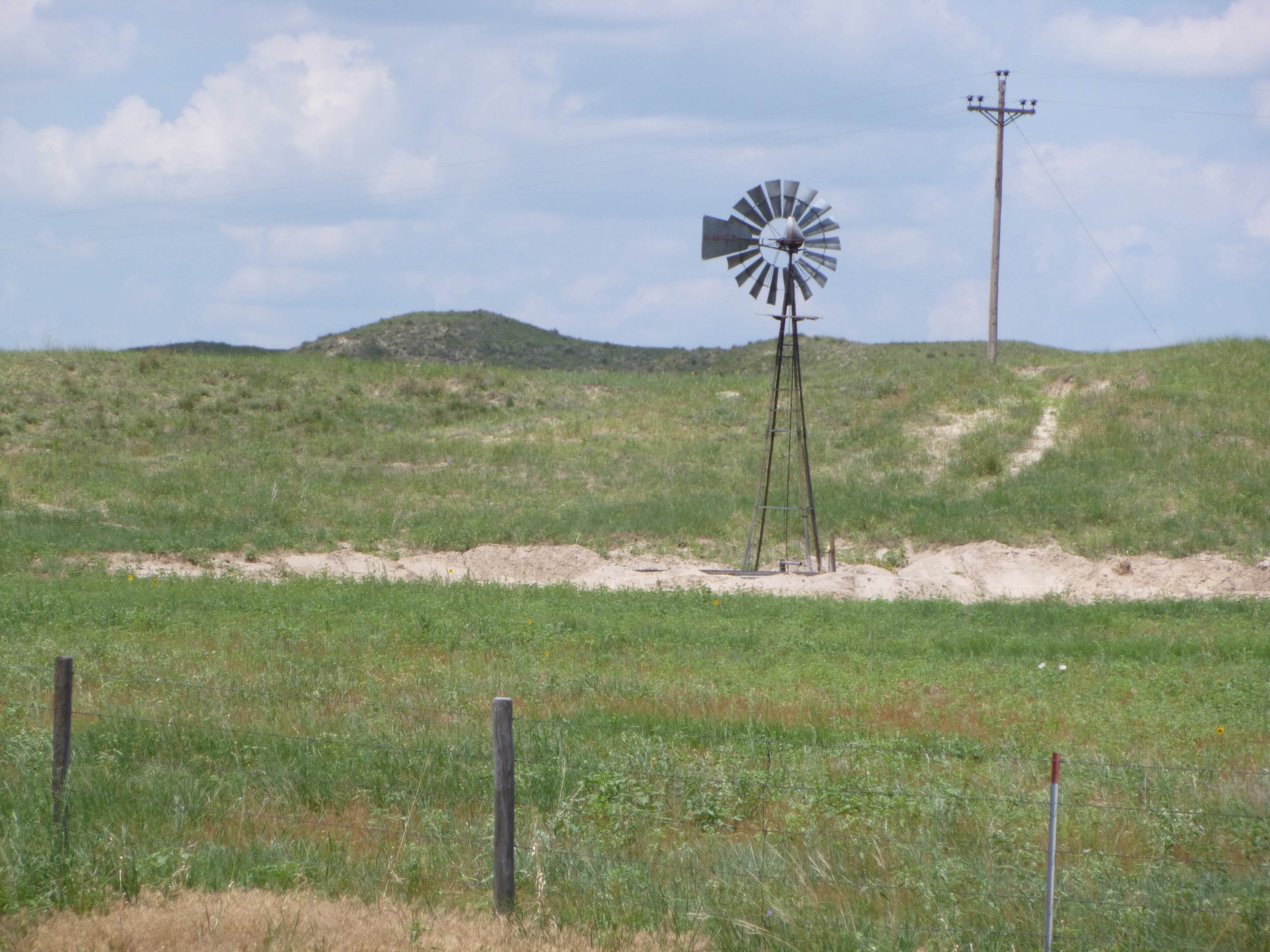
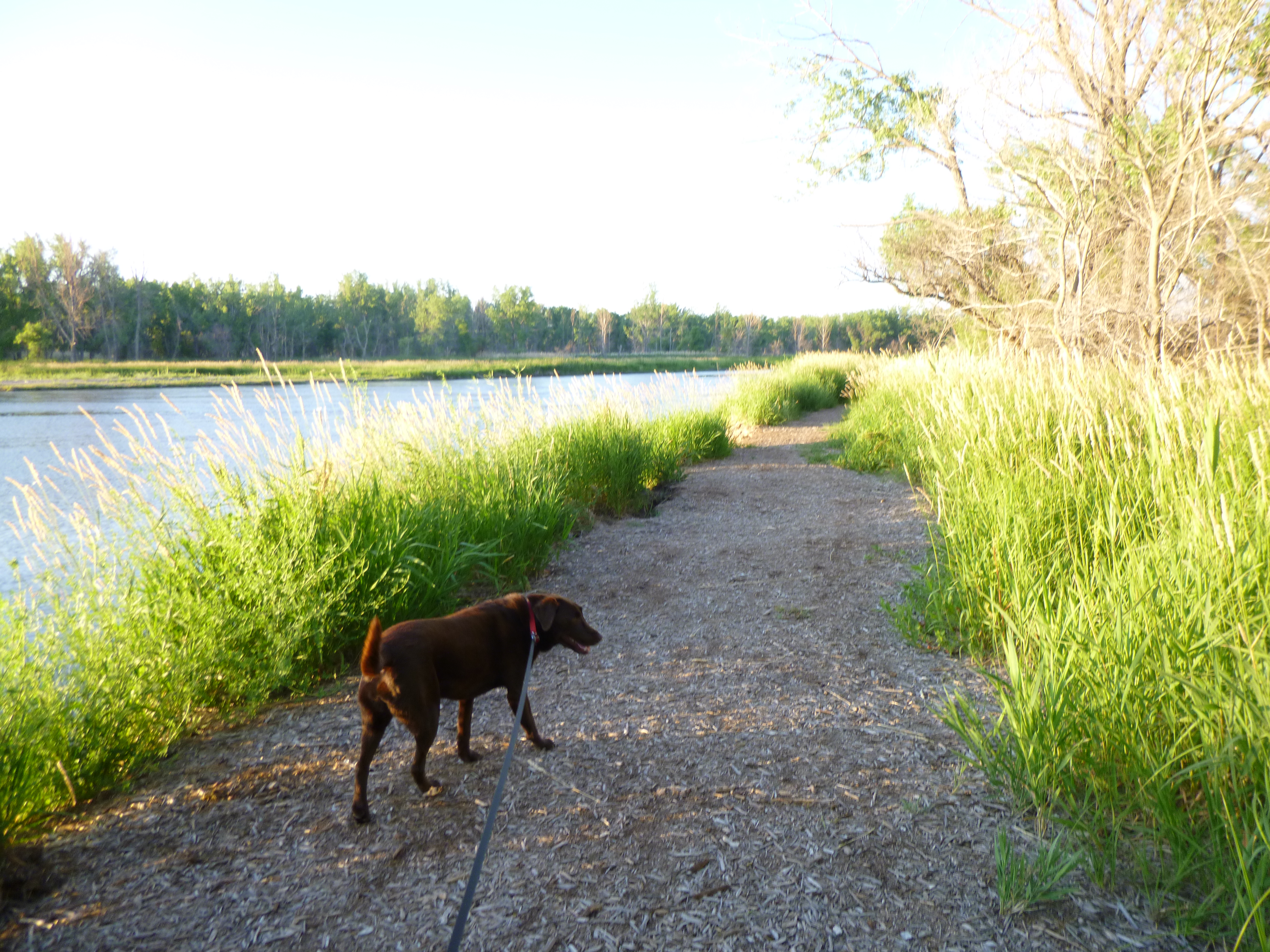
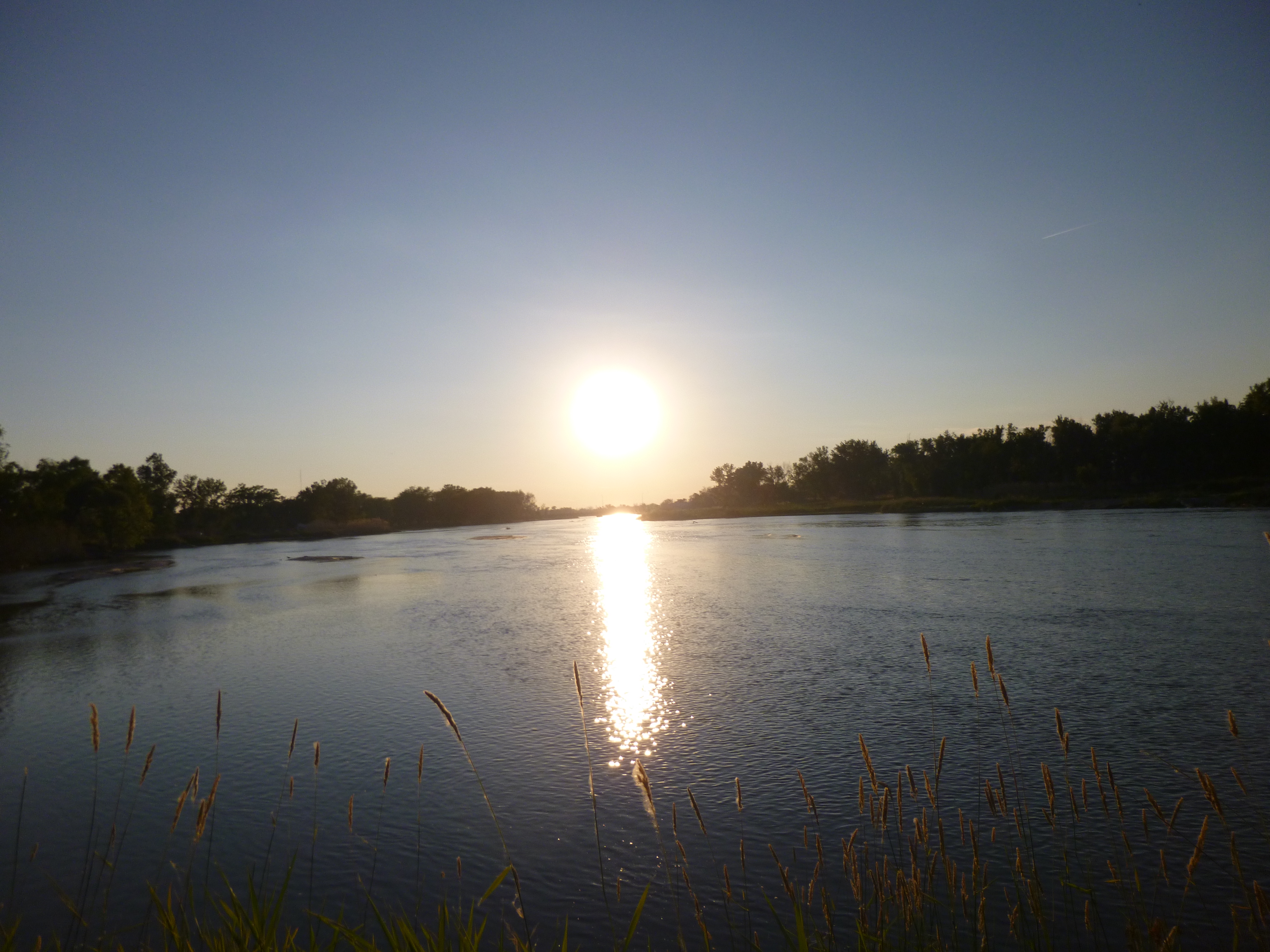
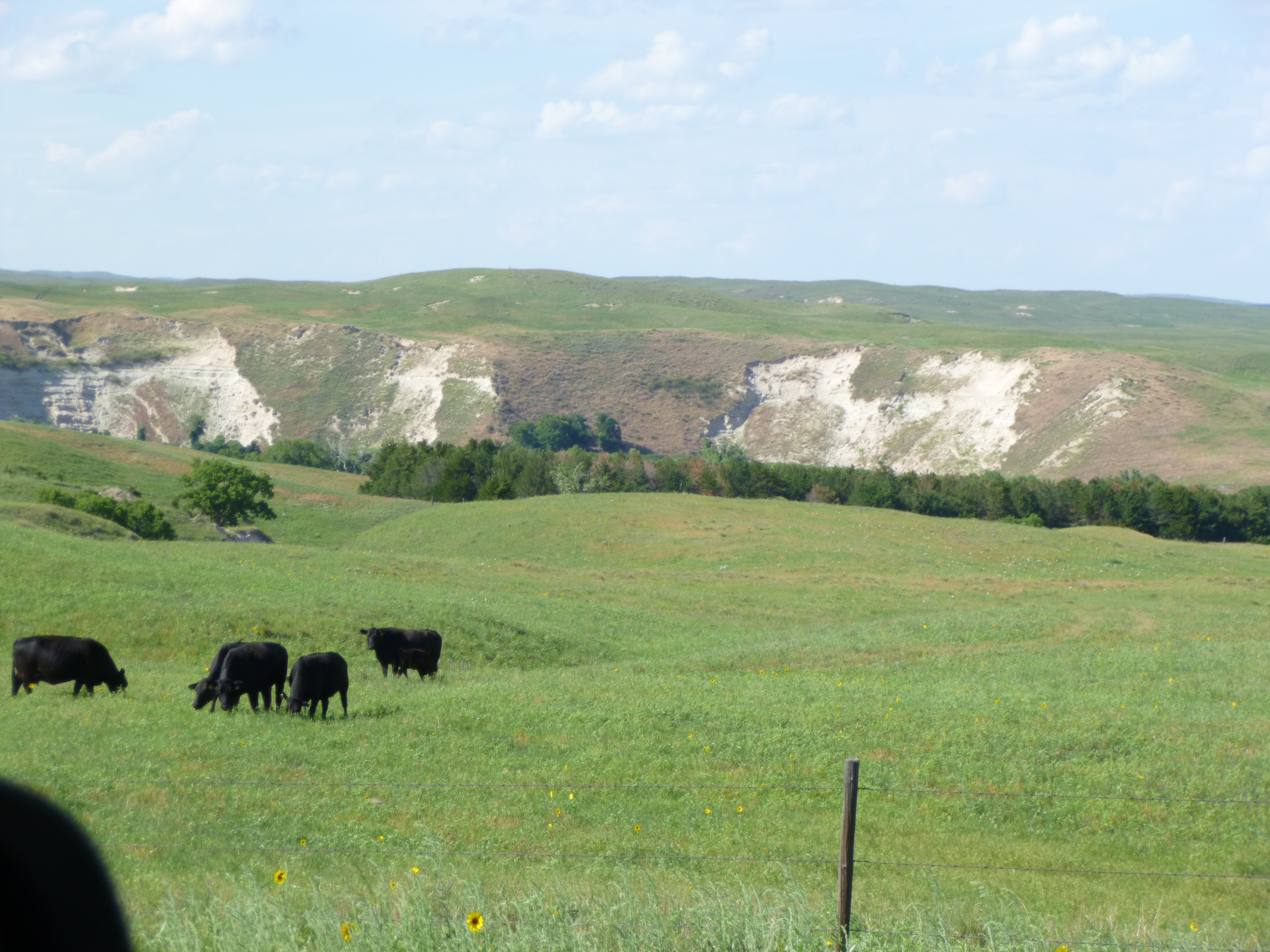
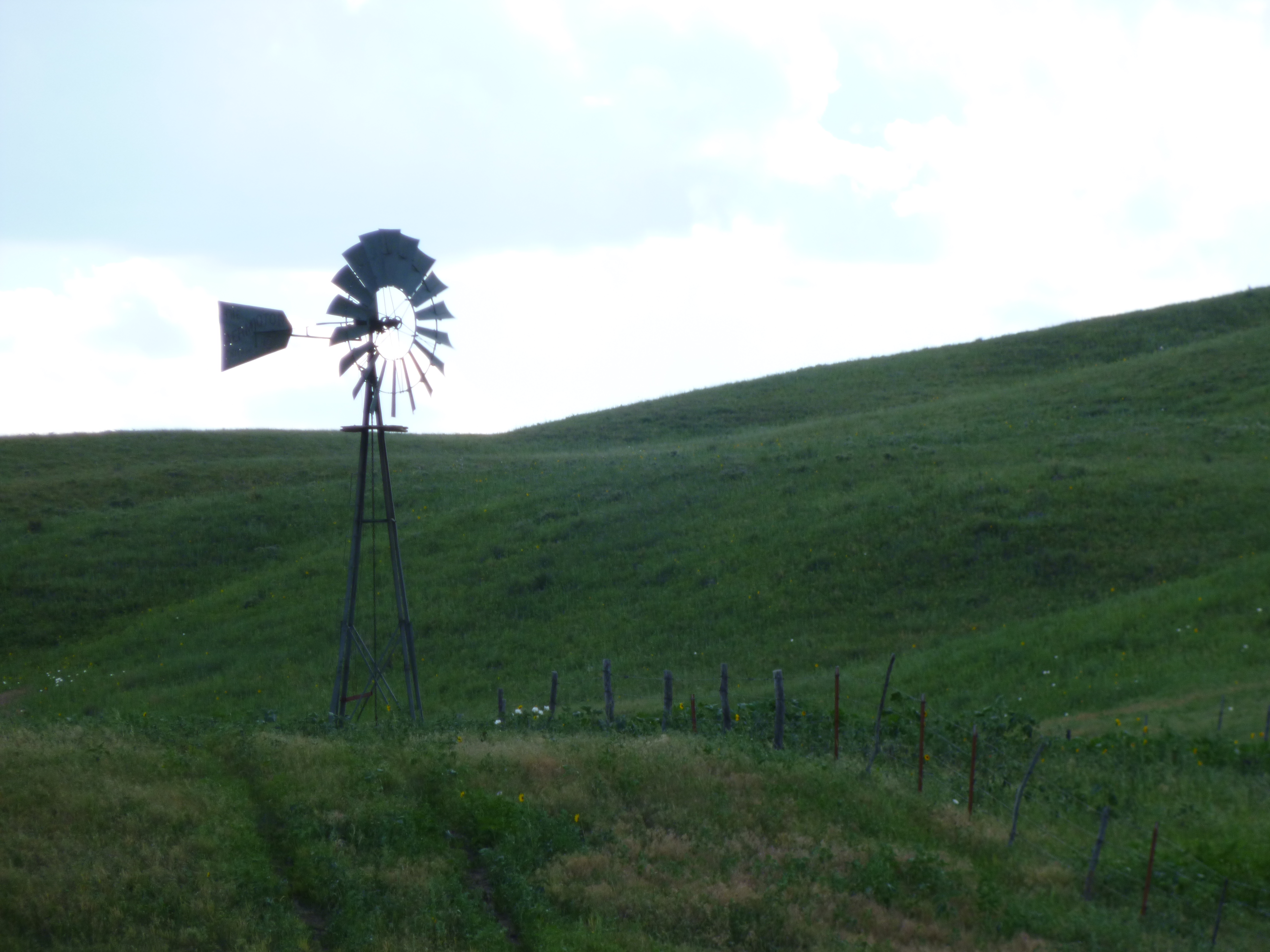
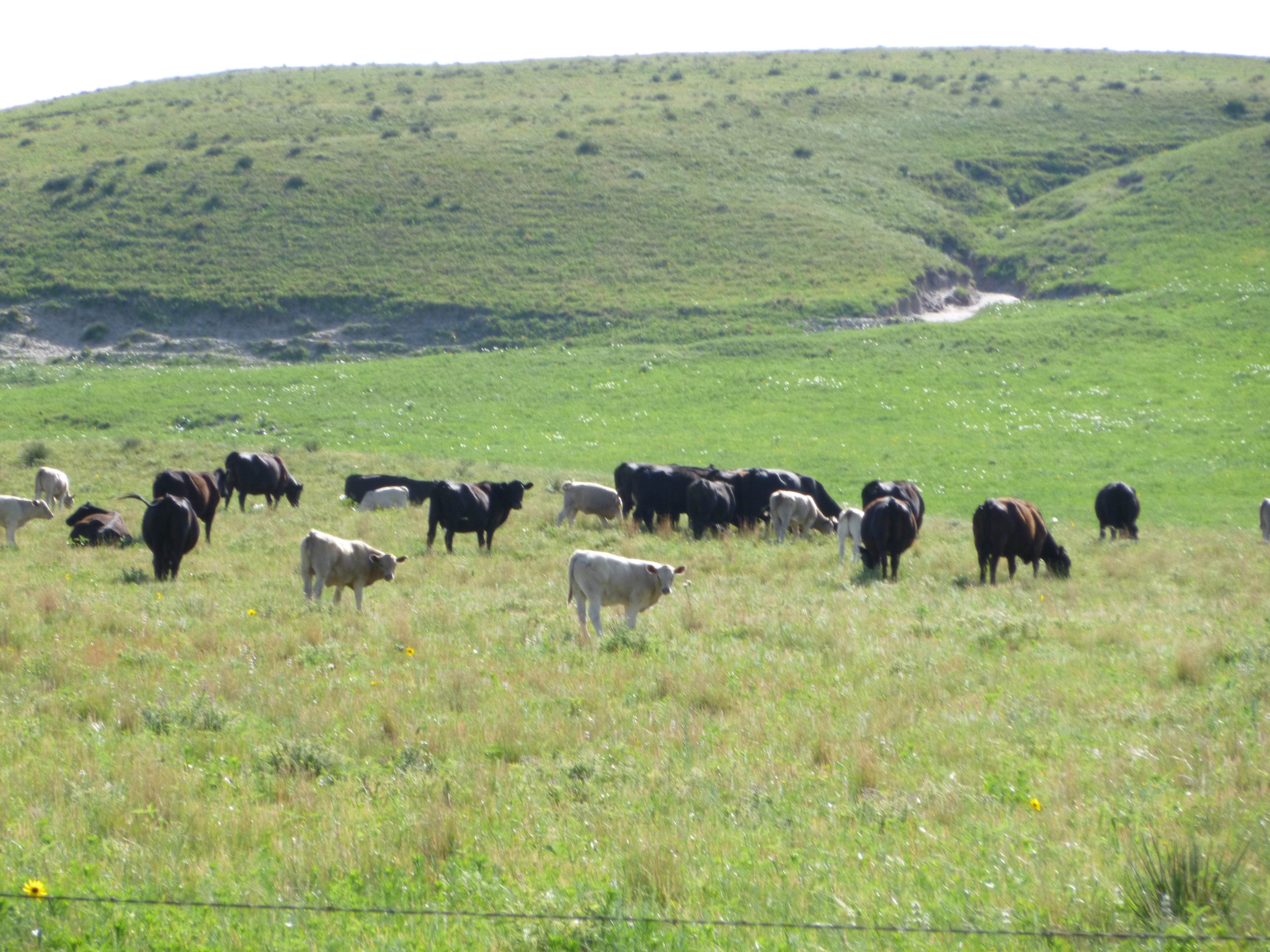
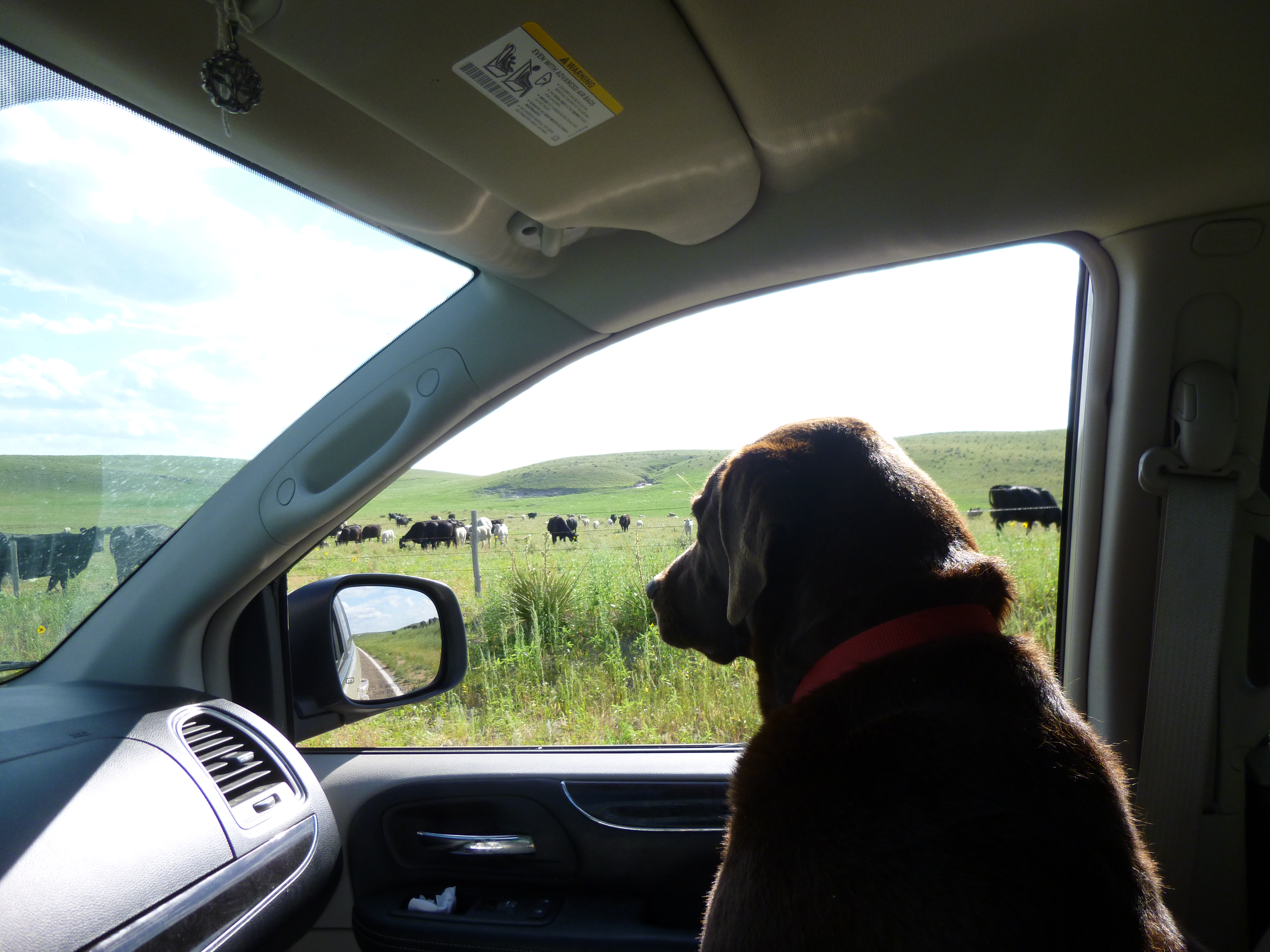
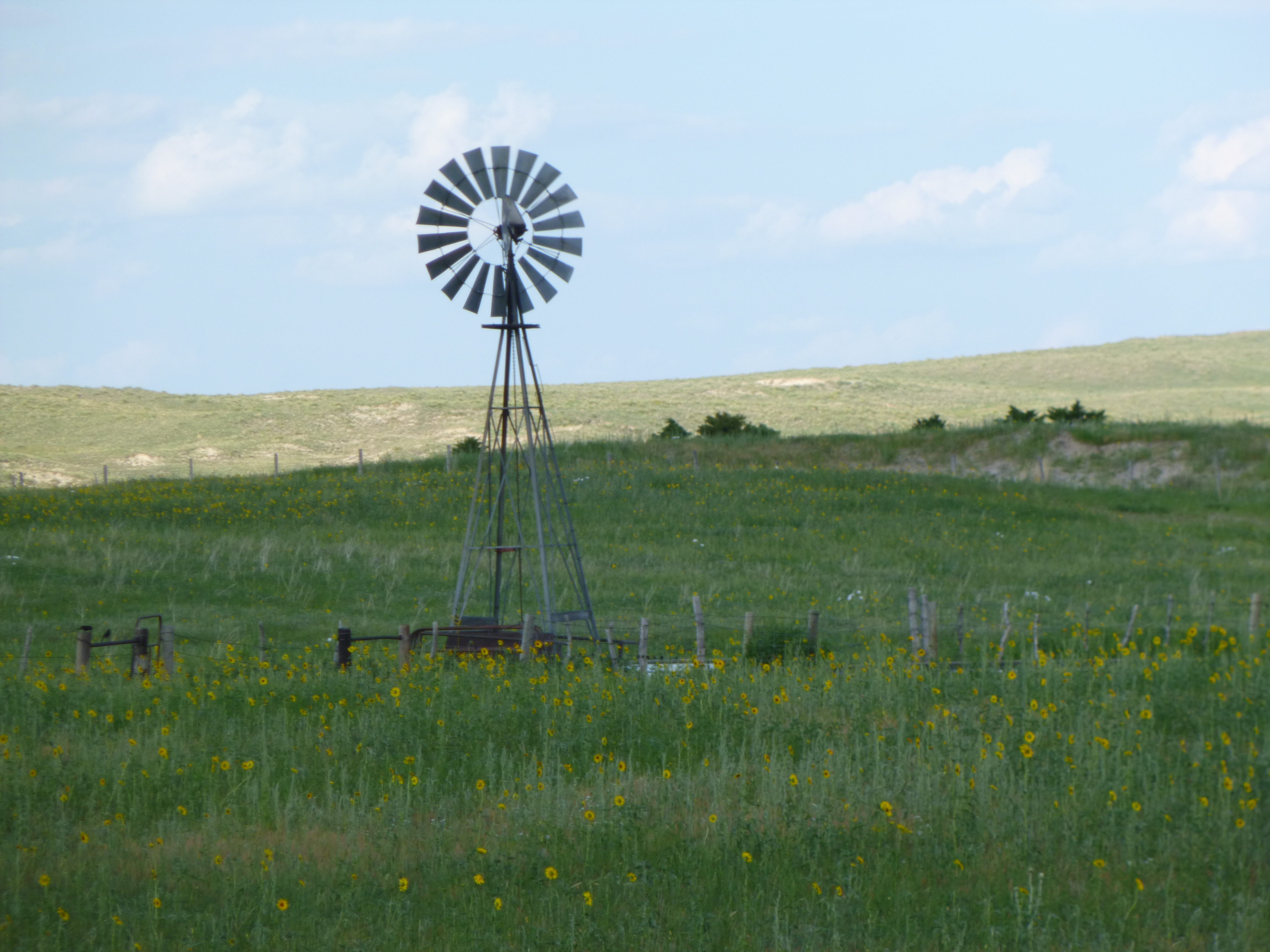
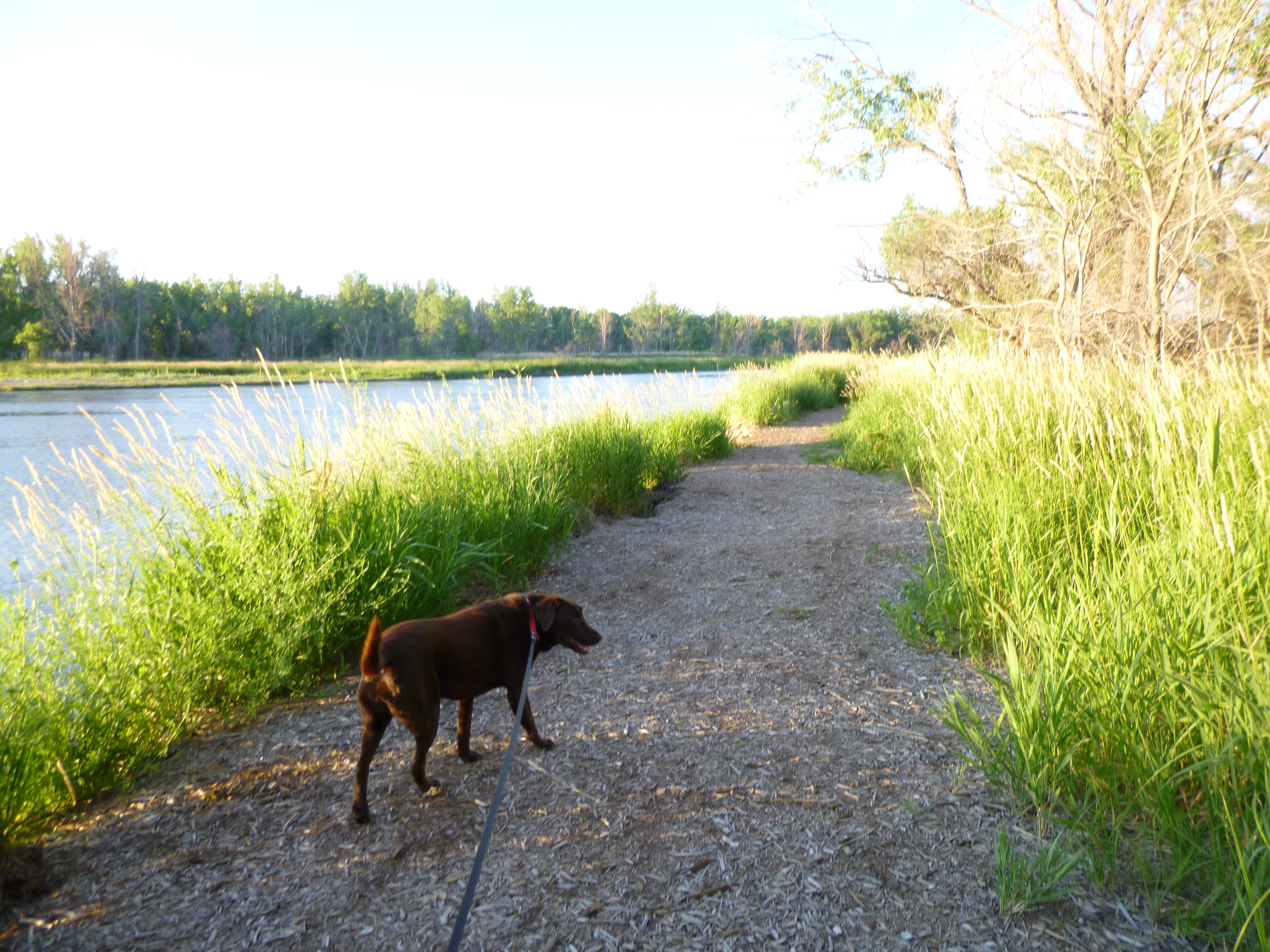
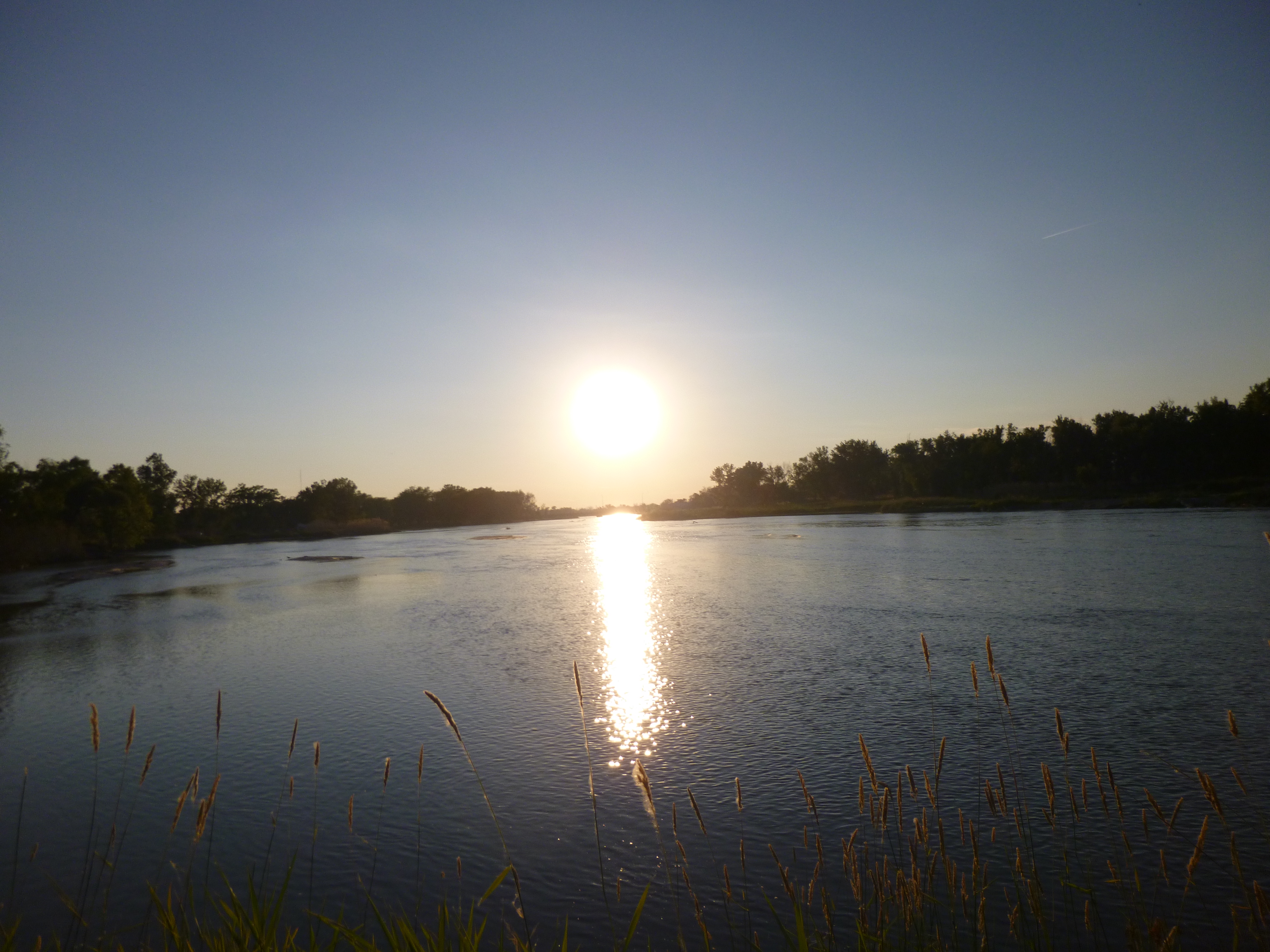
From there I continued driving to the little town if Thedford, where we did another mile of walking, and then I continued a little beyond that before heading south to North Platte. There was barely any traffic on the road south, and I soaked up the views of the sandy hills, windmills and black cows here and there. Once we were on the outskirts if North Platte, we stopped at a huge city park, and walked 2 1/2 more miles – along the river, on a nature trail, and around a little zoo that had lots of llamas and peacocks. The peacocks were starting to roost for the night, and they have a very interesting, loud squawk. One lady said it sounded like a loud meow gone bad! I like the sound! And then we were ready to call it a day too.
Nebraska – Saturday, June 29
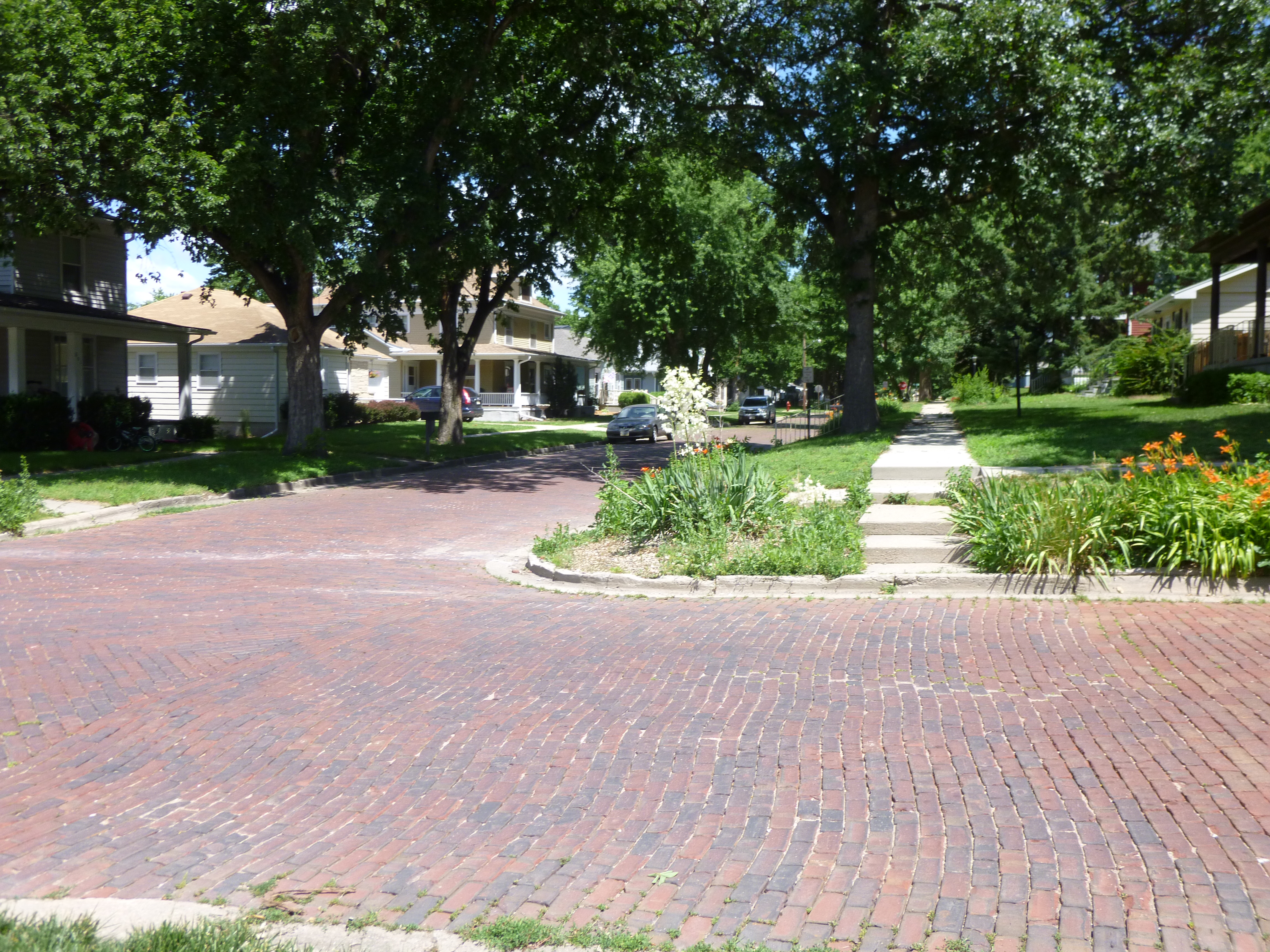
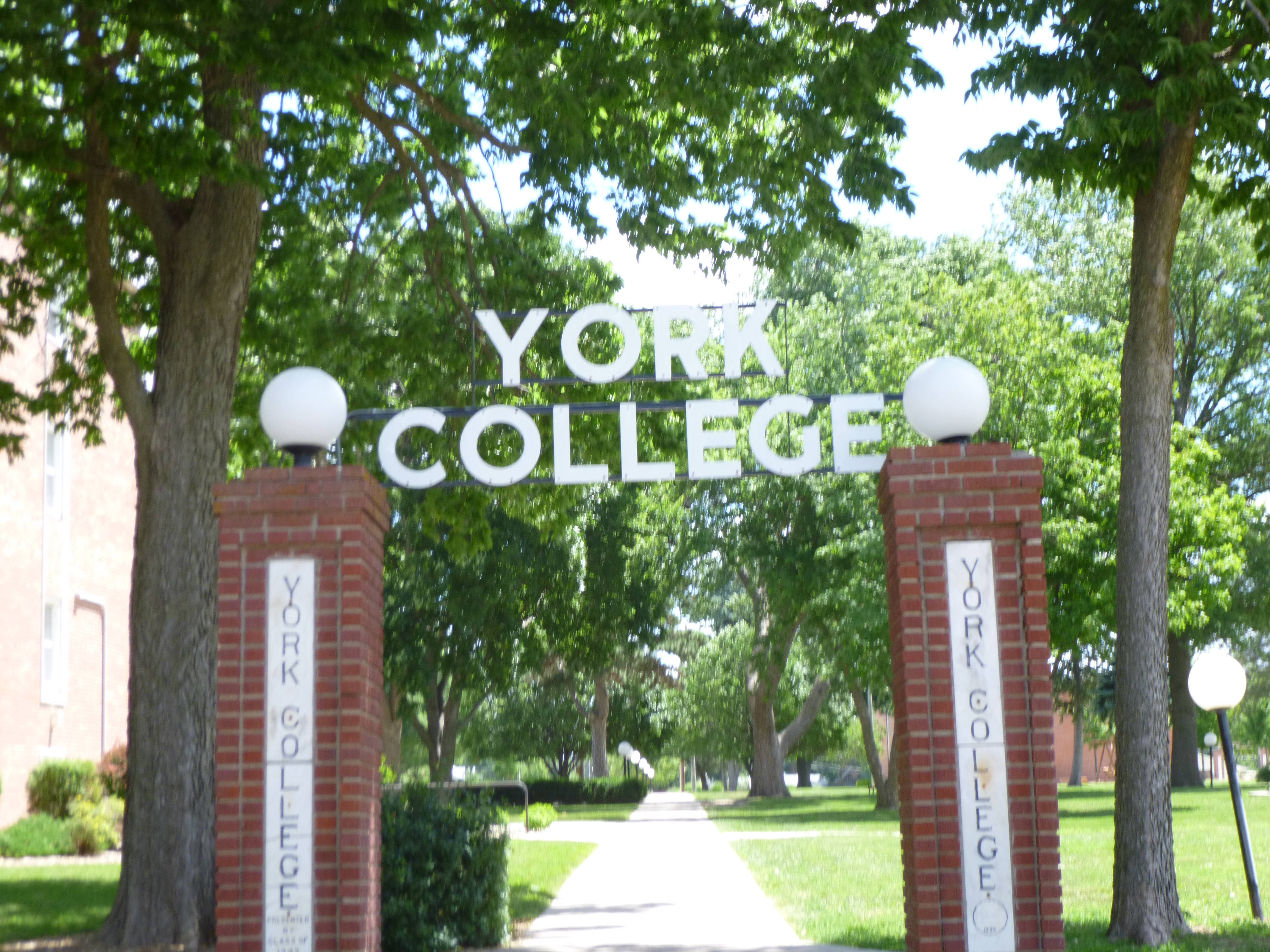
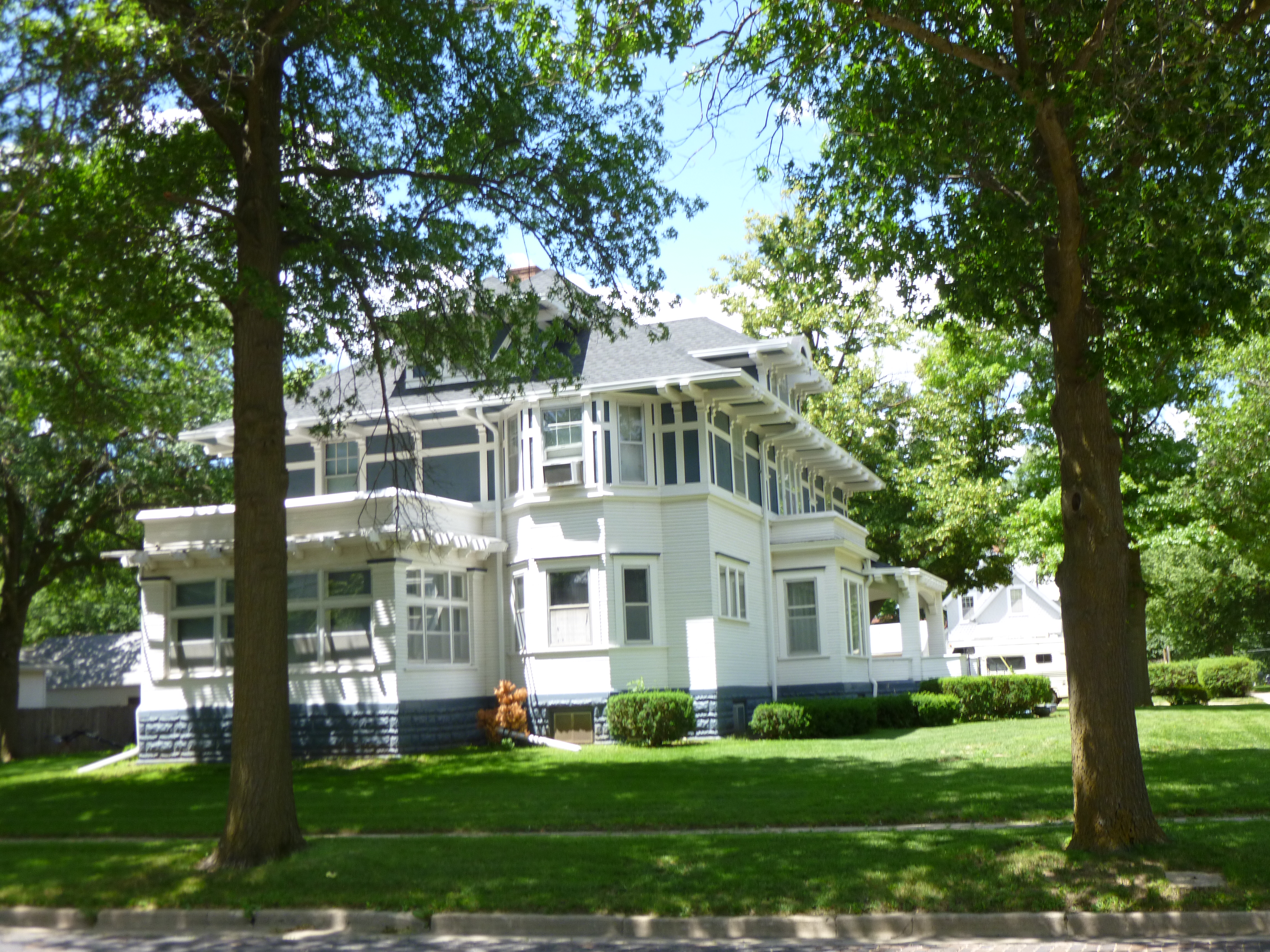
Since I ended up in York last night, I started my day off by walking around town. Tula and I covered 2 1/2 miles in town and out into some neighborhoods, and we walked by York College. Lots of streets were paved with brick, which looks pretty, but it kind of bumpy to drive on. On my way out of town, I saw a sign about a historical marker, but I couldn’t pull off the road quick enough, so I went up to a nearby Walgreens to turn around. But I figured as long as I was in the Walgreens parking lot, I may as well run in for a couple things that I needed, and in doing so, I found my donation-of-the-day opportunity. I was waiting in the checkout line, and I saw a cardboard box on the counter with a sign that said “Adopt A Soldier” and they were hoping that customers might buy some snacks and things for the troops overseas. I read a bit more, and saw that this was a project sponsored by the American Legion, and they would collect the items that people donate, and pay for shipping it overseas. And I really liked that. It had been a long time since I had bought things to put in a care package overseas – I did that once a week for the first 7 weeks or so of my journey, but I got frustrated with shipping costs – it ate up $13 of every care package budget, so the troops were only getting about $42 worth of stuff. But in this case, I could choose out the full $56 worth of goodies, and the American Legion would pay for the shipping! So I got them cans of nuts, raisins, trail mix, dried fruit, gum, life savers, skittles, peppermints and licorice. It took a while to check out because the cashier had to put a sticker on each item saying it had been bought by a Walgreen customer. There had only been a few things in the bottom of the box before I came along, and my contribution filled it up! So this donation happened simply because I saw a sign about a historic marker, missed a turn, and the Walgreens parking lot was the closest place to turn around. It’s kind of fun when things happen unexpectedly like that! So I went back to the historical marker, and it turned out to be a big rock that marked the Nebraska cutoff for the Oregon Trail. There was also a walking path there, and Tula and I followed that for a while, so we got another couple miles of walking in.
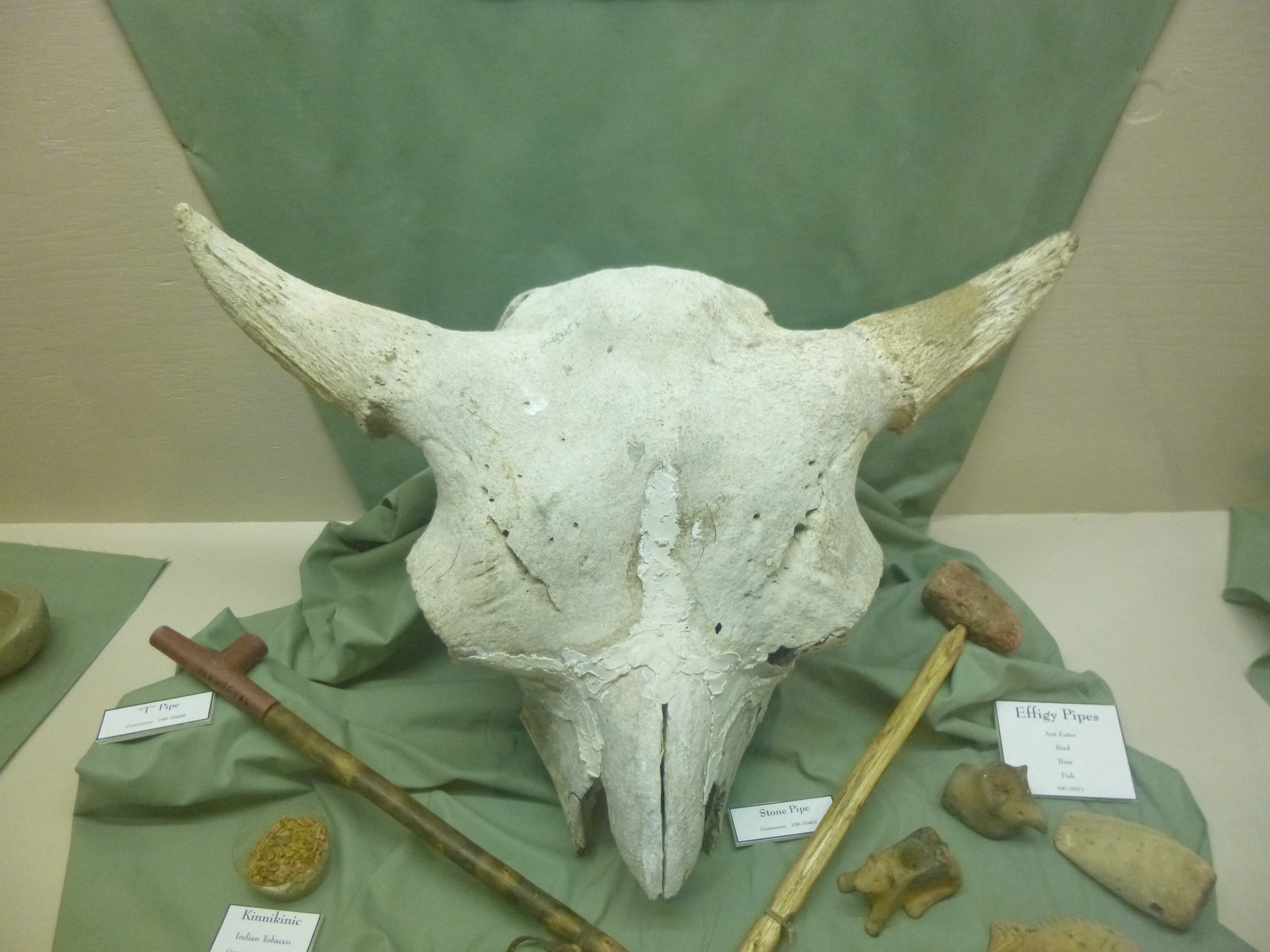
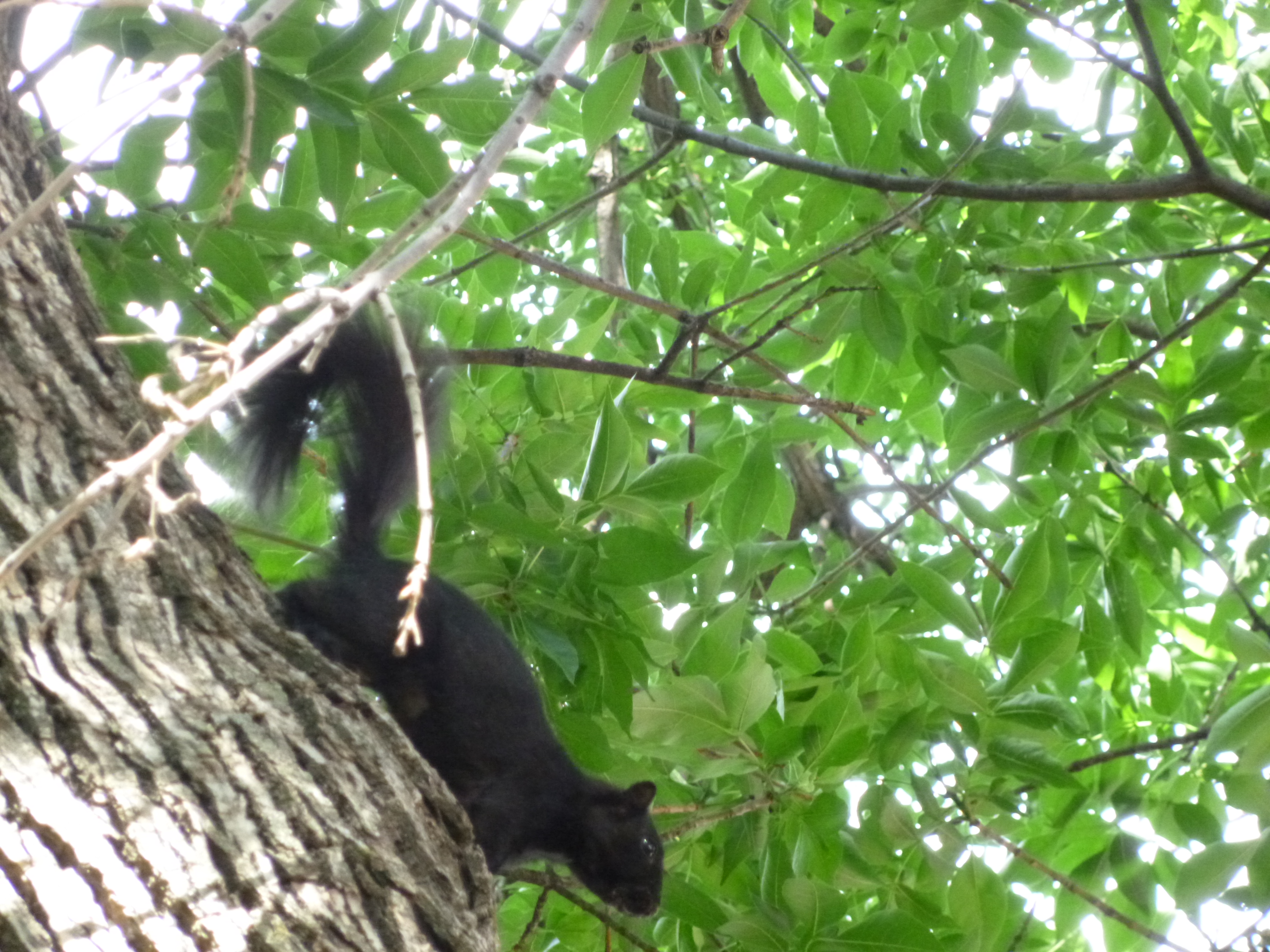
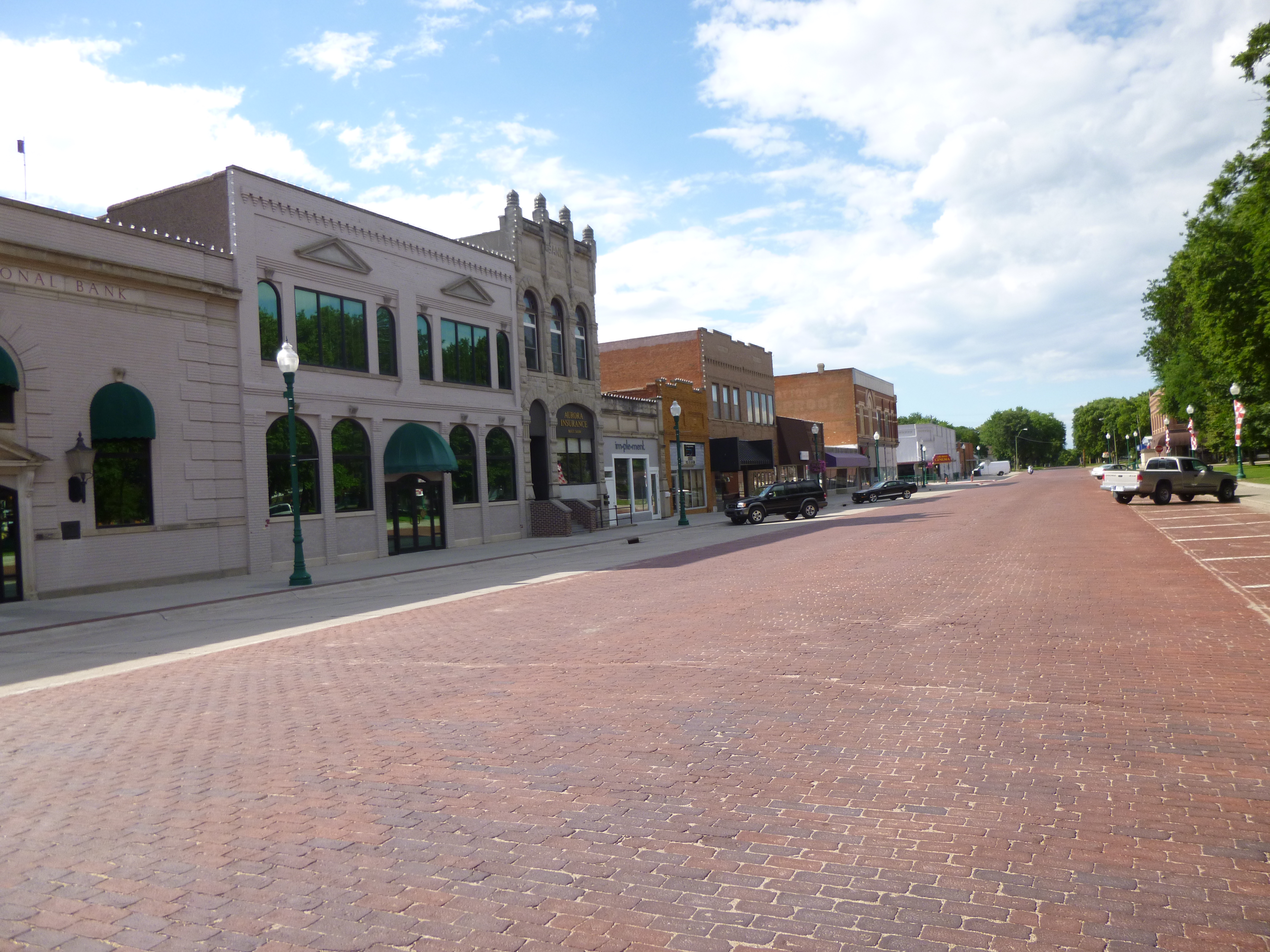
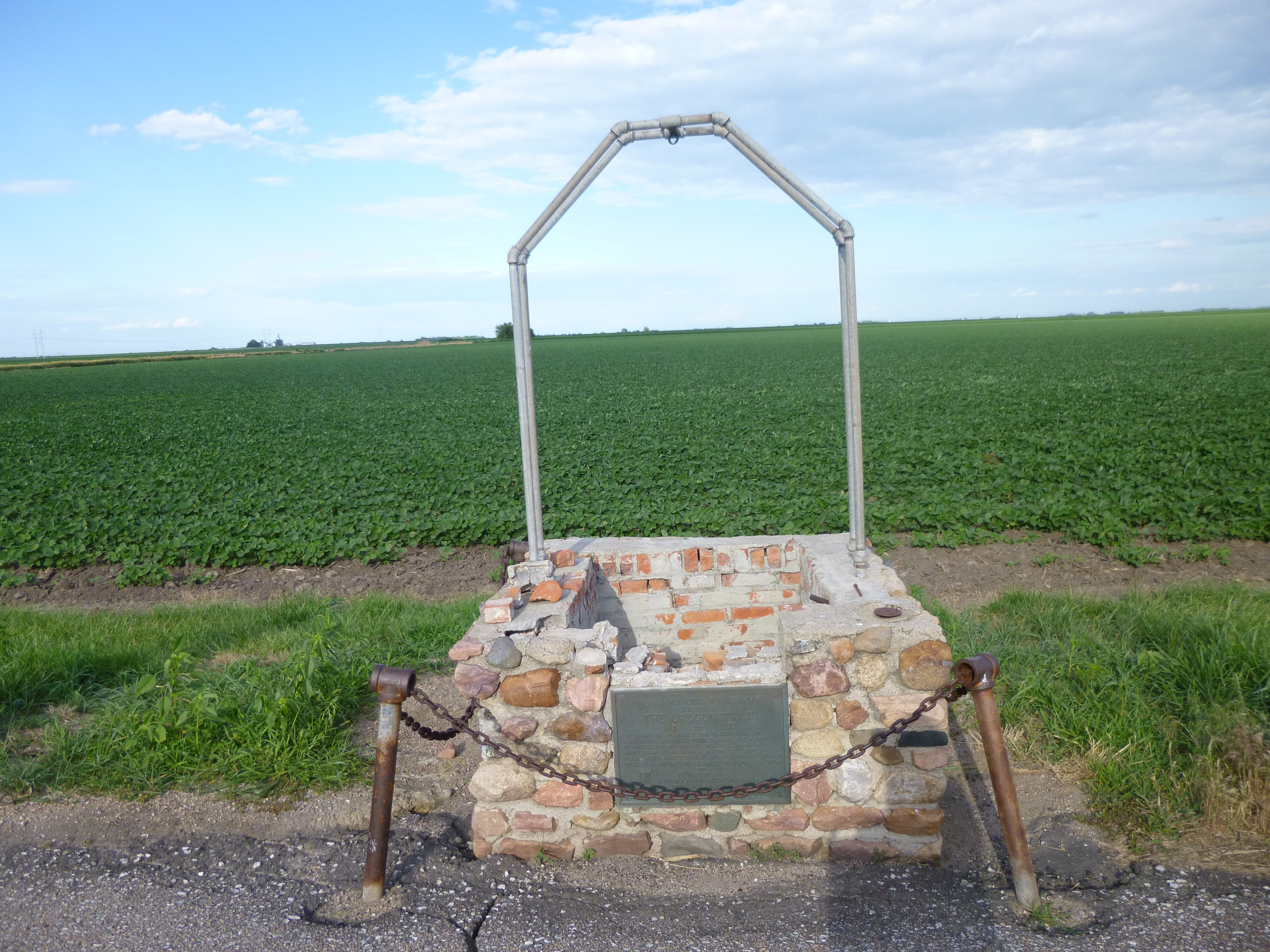
From York I headed west to the town of Aurora. I wanted to pop into the Plainsman Museum before they closed for the day, and it was a wonderful little museum depicting life on the plains from Native American times through the pioneer years and into the 20th century. And then it was time to get some more walking in. Aurora was a good town for walking, with a big town square and neighborhood streets leading off in all 4 directions. There were black squirrels here, and I’m not sure if I’ve seen black ones before. Tula chased several of them up a tree. We walked nearly 3 1/2 miles, which finished off the walking for the day. And then there was one other thing I wanted to see before leaving town – a deep well at a historic site, which was a good stopping point for thirsty pioneers on the Oregon Trail.
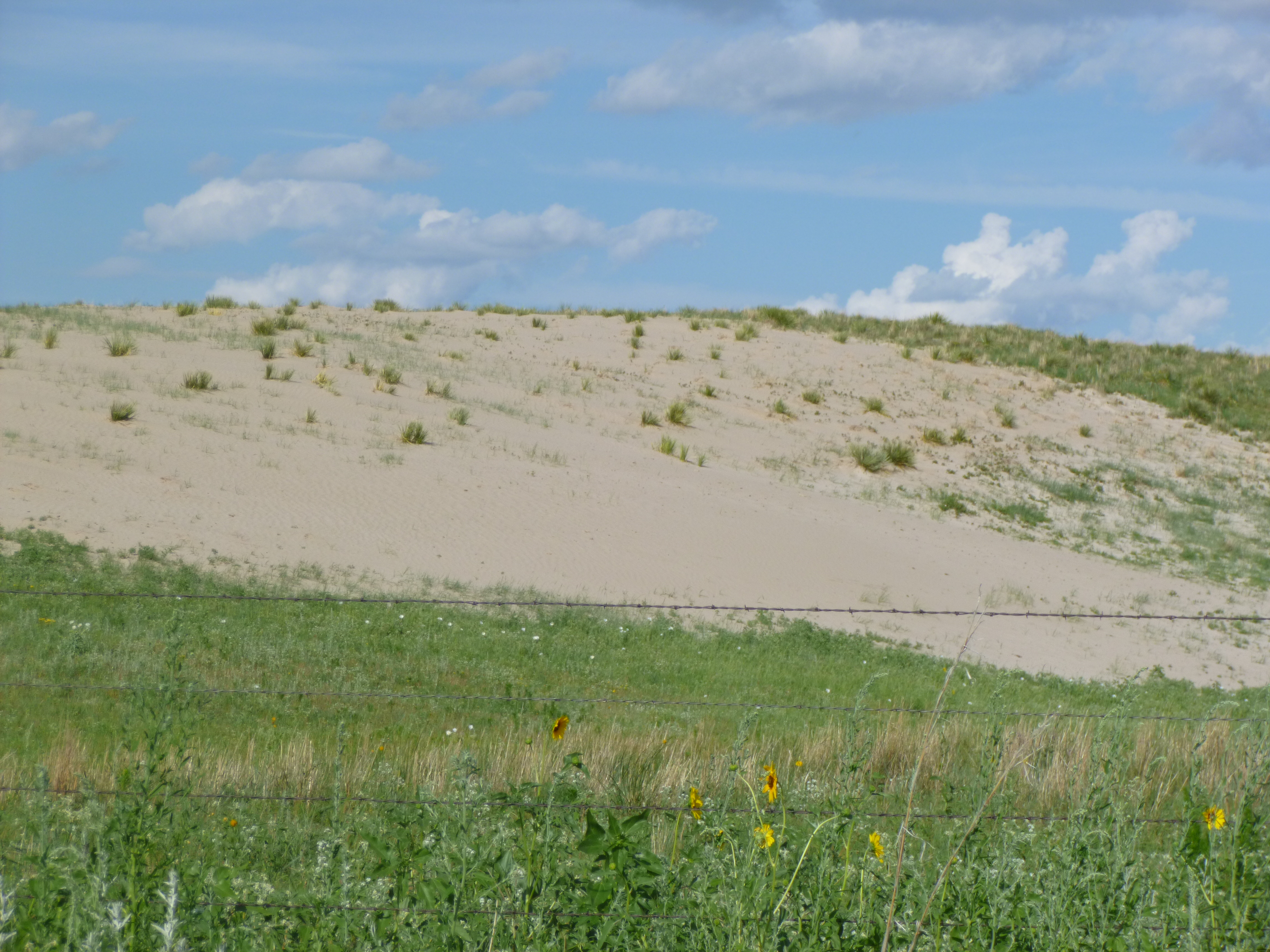
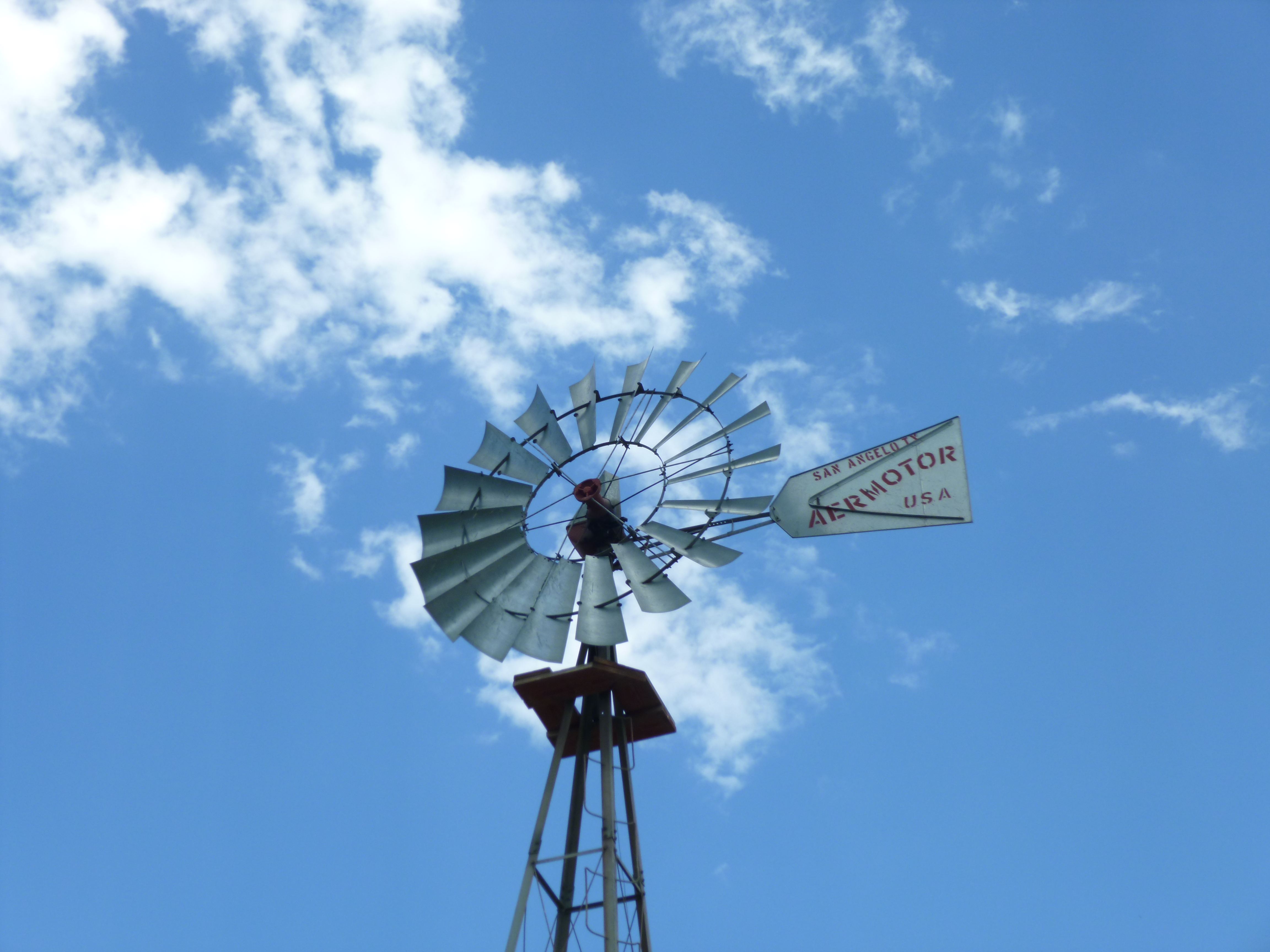
And, with evening hours upon us, I started driving into the sandhills of central Nebraska, which is the largest dune system in the country. Because of the sand, it can’t be farmed, but grasses grow on it, so ranchers can run their cattle on the land. It was very easy to see where the farmland ended and the sandhills started. The whole region is just grassy, sandy, rolling hills with cattle (mostly black Angus) and working windmills pumping water into tanks for the cattle. It’s beautiful and peaceful. It’s also the place where 80% of the nation’s sandhill cranes stop over on their migrations, along with millions of ducks and geese, so I don’t imagine it’s very peaceful in March and April!
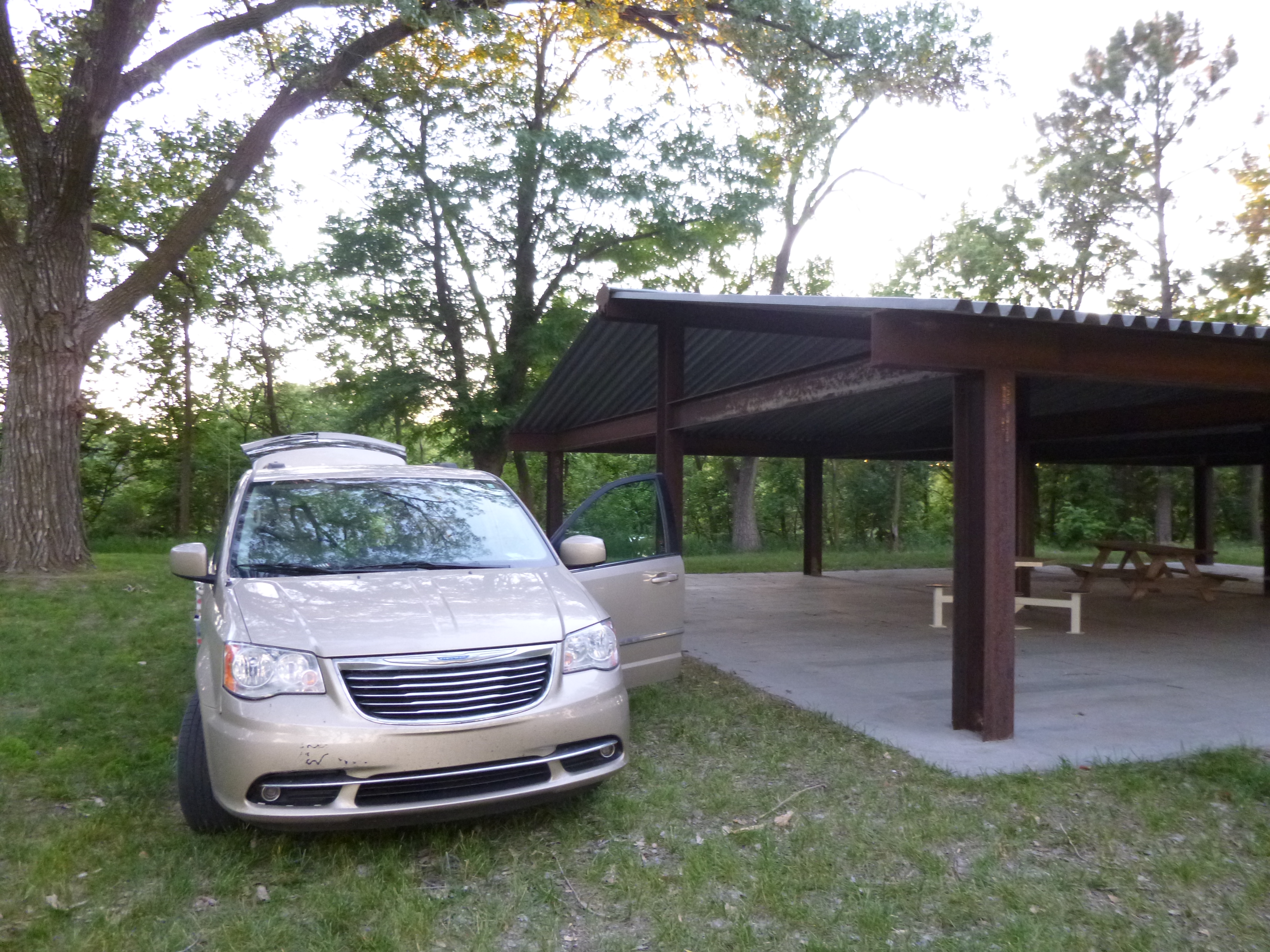
I was aiming for the town of Broken Bow (towns are few and far between in central Nebraska) but with daylight fading I didn’t want to miss the pretty scenery, so I started to think about finding a place to camp. I saw a sign for a state recreation area, and thought I’d go check out the camping possibilities. There was a place with big picnic shelters, and a boat launch into the river, and there were people camped down by the river. Most of them seemed to be pretty young, and since it was the Saturday before the 4th of July, I figured there might be some fireworks activity, so I didn’t want to camp down there by them. So I just drove back to the picnic shelter area, and since there weren’t any signs saying Do Not Camp, I figured it was okay to stay there. And it ended up being a nice spot, and I enjoyed the few fireworks the other campers set off over the river.













Nebraska – Friday, June 28
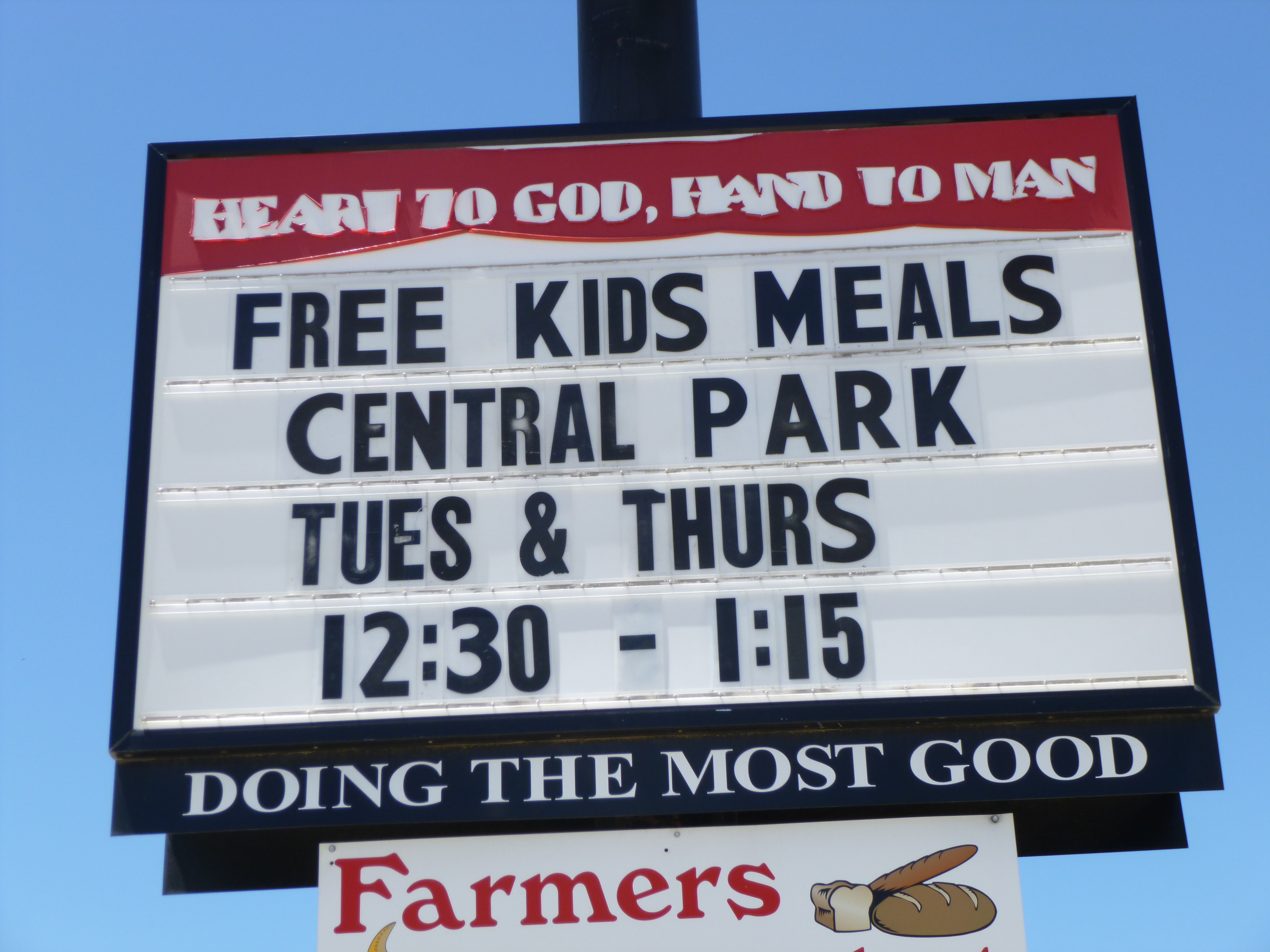
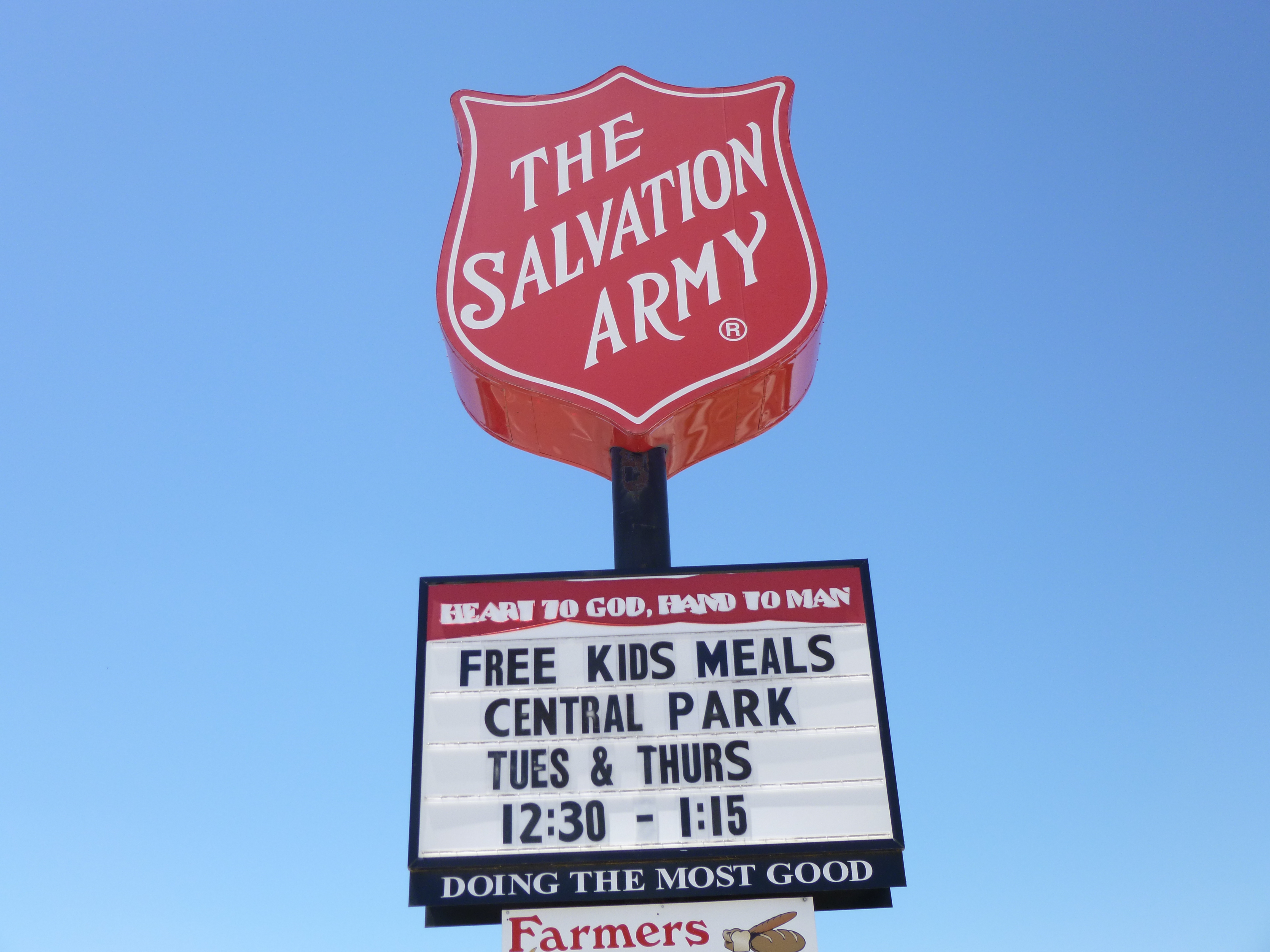
I had several donation ideas for today and none of them worked out, which didn’t matter in the end because I found some I liked even better! The first place I had an address for was theoretically a soup kitchen, but it just looked like someone’s house, and there didn’t seem to be anyone around, so I didn’t go there. Then there was a place that for some reason I thought was a women’s shelter, but it turned out to be some sort of daycare place! At that point, Tula and I got out to walk a couple miles in the neighborhoods of Norfolk. Then I drove to a food pantry, but their hours were very short today and no one was there when I stopped by. There was a sign saying food donations could be left inside an unlocked door, but all the doors were locked so that didn’t work either. So I figured it was simply time to move on to the next town. But in driving out to the road I needed to head south, I passed a big Salvation Army sign, with a message about a new kids’ program – free lunches in the park on Tuesdays and Thursdays. That caught my attention! I went in to their office and they told me about this program, which they just started this year in June when school was out. They call it Kids’ Cruisin’ Kitchen, and it’s for the kids who often get meal assistance during the school year. The Salvation Army already had a mobile canteen, so they worked worked up some menus and got the word out as best they could. The kids get a nice balanced meal, and each time they do this, there are more and more hungry kids as the word continues to spread. I’m guessing the park will be a very popular place to be for lunch in the coming weeks, and they’ll continue this program all summer. They also told me they see an increase in the summer in the numbers of people who come in for meals at their soup kitchen (one would expect to see an increase in the winter months) and it mostly boils down to hungry kids being on summer break. So I was happy to make a donation toward this new program.
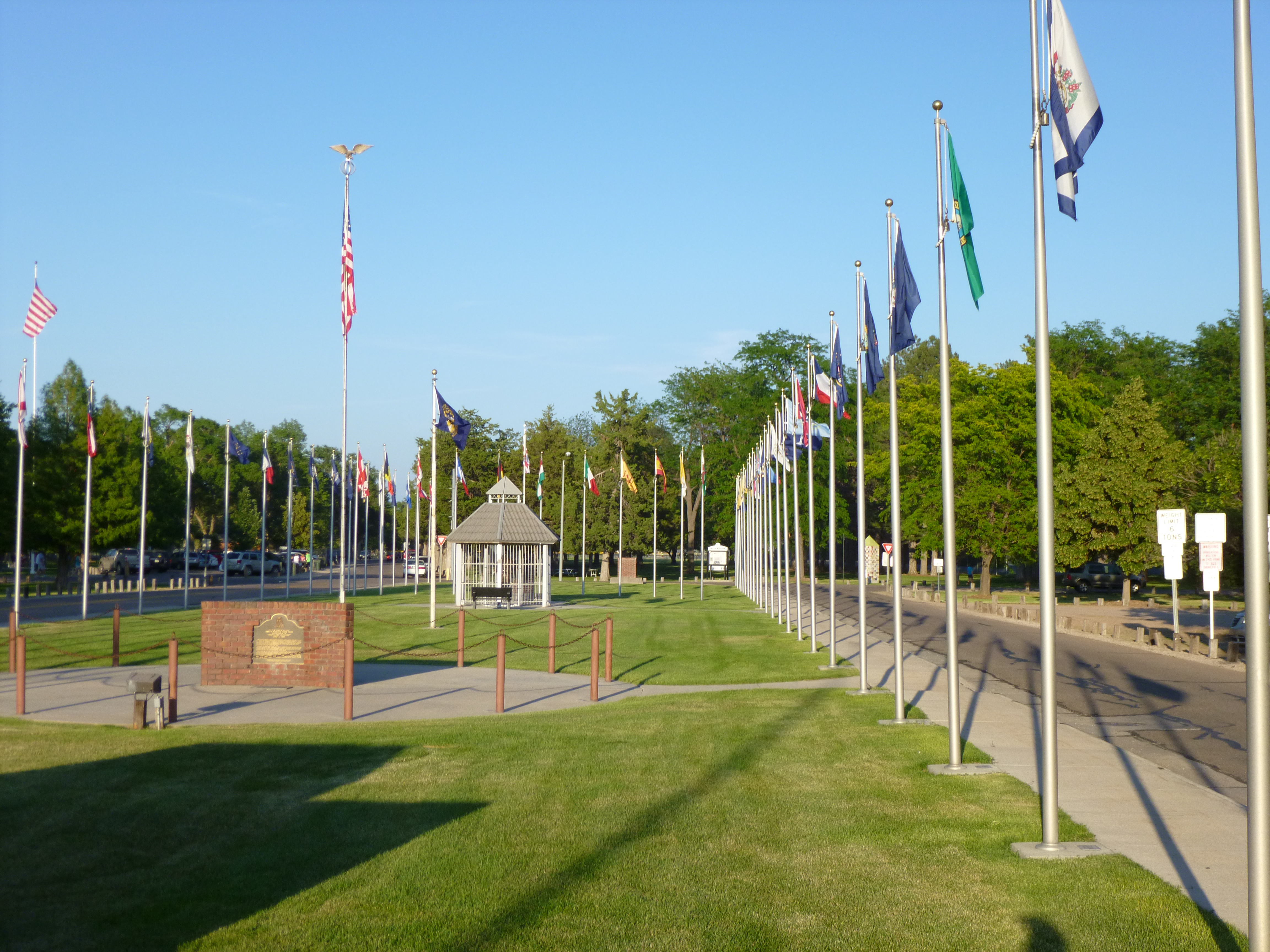
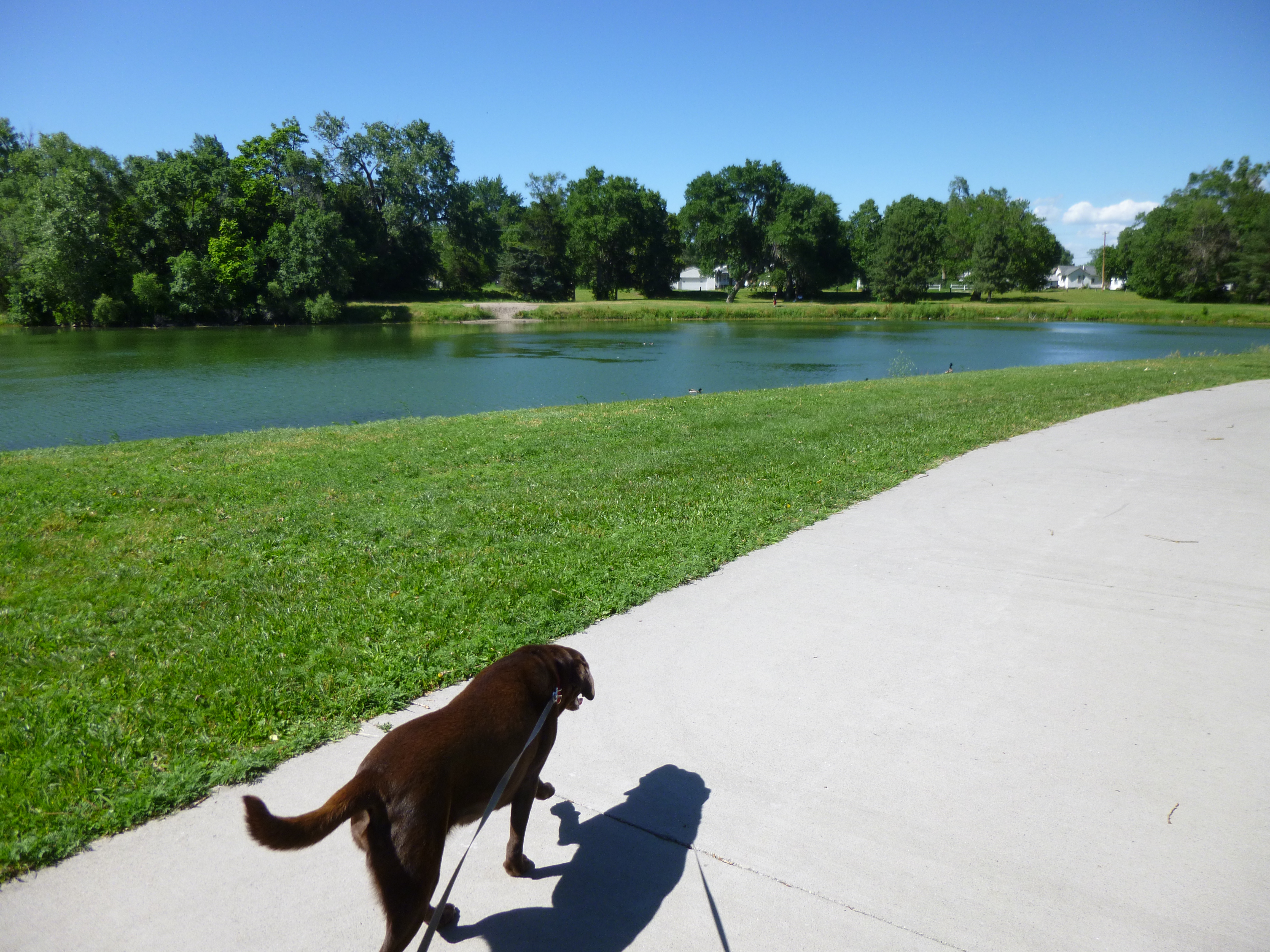
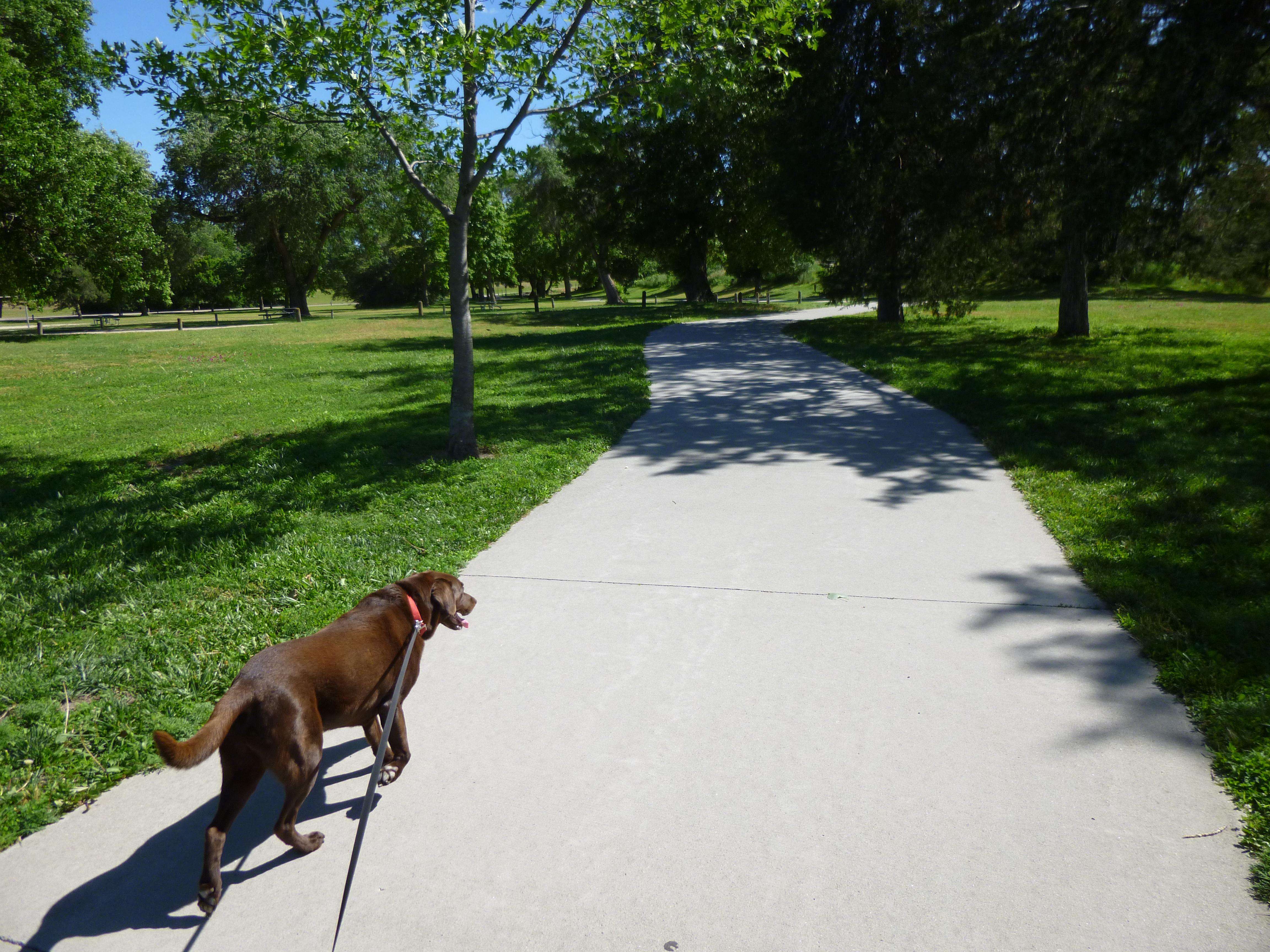
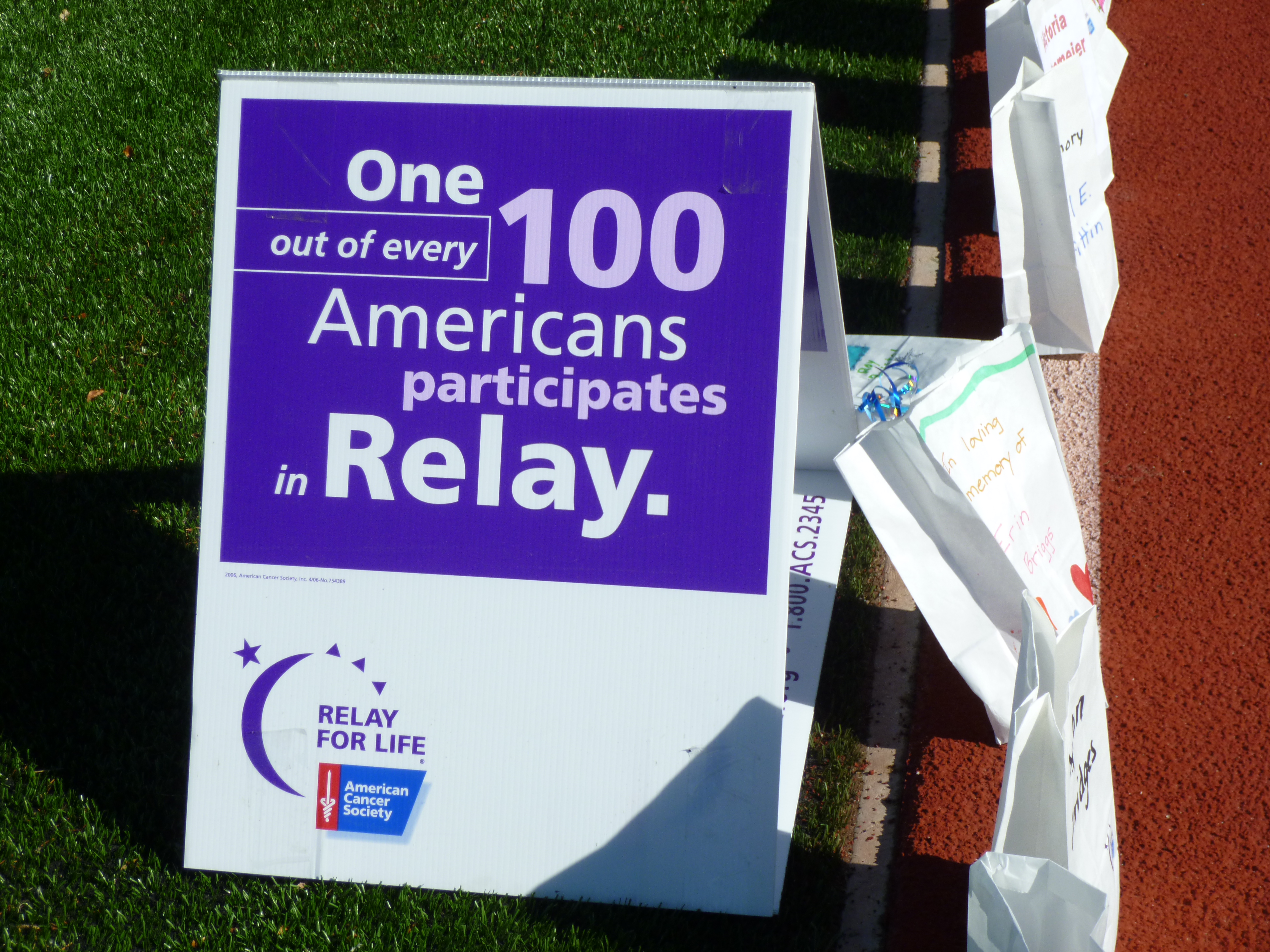
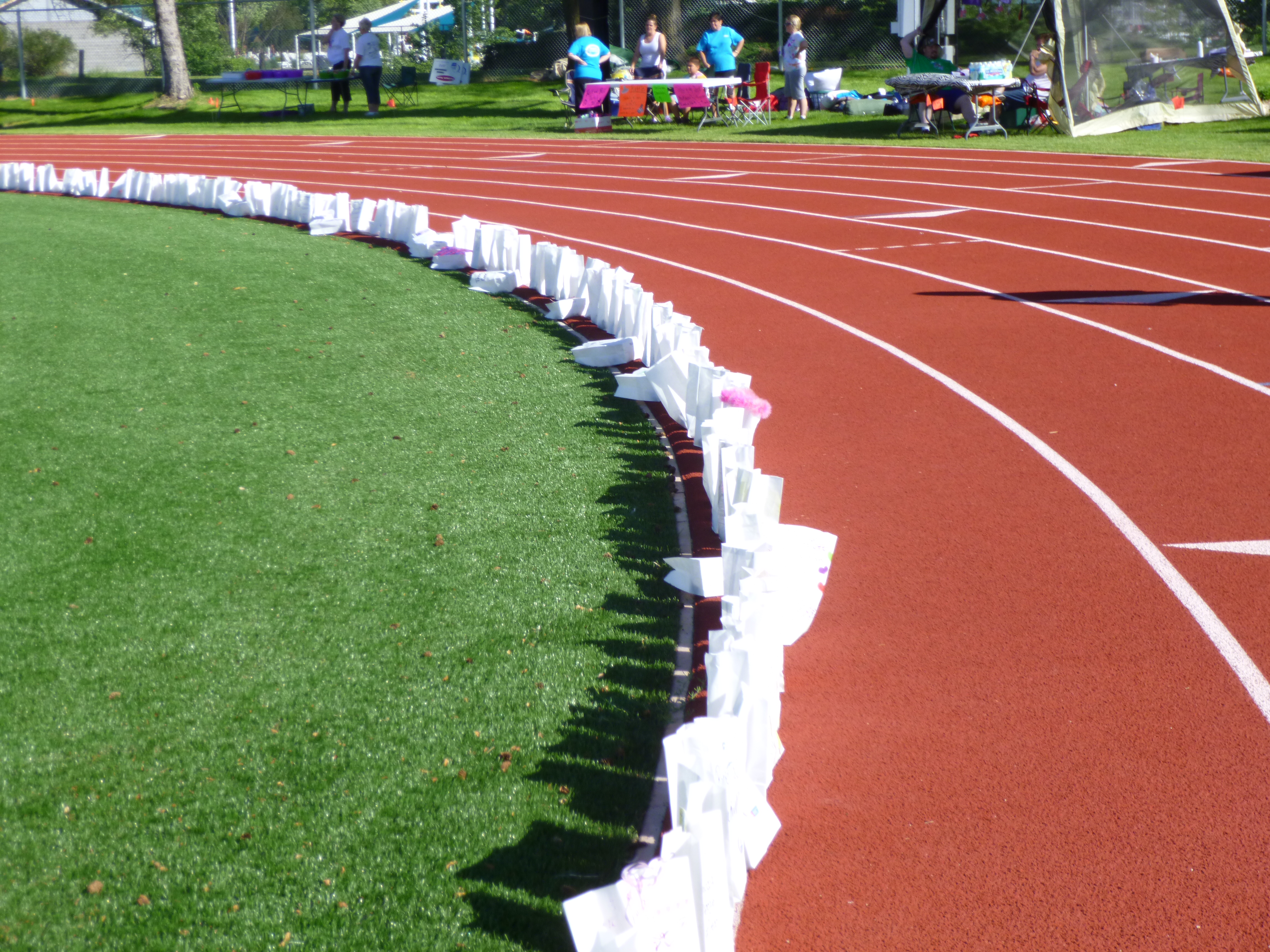
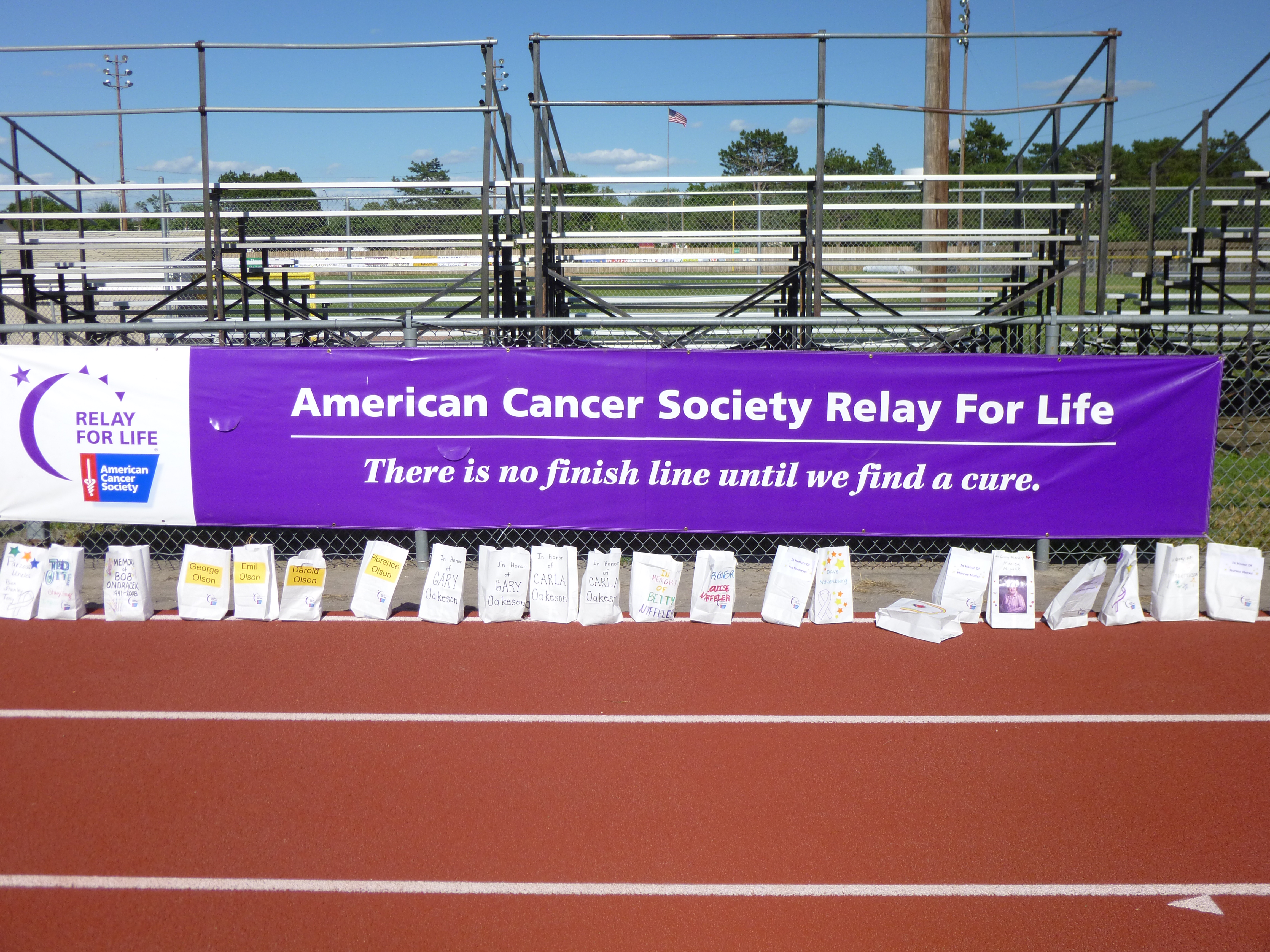
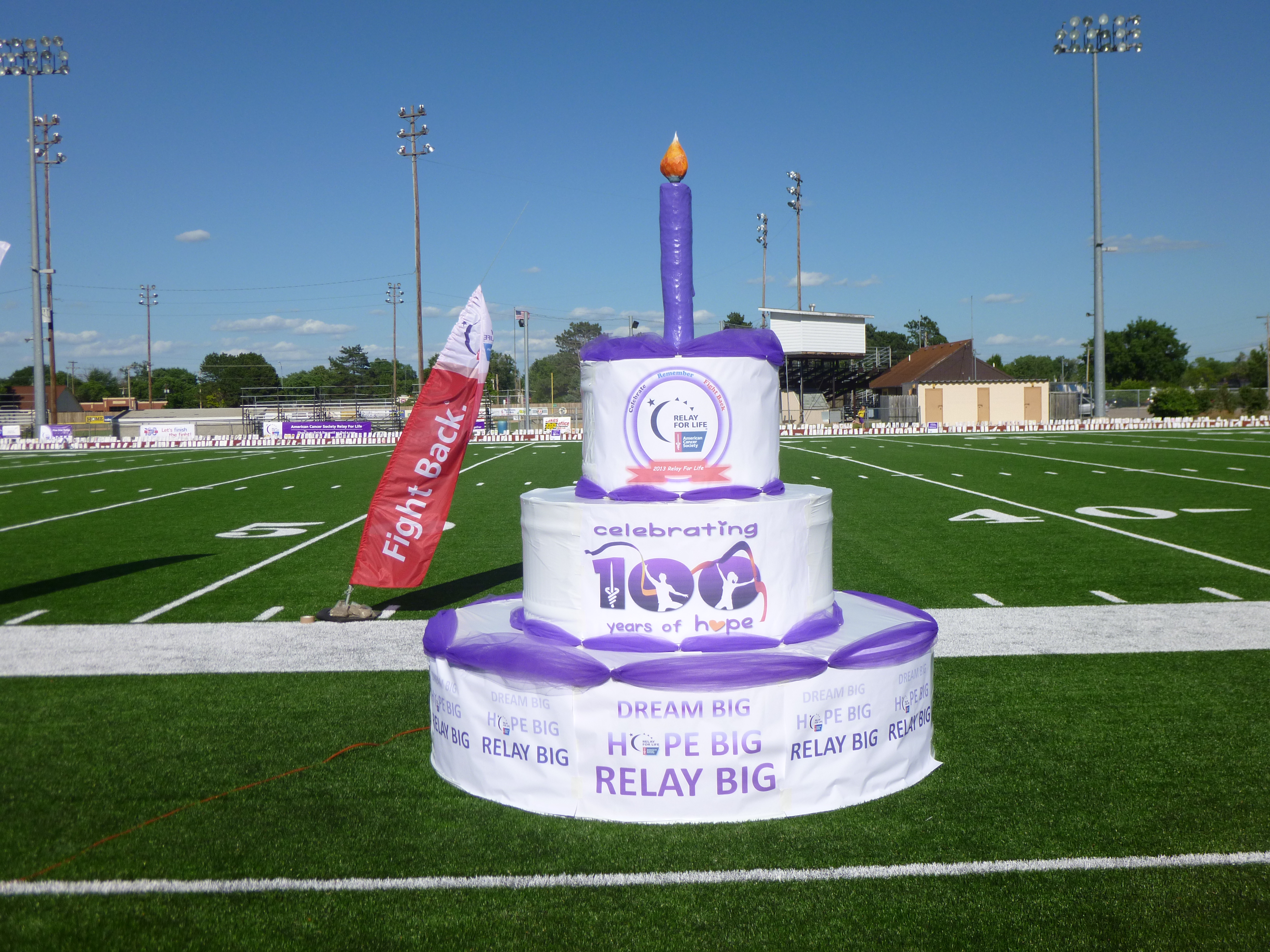
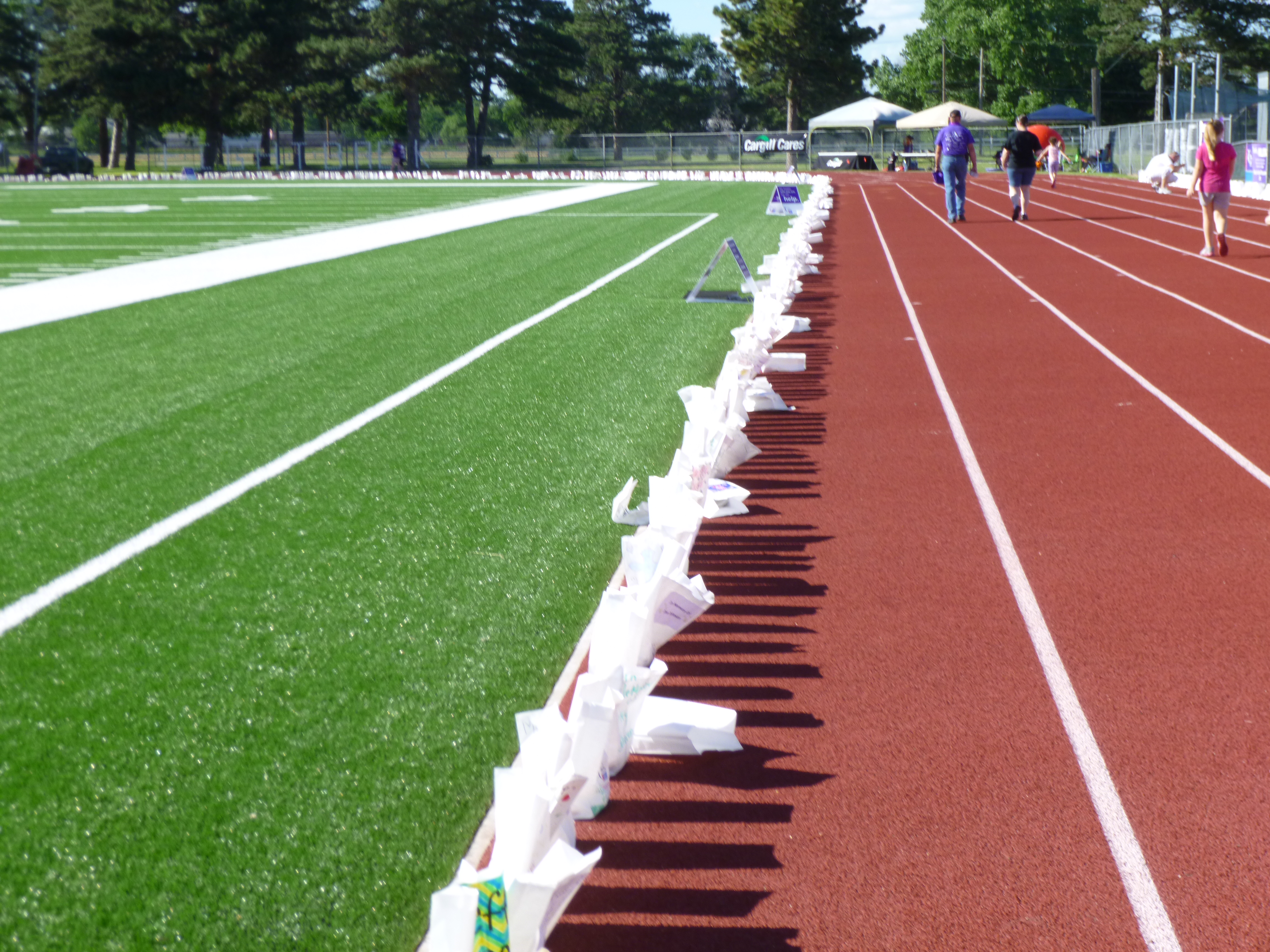
Then I headed south toward Columbus. I found Pawnee Park, and noticed a bike trail by the Platte River, so Tula and I got out and walked a couple miles along that. There was also a big veteran’s memorial area, complete with statues and flags from all 50 states, so I went to look at that, and then I found another trail through a different part of the park. That trail led me to the local high school stadium, and I could see they were getting ready to start a Relay for Life event to raise money for the American Cancer Society. I’ve seen lots of flyers for Relay for Life events in the different towns I’ve been in, but I’ve never been in the right place at the right time….until now! I wasn’t part of a team, but I was certainly a walker, and they were happy to get my donation. I got there about an hour before the event officially started, but there were already lots of people there, and some people had already started walking laps around the track. The track circled the football field and was almost completely lined with decorated white paper bags, honoring someone who had successfully battled cancer, or remembering someone who had lost the battle. If I’m not mistaken, teams raise money for cancer research by collecting pledges for the number of laps walked. Cancer survivors received purple t-shirts, and one string of beads for each year they had been cancer-free. I still had nearly 3 miles to walk, and I finished them off doing numerous laps around the track. The surface was cushioned, which was an unexpected treat. The longer I walked, the more crowded the track got. It looked like they were going to have a pretty good turnout for the event that would last all night long. I also looked at the silent auction stuff. I was really happy to run into a Relay for Life event that I could actually partcipate in!
I was ready to sit in the car for a while, so I drove farther south into Nebraska, stopping in the town of York.
Nebraska – Thursday, June 27
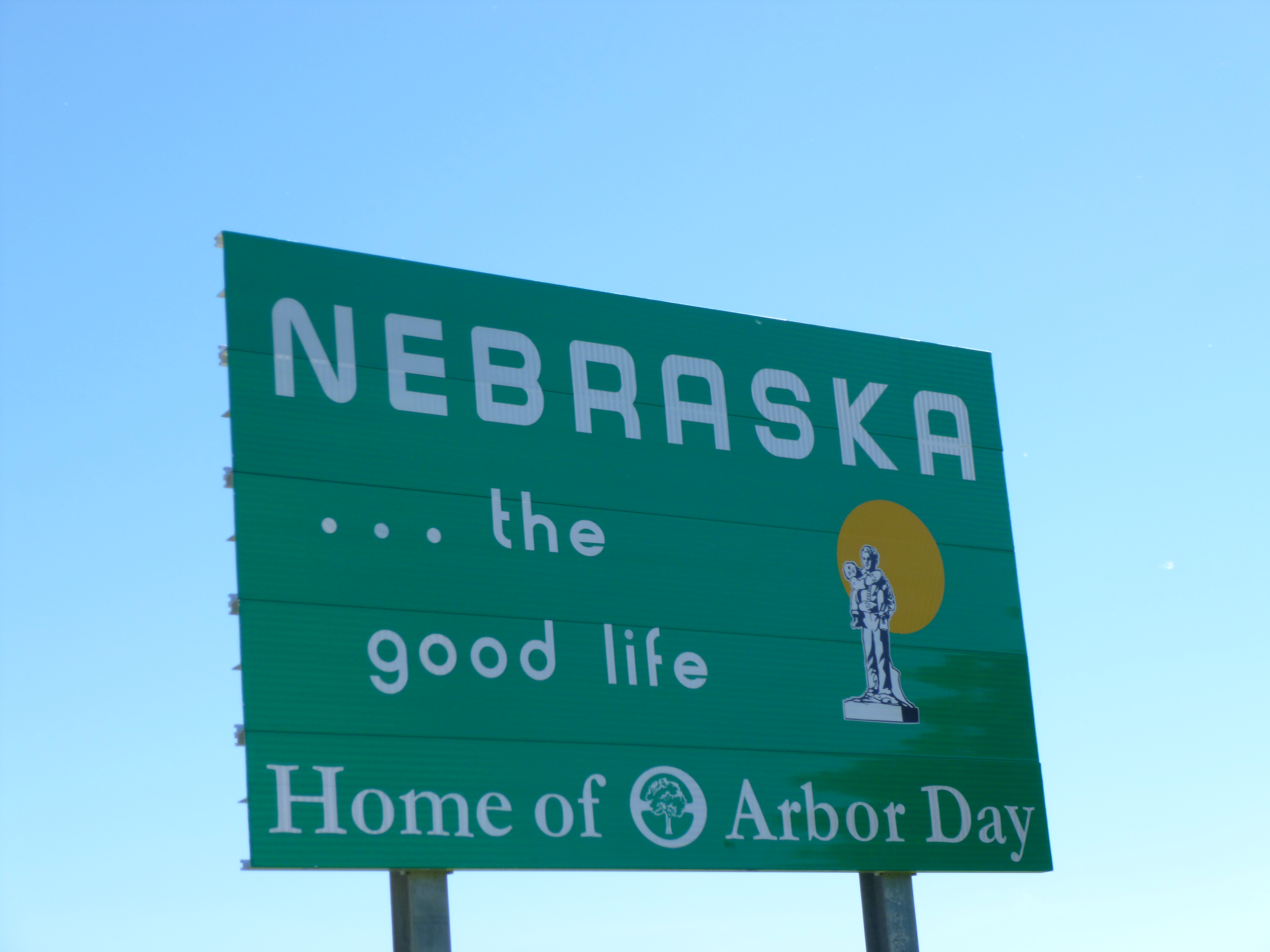
I spent the morning in South Dakota with my dad and Joan, and also took care of things like laundry and financial records. Around noon we headed up to the little town of Tea, outside of Sioux Falls, which is known for its steakhouse – an unpretentious little place, but they have the best steak in South Dakota! So I enjoyed a t-bone lunch and knew I wouldn’t need much to eat for the rest of the day! We drove back to Beresford and I loaded up the final things into the van, and then took off for Nebraska, and 60 miles later I was in State #39!
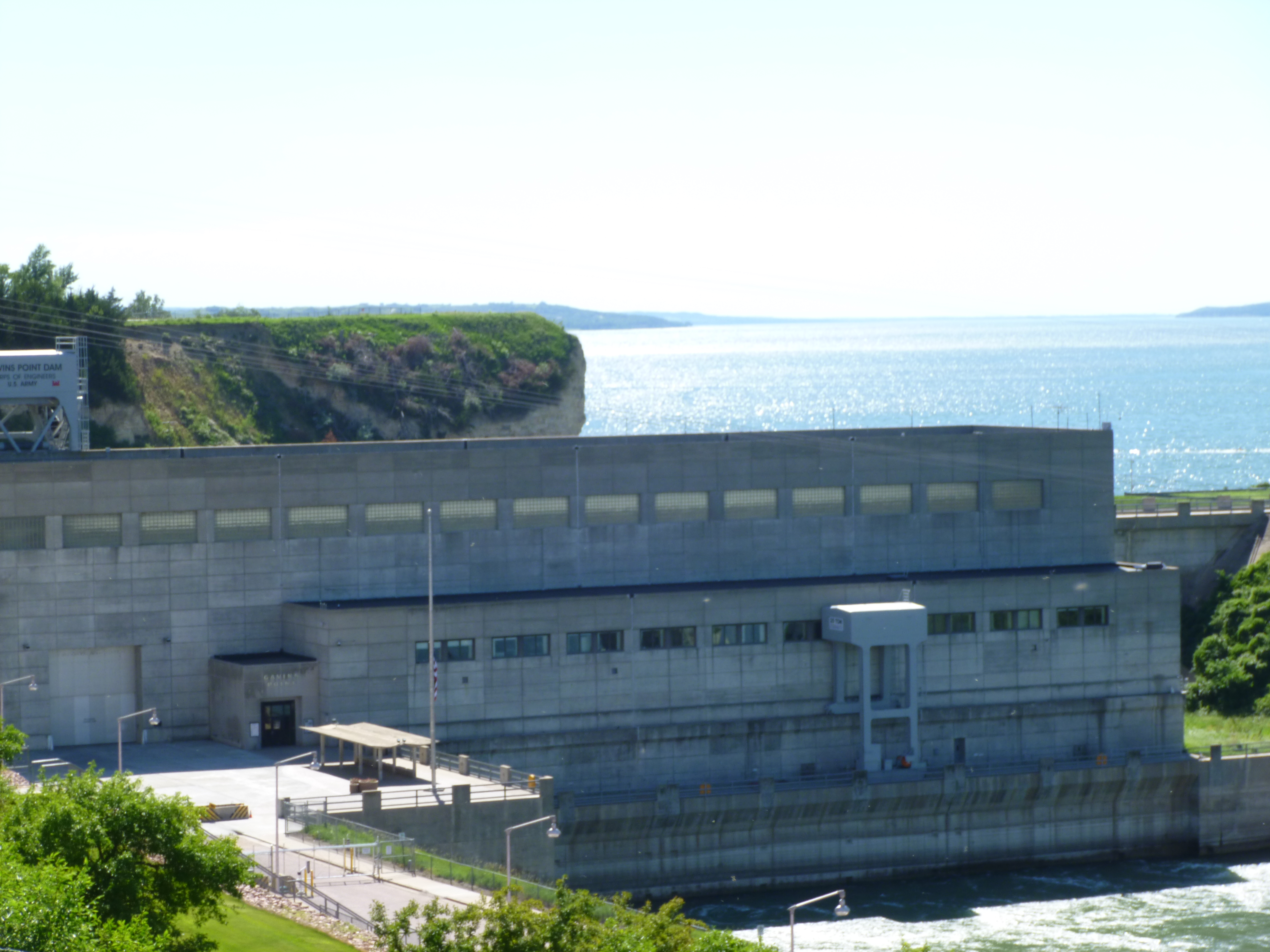
The Missouri River separates South Dakota and Nebraska, and the big Lewis and Clark Lake was right there. It’s actually more of a reservoir since there’s also a big dam. I had hoped to start with my walking there, but most of the recreational opportunities seemed to be on the South Dakota side, and the visitor center had closed early, so I admired the huge dam, and continued south into Nebraska. There’s not much in this part of Nebraska, and after about 30 miles I came to the little town of Randolph, which proclaims itself to be the Honey Capital of the World. It was a tiny little town, and Tula and I got out for some walking, and after a little over 1 1/2 miles, we had kind of covered everything we could. I didn’t see any evidence of bee keeping or honey making! It was just a small farm town with the typical train tracks and grain elevators and all. But there were more of those really fragrant trees, so the town smelled good.
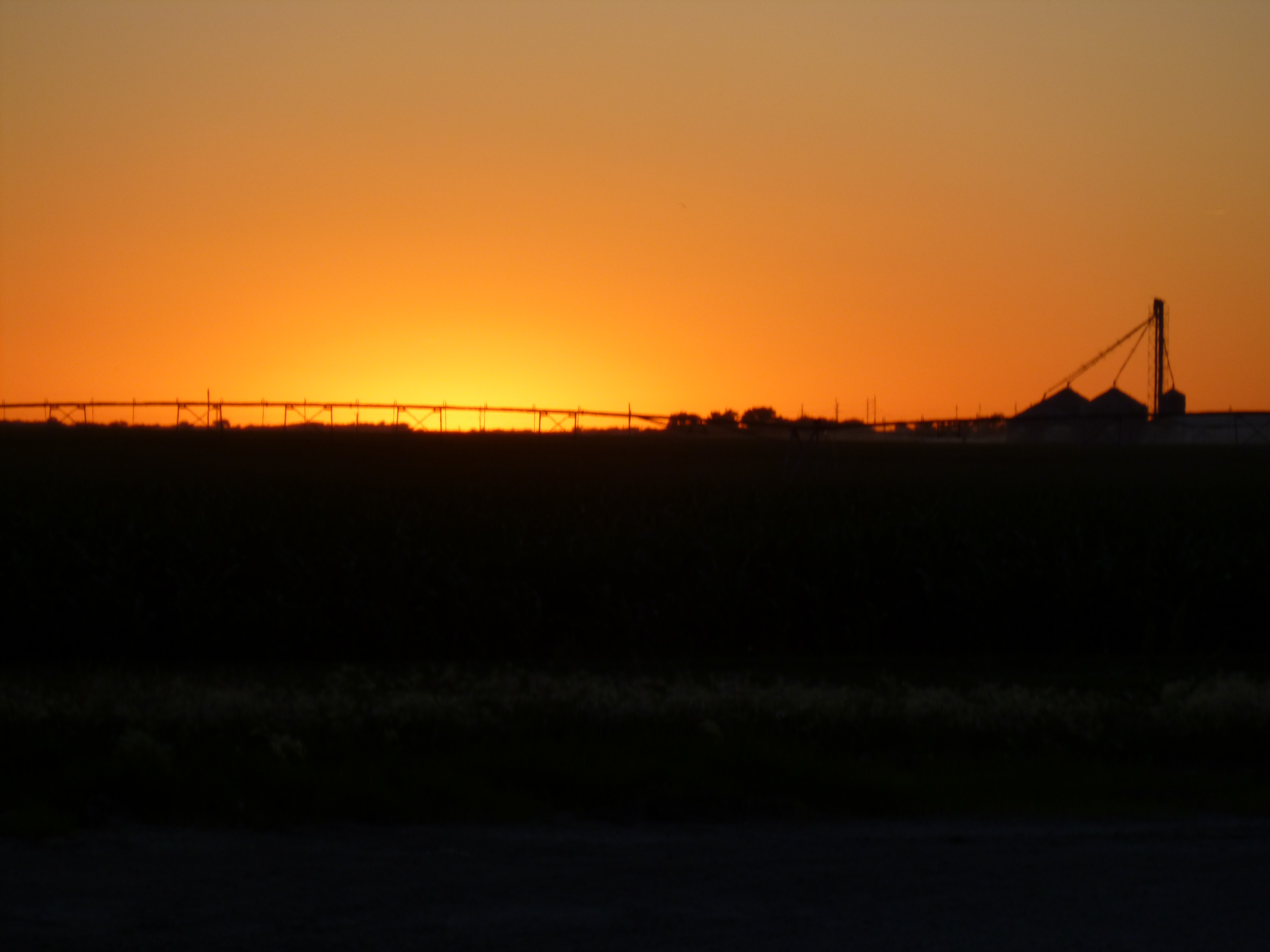
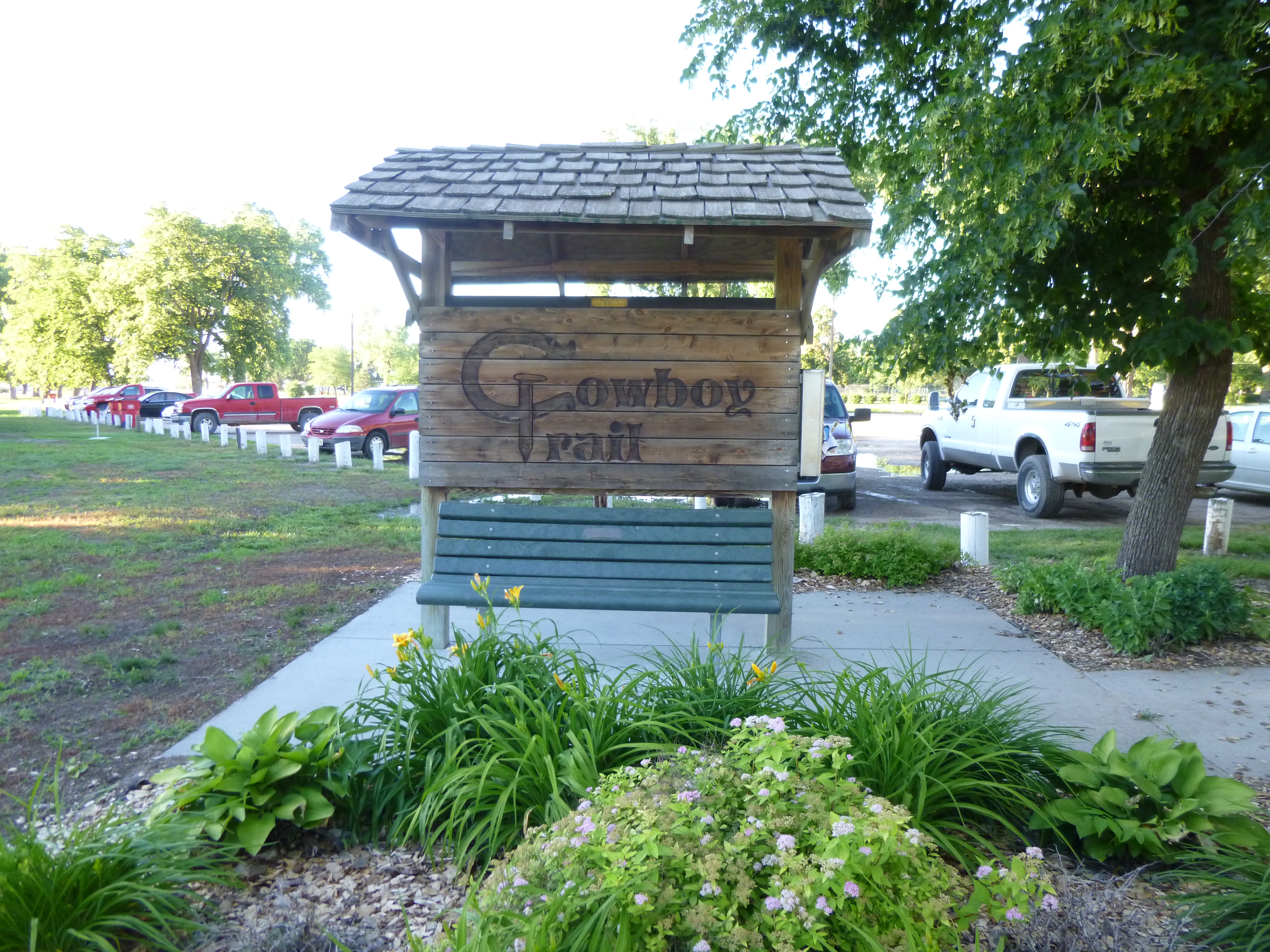
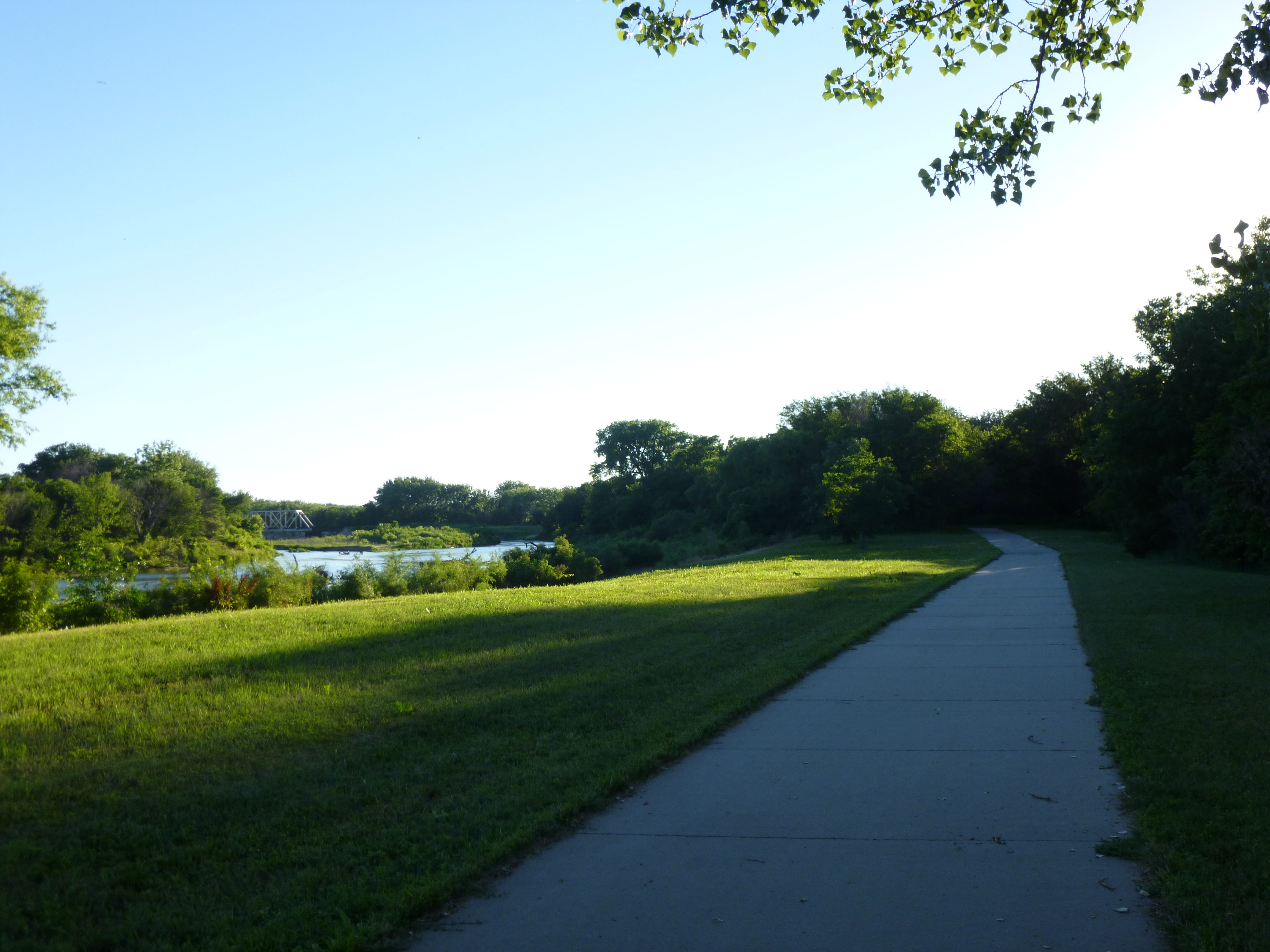
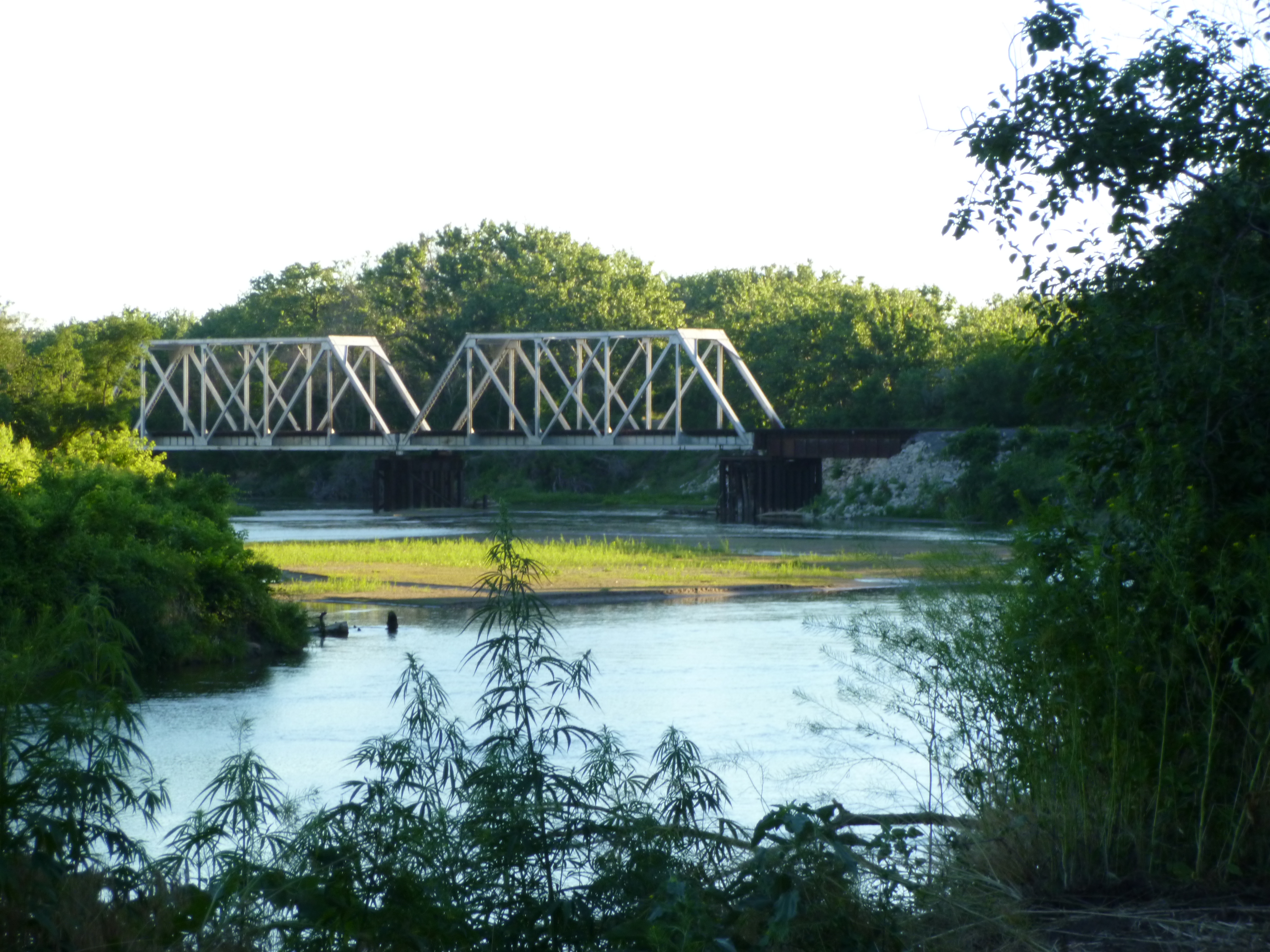
I drove another 25 miles to the town of Norfolk, where I was going to stop for the night. Since I got a mid-afternoon start from South Dakota, it was already evening time by now, but I had read there was a Cowboy Recreational Bike Trail, and with it staying light so late, I knew I could still do some walking. I found the trailhead at TaHaZouka Park along the Elkhorn River. It was a pretty park and a pretty trail, and Tula and I got a couple more miles in, then I put her in the car and covered 5 more miles, finishing up about 9:30pm just as the last of the light was fading. It was a pretty trail, winding along the river and past cornfields, and I watched the sun go down behind all the corn. I was really happy to get all my walking done today, despite my late start.
I didn’t make a donation today with the limited time in Nebraska, but it’ll be easy enough to double up in the next day or so. I already have a couple ideas for tomorrow.





Iowa – Wednesday, June 26
Before heading out this morning, I stopped by the local vet in Beresford to find out about the timing of Tula’s next blood test. She finished the last of her antibiotics last night, and I wasn’t sure how long to wait to check her Lyme disease levels again. It turned out the local vet hasn’t really dealt too much with Lyme disease, so I simply called Tara’s vet, and they suggested I wait for a couple weeks to let her body get back to normal after the medication. Then it was about a half hour drive straight east to cross back into Iowa, and I had plans to visit a few small towns to walk, and hopefully find a good food donation opportunity since I hadn’t really uncovered much online; other than most of these places seem to be served by the Food Bank of Siouxland down in Sioux City, which was not on my list of towns to visit today.
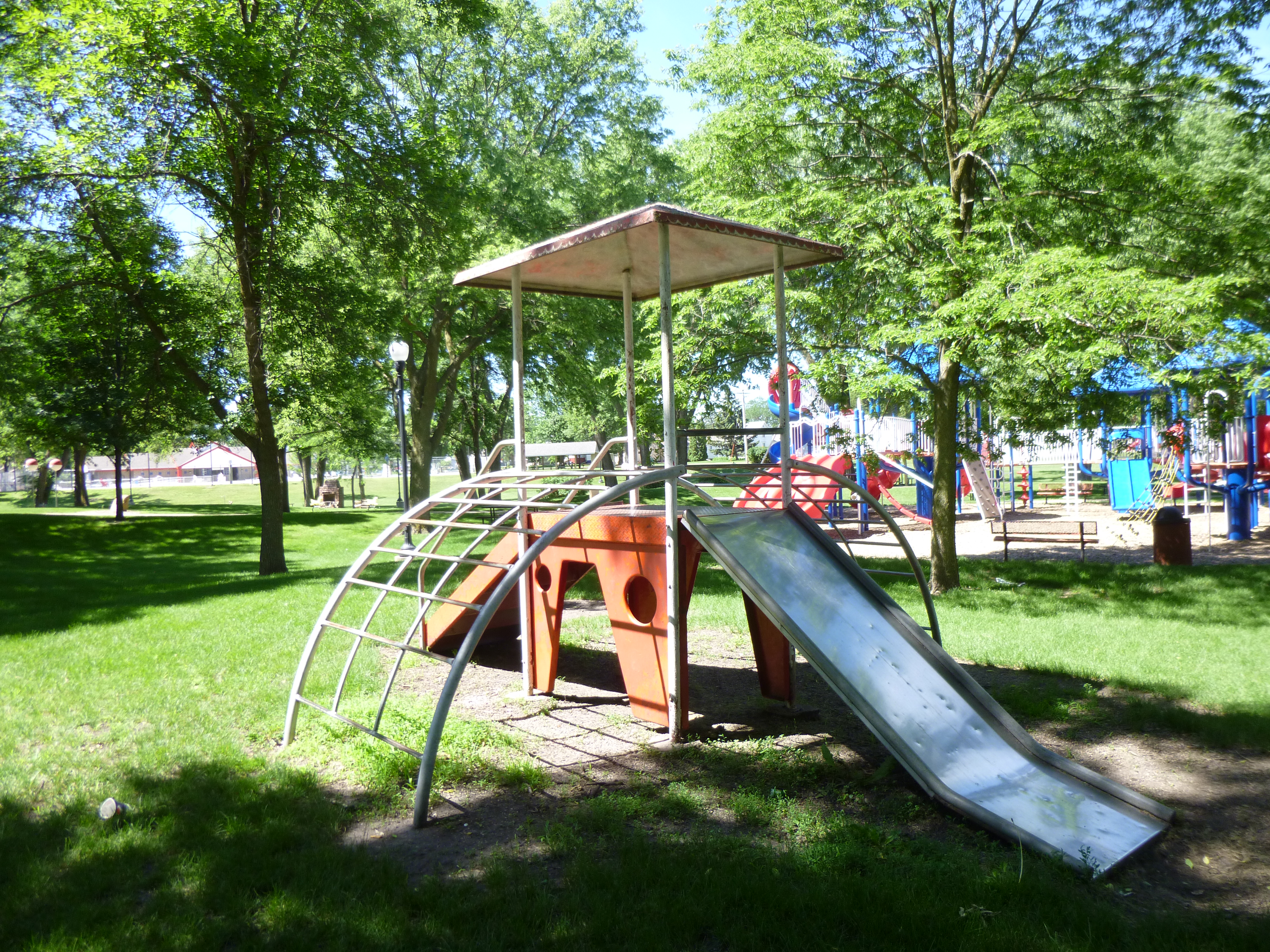
The first Iowa town I came to was Hawarden. I wasn’t really planning to stop there, but I passed a pretty park and figured it would be as good a place to start walking as any! Tula and I set off through the park, and nearly right away I came across some old-style playground toys that transported me back to my youth and lots of time spent in Pembroke Park and Eton Park. I hadn’t seen old metal slides with bumps in them for ages! They stand there and bake in the summer sun and the metal used to get so hot! And there was another 4-sided slide/monkey bar sort of thing, with metal steps and metal bars – I don’t know how we played on some of that stuff in summer as kids! The park did have “modern” playground equipment too, which is where the kids were – it was all colorful and hard plastic so it didn’t get hot. And I’m sure it was much safer than the old-time playground equipment! But it was fun to see the other stuff and think about those days! Tula and I walked a couple miles, and then I put her back in the van, and I walked a couple more through town and the neighborhoods. As with most of these small towns, the end of town is anchored by big grain elevators and other agricultural buildings. Altogether I walked 4 1/2 miles in Hawarden.
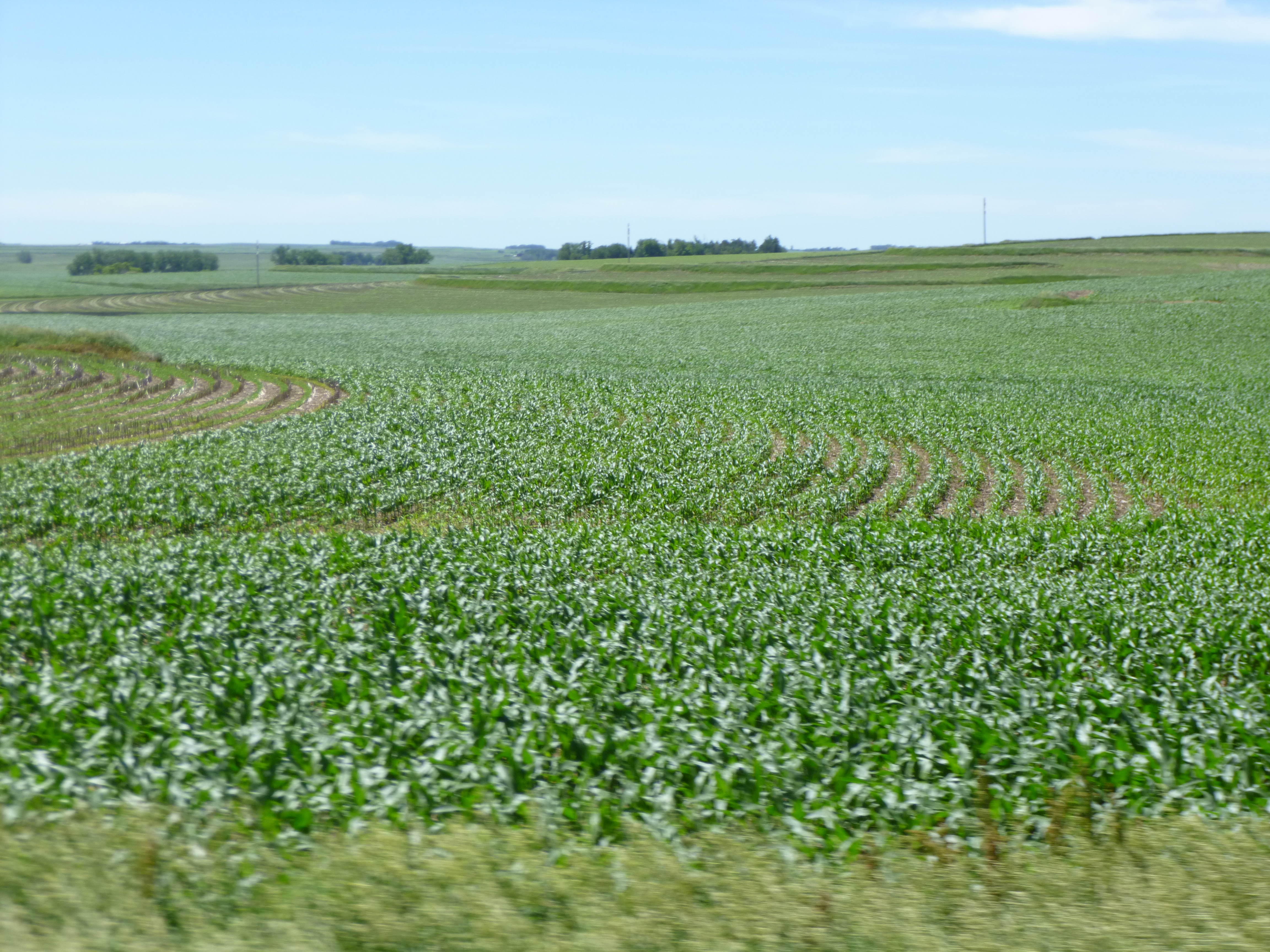
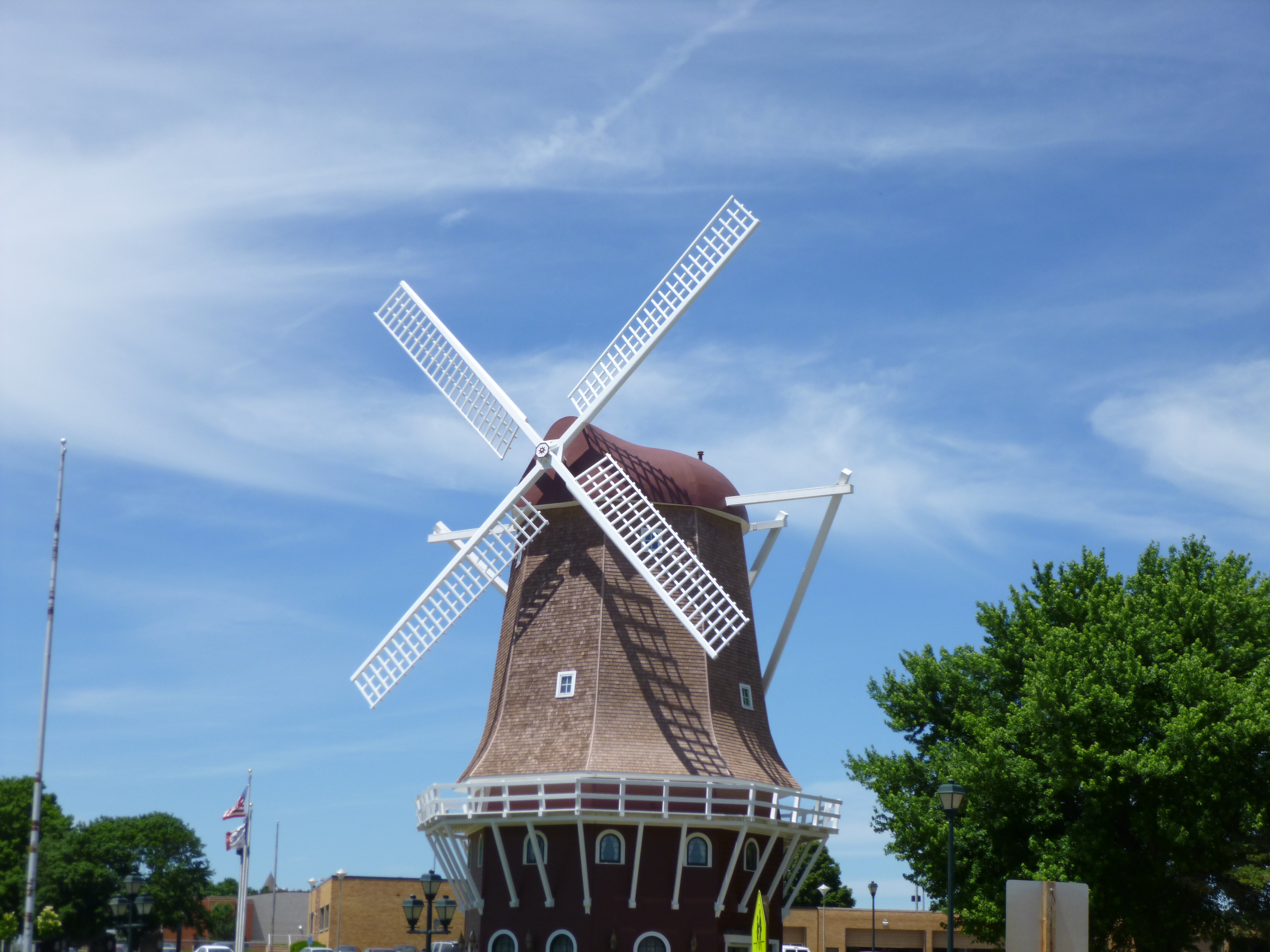
Next up was Orange City, which wasn’t very far away. Its visitor center was located in a windmill, and this town has a lot of Dutch history, including a big tulip festival that was held a few weeks ago, and an old wooden shoe factory that is now a different shop. Orange City was a beautiful town for walking, and I spent more than an hour walking through town, seeing Dutch shops and walking through tidy neighborhoods. There’s some kind of tree here with small lily-of-the-valley sized flowers, and they really make the air fragrant – it’s kind of a familiar smell, but I couldn’t place it. By this time I was starving, and Tula and I took our picnic lunch (leftover chicken and potato salad from last night) into the park, where there was also a display of small scale-model size windmills. I had no idea there were different kinds of windmills for different jobs, and they were used as far back as the 1600s and 1700s. There were windmills for grinding wheat and corn; windmills for sawing lumber; and windmills for draining water (which I didn’t quite understand). I walked 3 1/4 miles in Orange City. This part of Iowa is beautiful. It was a pretty sunny day, and all the land seemed to be green rolling hills – the crops in the fields around here all seemed to be growing abundantly! It was like storybook farm country!
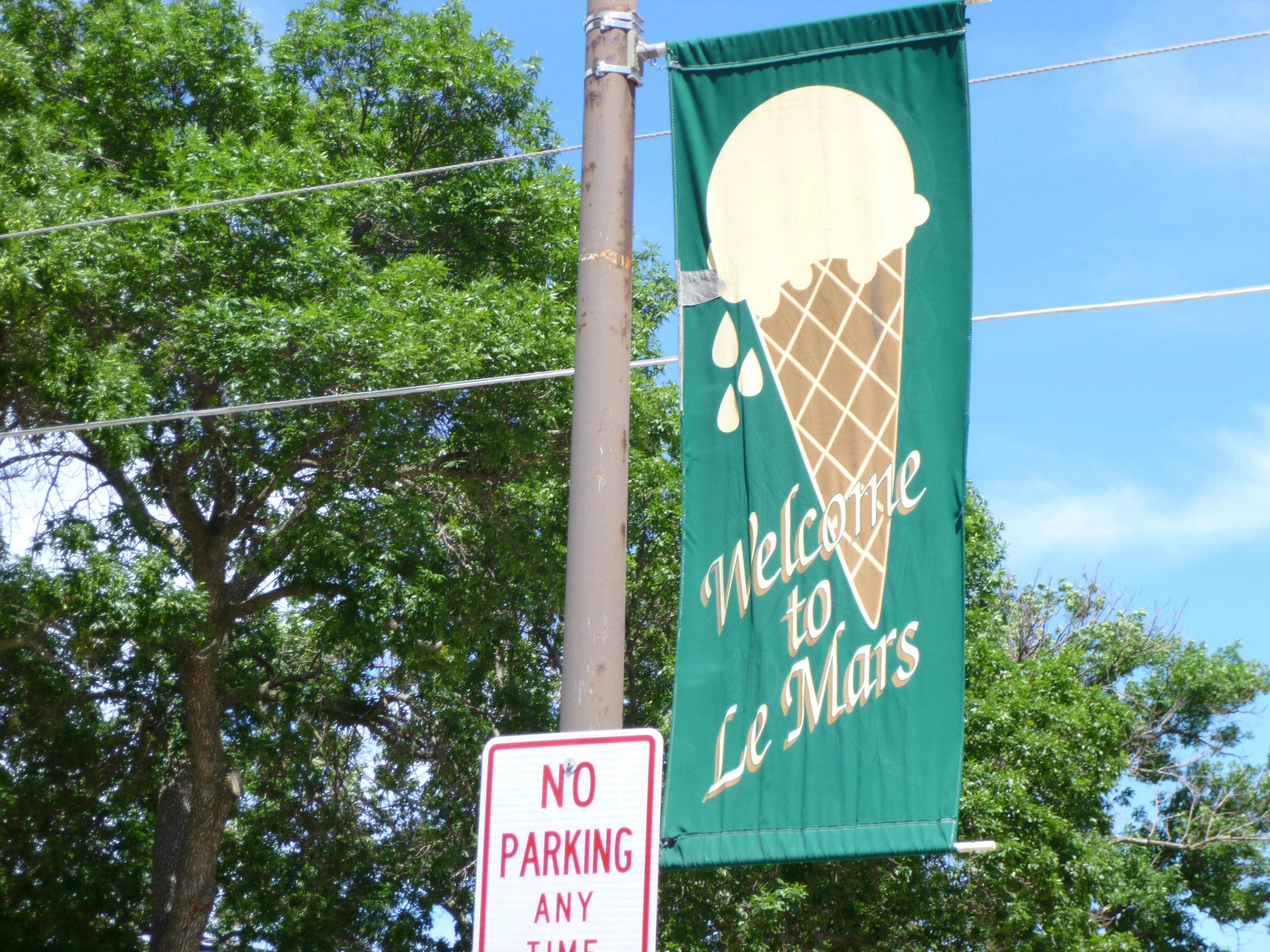
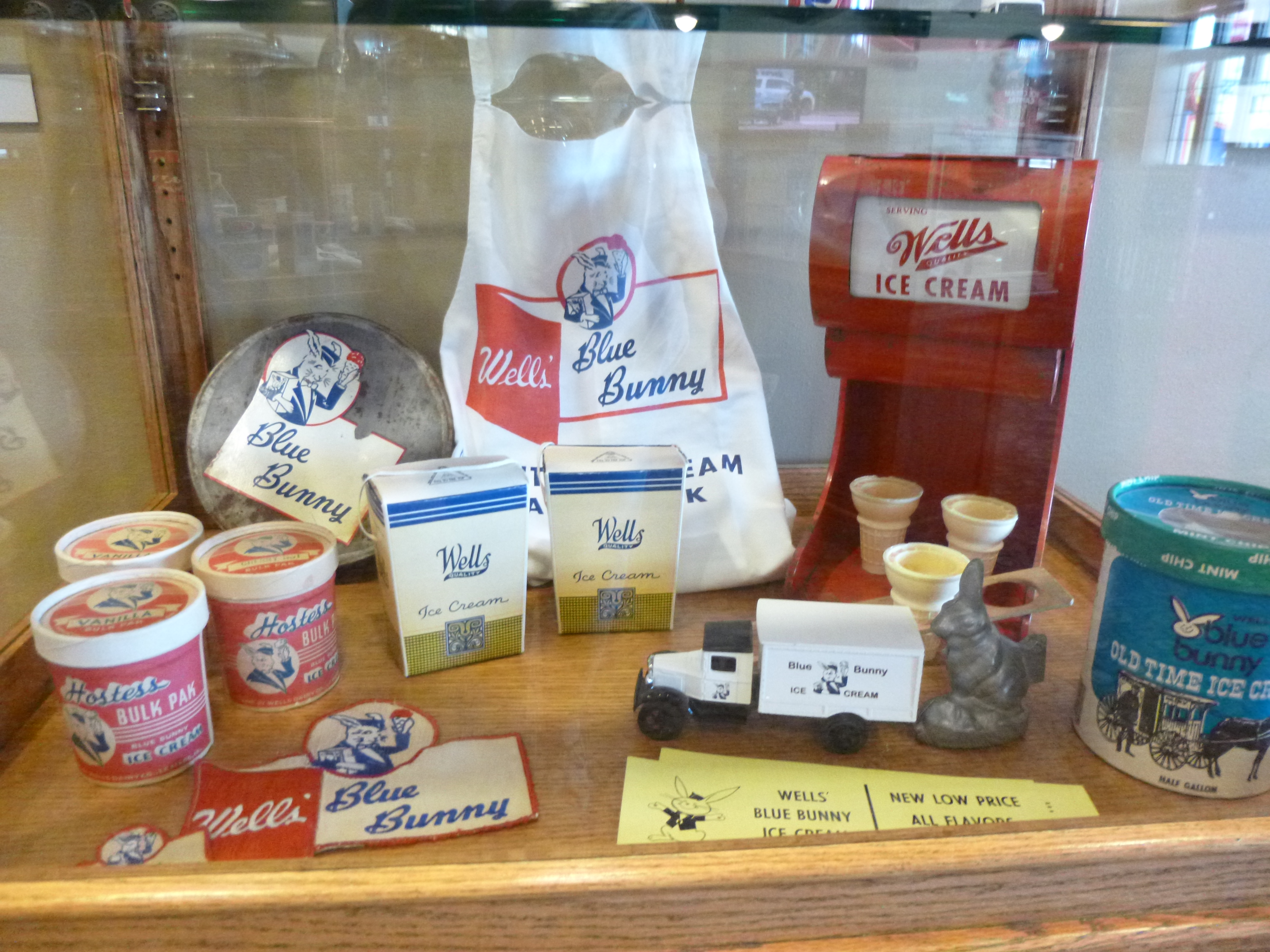
And then I was off to Le Mars – the ice cream capital of the world! The Blue Bunny ice cream plant is located here, and they produce over 100 million gallons of ice cream a year. I can’t even comprehend how much that is! Tours of the dairy are no longer offered for health/sanitary reasons, but of course there was a Blue Bunny ice cream shop in town, complete with small museum and souvenir shop. The street corners have ice cream cone statues, painted in different designs by different groups. Tula and I walked over 1 1/2 miles in town and that was my total of 9 1/2 for the day, to make up for my shortfall yesterday. When I was done with the walking, I visited the ice cream shop of course! I looked around the museum, and then got one scoop of chocolate chip ice cream (which is getting harder to find – most of it seems to be chocolate chip cookie dough). I thought they made a mistake and gave me a double or triple scoop – their definition of a scoop is huge! But it was very tasty.
Despite walking all around 3 different towns, nothing popped up as a donation opportunity in this area, so I went back to the website for the Food Bank of Siouxland, and saw that one of their programs is the Mobile Pantry Program, and that’s how they help a lot of these smaller rural towns. I called someone there and left a message, but I never heard anything back, so I simply mailed in a donation to them, along with a note specifying the donation was for the Mobile Pantry, and I told them the towns I visited, so maybe the donation can be used for people in those towns.
At this point, my time in Iowa was complete. I had walked all 56 miles, and made all 7 donations – Friendly House, Lutheran Church Food Pantry, Nordic Dancers, Honor Flight, Miracles in Motion, Fresh Produce Program and Mobile Pantry Program.
When I was done with everything, I made the drive back to Beresford, and spent a little time with Sandra as she was sorting through my aunt’s house, and then had a quick bite to eat with her and Jay. We then went to visit my Aunt Gloria in the local nursing home, and it was a real good visit. Like many patients there, there are good days and bad, and she was having a good day, so that was a fun way to end my full day. Then I spent the night at my dad’s house again. Tomorrow I’m off to State #39!












Iowa – Tuesday, June 25
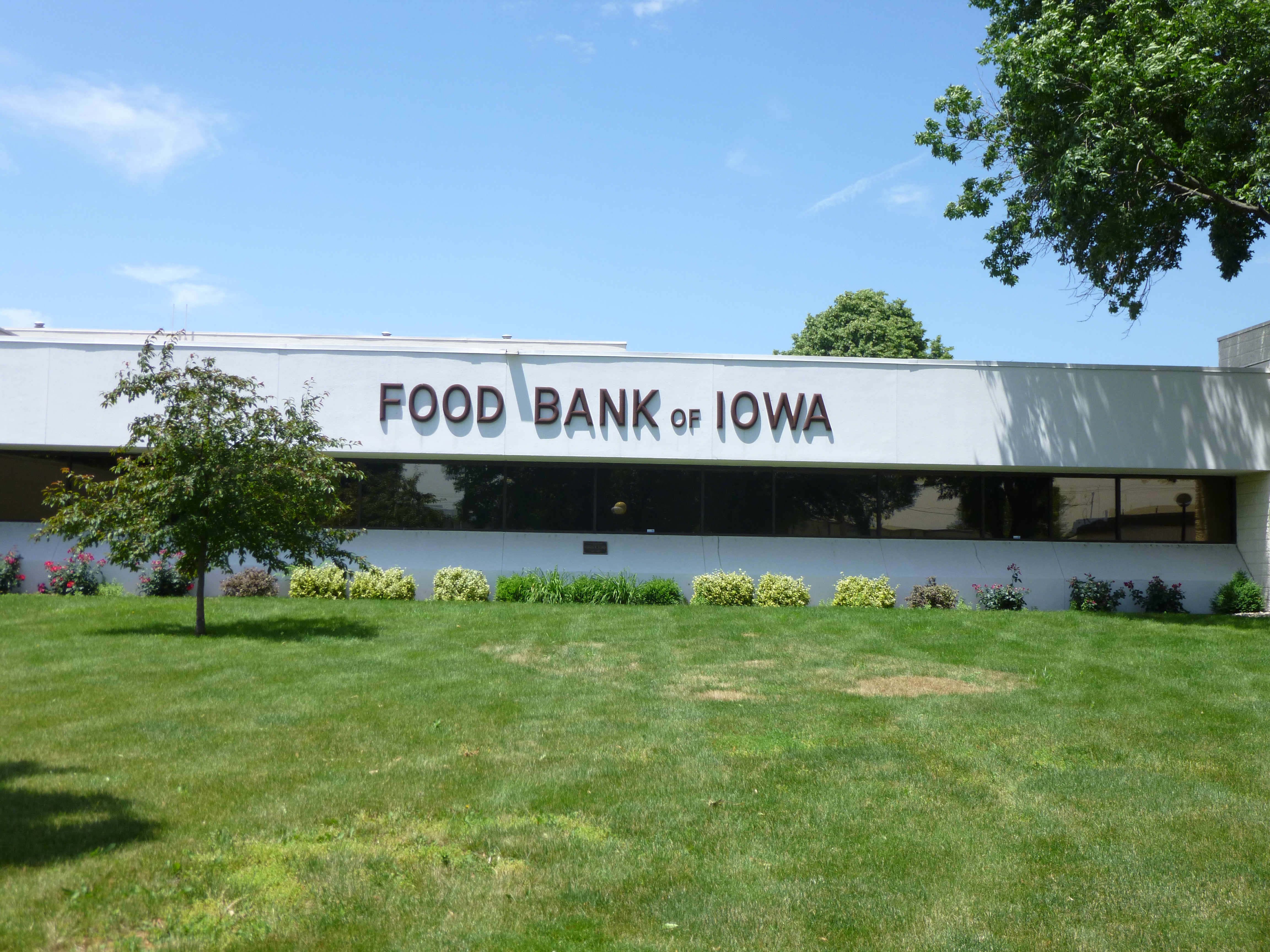
The first thing I wanted to do today was take care of my donation, and for that I had to drive west to Des Moines. I was going to make a donation to the Food Bank of Iowa, and when I was reading about them this morning, I saw one of the programs they’re affiliated with is called HUSH, for Help Us Stop Hunger. I read that it’s a program where hunters can hunt for extra deer, which is then processed, and the meat is given away through the various food pantries, so not only does it help control an overly large deer population, it helps feed hungry people. So I called them to ask a few questions about that program, and also about their “Putting the Brakes on Hunger” program. In the end, I made a donation to their Fresh Produce Program instead! It took me a little while to get to the food bank, and when I arrived I met Carey, Lindsay and Stacey. Carey answered my questions about the HUSH program, which is administered by a different agency (a DNR sort of program; whichever one issues the deer permits). The Food Bank of Iowa manages the distribution of the venison through their many food pantries, but since they don’t actually manage the program, it would have been complicated for them to take a donation for it. But she told me this has been going on for a number of years – hunters can buy an extra deer permit so that they are all taken legally, and then the hunters take those deer to a participating processing place, which processes all the venison into hamburger and it’s packaged in 2# bags and frozen. At first people weren’t quite sure if they wanted ground venison in their freezer – but the food pantries started providing recipes and other suggestions, and now the venison flies out of the freezers when it arrives. Even though I couldn’t make a donation to that program, I still think it’s a really good idea. I don’t know if my home state of Michigan has any programs like that – I’ve never heard of any and Michigan has a high rate of car/deer accidents due to overpopulation. I’ve often thought about this as far as goose hunting too – there’s too many geese and a lot of hunger, but the goose meat might be a tougher sell than the venison! It’s food for thought though!
Carey then showed me around the whole facility while telling me about the different programs. This food bank partners with a couple hundred food pantries in many counties to help provide food to those who need it. Last year they passed out 9 million pounds of food! Even though they get a lot of corporate food donations, they welcome smaller donations as well – every little bit helps. She told me about another type of program which I hadn’t run across yet, and that was the Fresh Produce Program, and I thought it was an awesome idea. There’s a big correctional facility in town, and last year they partnered with the food bank to start providing fresh produce from a garden at the correctional facility. They have a 12 acre garden there, which is huge, and the pre-release inmates have to fill out a job application if they want to work on this project, and they have to show up for scheduled hours of work, and not only is it helping the inmates with job skills and responsibility, but their hard work results in a lot of fresh vegetables for hungry people. Last year they successfully planted and harvested cabbage, onions, and squash among other things, but didn’t have luck with the carrots! The food bank provides the equipment, and seeds, and fuel for distribution efforts, and I really liked this program, and that’s where my donation went today. Again, it’s a program that helps everyone involved on both ends, and there should be more of those! Once Carey had shown me around, the others met us in a conference room and we chatted a bit – they had questions about my journey and I had a few more questions about what they do. I was there for quite a while and it was really interesting.
And then I had to hit the road. Since the northwestern side of Iowa shares a border with South Dakota, and my dad lives fairly close to the border, I was going to be staying there tonight, and having dinner with Dad, Joan, and cousins Jay and Sandra. I was a little farther away than I thought, so I got on the freeway, and drove to the town of Elk Horn, where Tula and I got out for some walking. Elk Horn was settled by Danish people, and it’s still considered to be the largest rural Danish settlement in the country. The most well known feature of the town is a big windmill that they shipped over from Denmark. There’s a surprising amount of billboard advertising about the town and windmill, and the town didn’t seem all that big, considering all the hoop-la! I did 3 1/2 miles of walking there, and decided to use the extra 3 miles I had walked in the last couple of days, bringing me up to 6 1/2 for today. I didn’t have time to walk the other mile and a half, and will do that tomorrow because I won’t have nearly so much driving time.
From Elk Horn I mostly stayed on the freeways to Beresford, South Dakota, where it was fun catching up with family and we all enjoyed a summery meal of fried chicken, potato salad and fruit salad.






Iowa – Monday, June 24
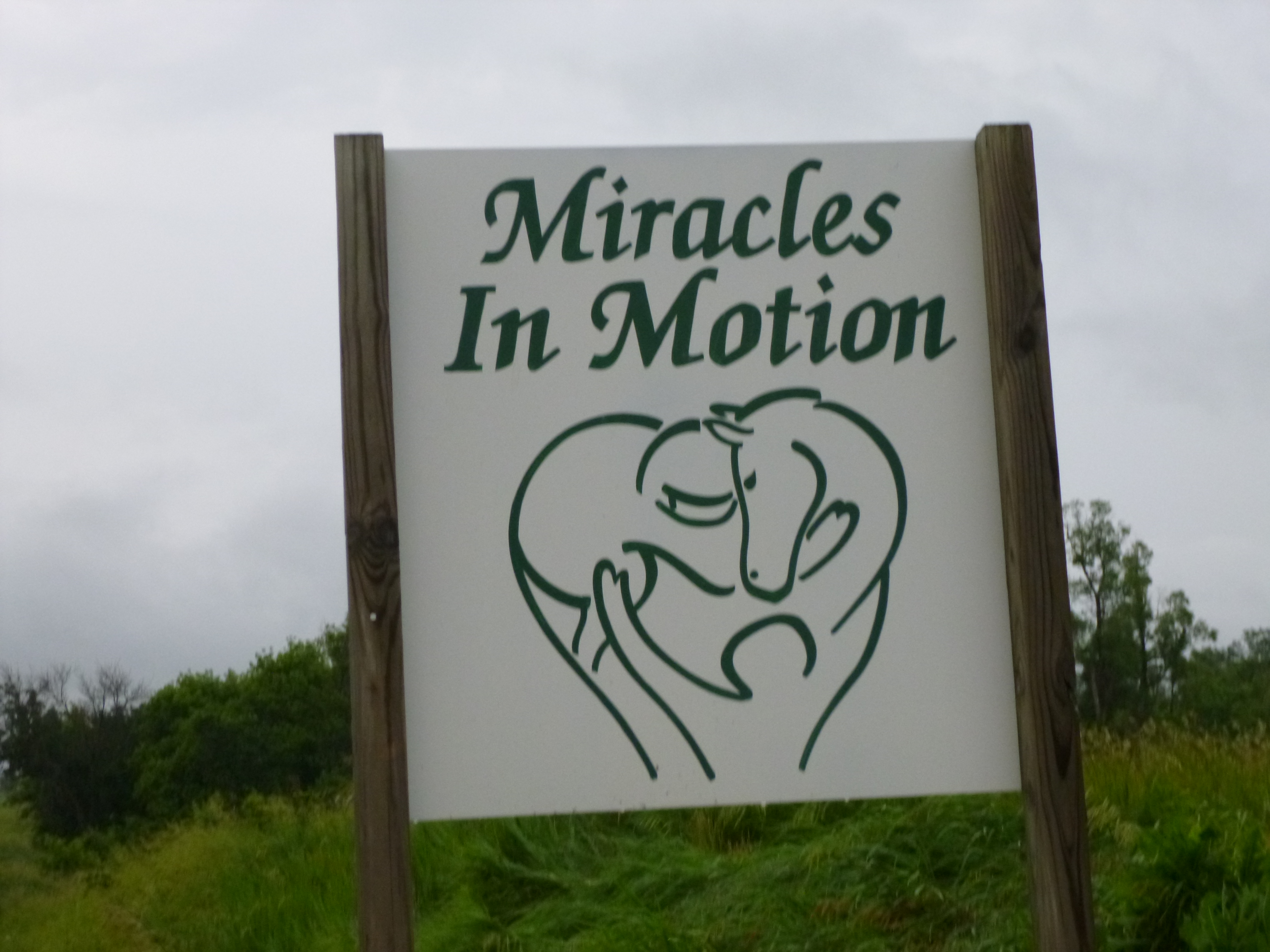
It was another soggy morning when I got up, but I loaded up the van during a lull in the rain, and headed over to the little town of Swisher, where I was going to visit the Miracles in Motion stable and watch some classes. I had talked with Cheryl, their community outreach person, late last week, and she told me the times of the classes this morning. I wasn’t sure if the classes would be happening in the rainy weather, but they weren’t too far away so I drove out there anyway. And everything was going on as usual. Cheryl met me, and I watched the class in progress. The morning classes were hippotherapy classes, which meant that either an occupational therapist or a physical therapist was conducting therapy while the kids were on horseback. One of the therapists, who has been working with people for 30 years, said hippotherapy is one of the strongest forms of therapy, because in addition to doing therapy exercises, the kids are also unwittingly using back and abdominal muscles while sitting on the horse, and the physical act of sitting on a horse is beneficial to working hip joints and other areas. So it was interesting to watch the kids and their therapists doing their exercises with rings or balls or other teaching aids, all while sitting on a walking horse that was being led around by one person, with a sidewalker on each side. Plus the regular riding instructor was there. So each rider had the horse walker, 2 sidewalkers, a therapist, and the riding instructor overseeing things. They only have 2 horse/riders out at a time while conducting hippotherapy sessions. And I saw part of 3 sessions. Sometimes the tack had to be changed, and sometimes there’s a change of horse – all depending on the need of the rider. The kids I saw were mostly using a bareback pad to sit on, and they did their exercises while riding facing forward, then facing backward, and even sitting sideways – all of that uses different muscles and different kinds of balance. The kids I saw were pretty young, and could just be lifted up and down off the horse, but they do have a lift to help with adult-size riders. Cheryl also showed me around the barn so I saw the stalls and the very-organized tack room, and met their little miniature horses, who often act as ambassadors for the barn. They have 18 horses there, and they need to be “bomb-proof” – so calm that nothing fazes them. And they were certainly calm! The riders would play catch with their therapist, and the balls didn’t bother them, and a thunderstorm passed through while I was there, and that didn’t seem to bother anyone either. The parents I talked to said their kids love their horse sessions, and some had seen a difference after just one session. One boy dreamed about his horse before his class. They have a wait list of people who would like to participate in their different activities. In addition to the hippotherapy sessions, they also have “Leg Up” classes for disadvantaged kids to have a chance to experience horse care and other opportunities, and regular therapeutic riding classes also. Those would all be happening later today. And they also have a therapeutic cart and driving program as well, which made me think of my old pony and cart! There’s a nice outdoor arena too (we were in the indoor arena of course because of the rain) and they would love to be able to get the place heated eventually so they could conduct classes all year round. They can’t do anything in the winters because it’s simply too cold. There’s also a sensory trail outside, with different objects the kids can reach out to feel – including hanging pool “noodles” to walk through. Miracles in Motion has been around for 25 years, and they started with borrowed horses in a borrowed space, and through sheer hard work, the program has grown into what it is today. They currently have about 180 dedicated volunteers and work with about 170 students a year. I was happy to find them to make my donation-of-the-day. Everyone I met was really nice 🙂
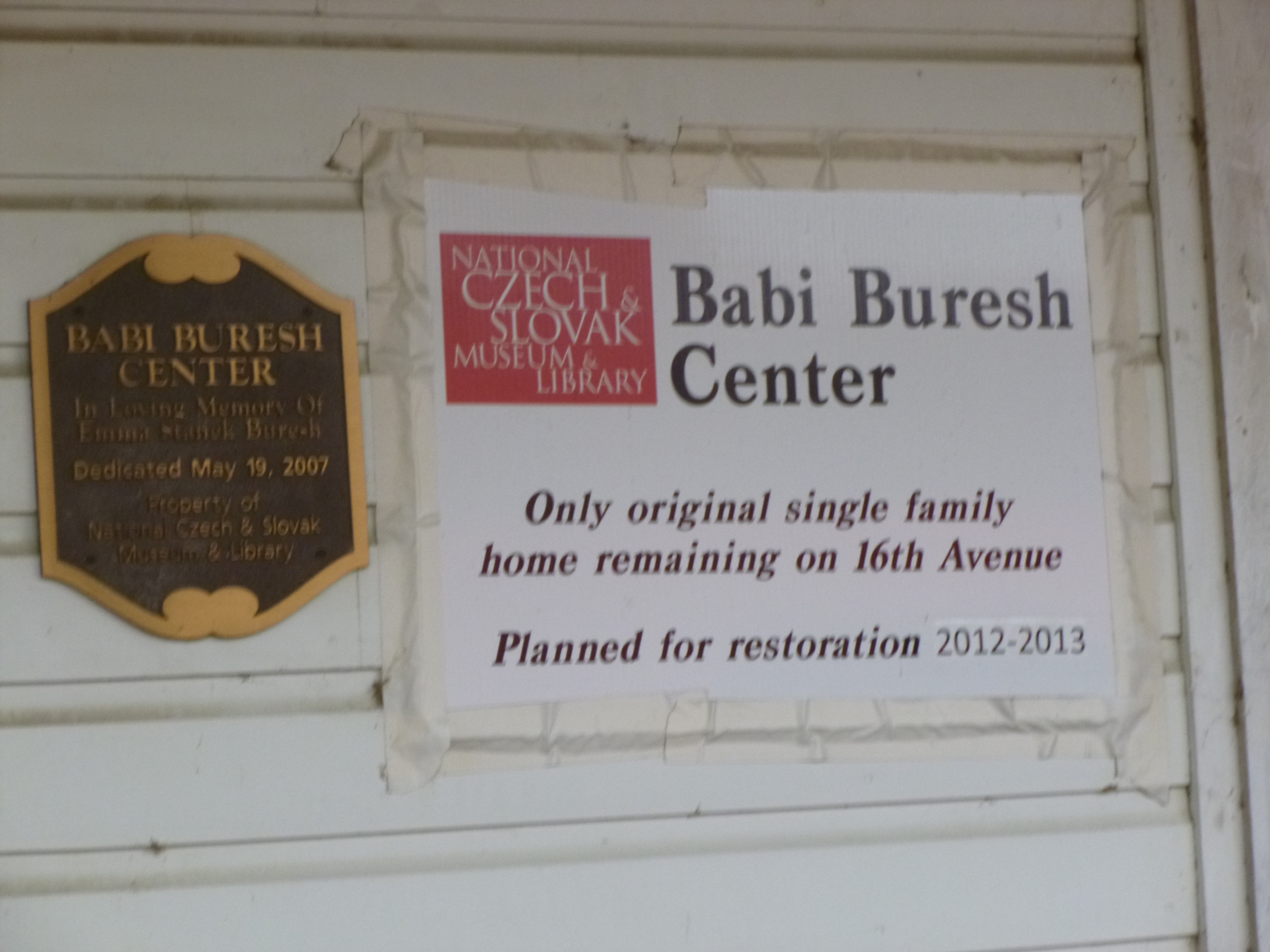
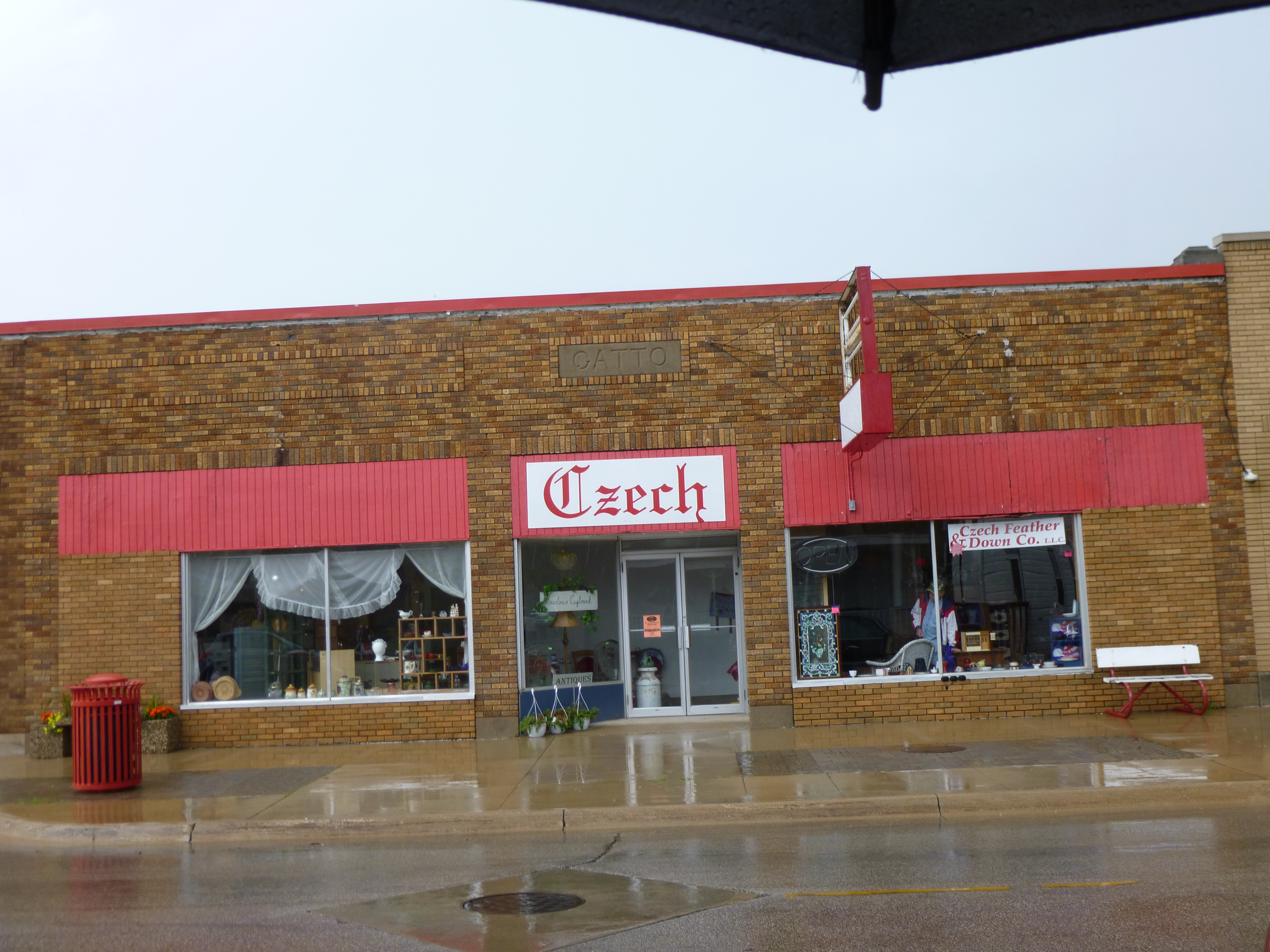
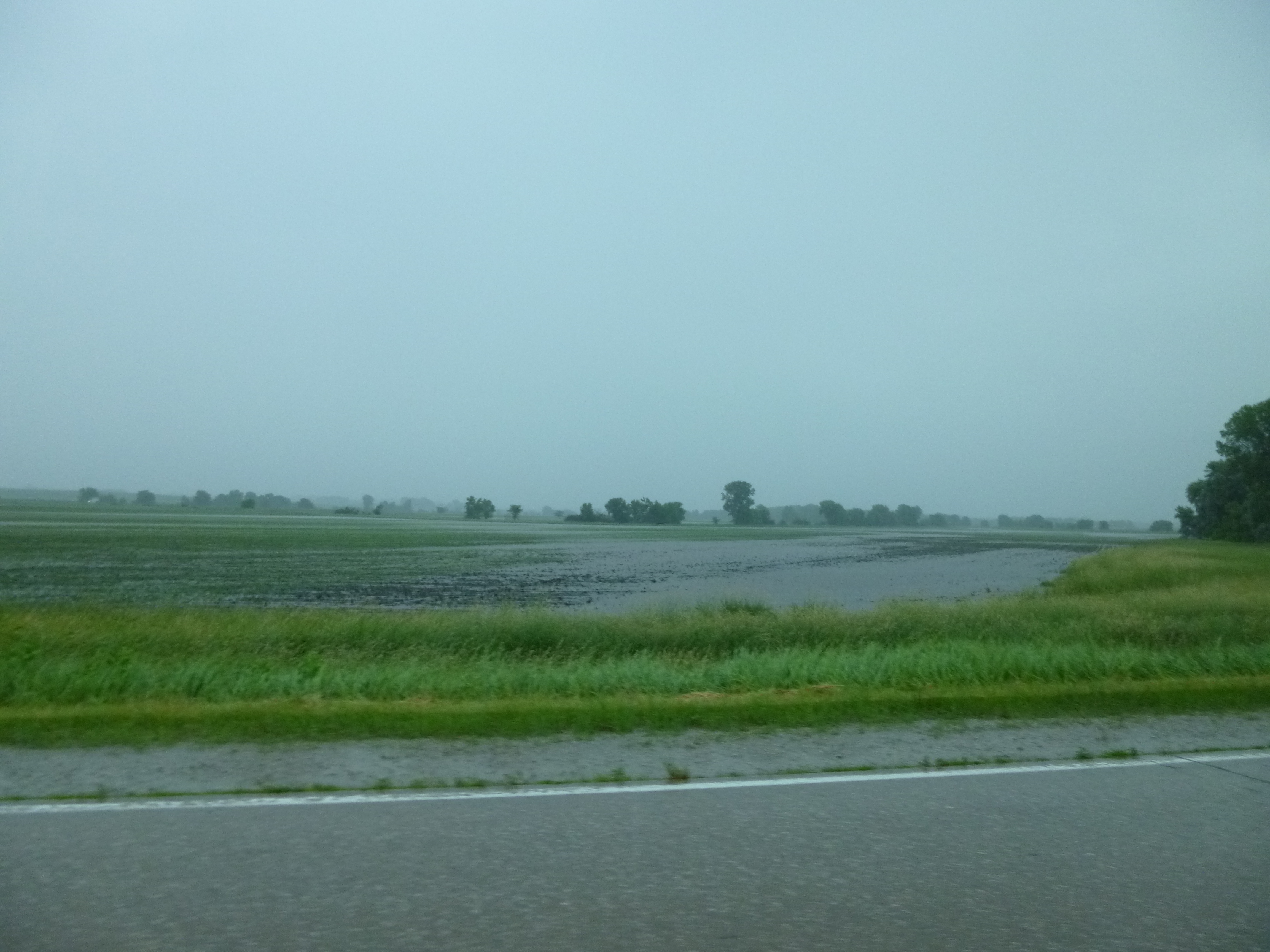
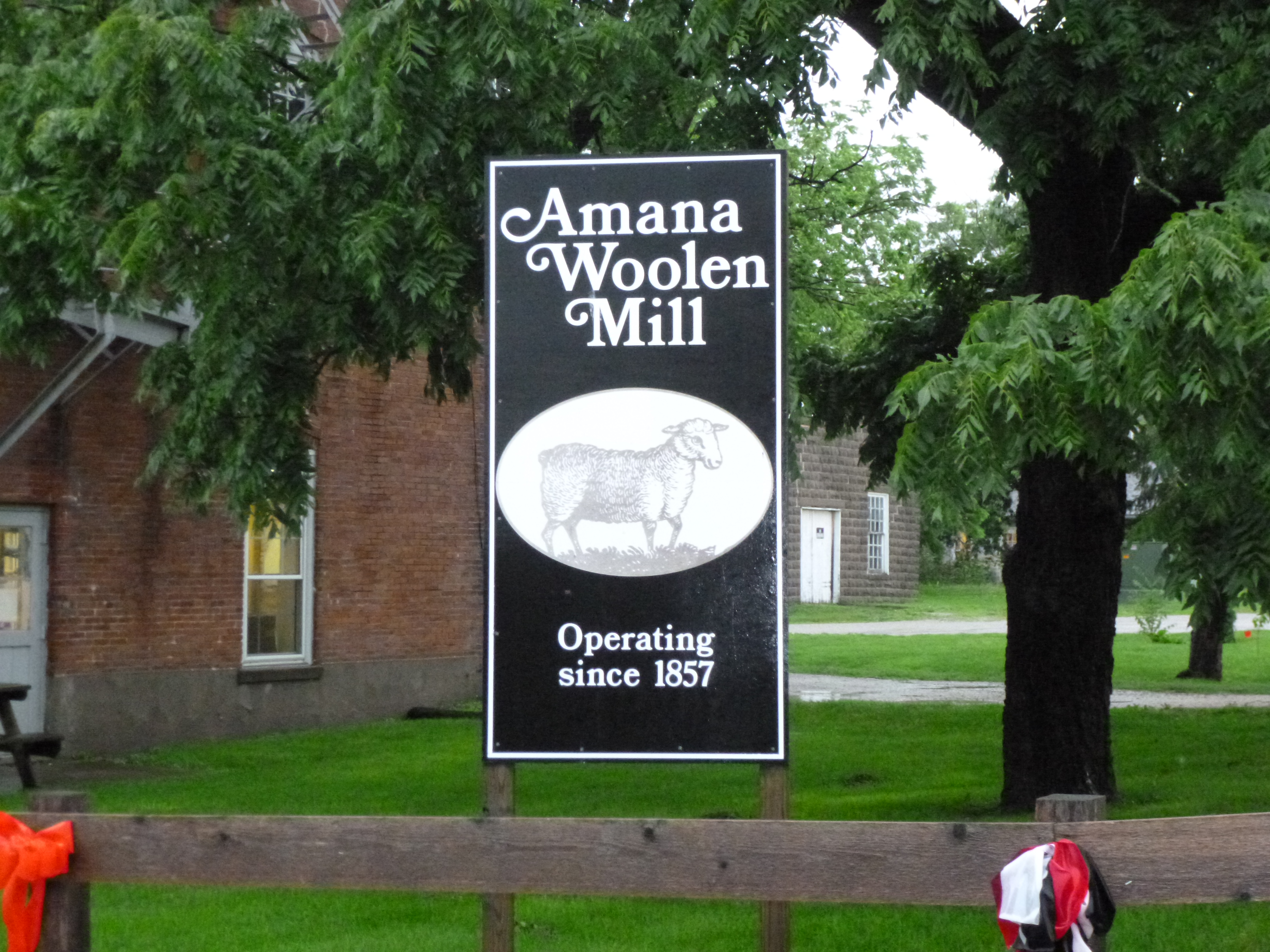
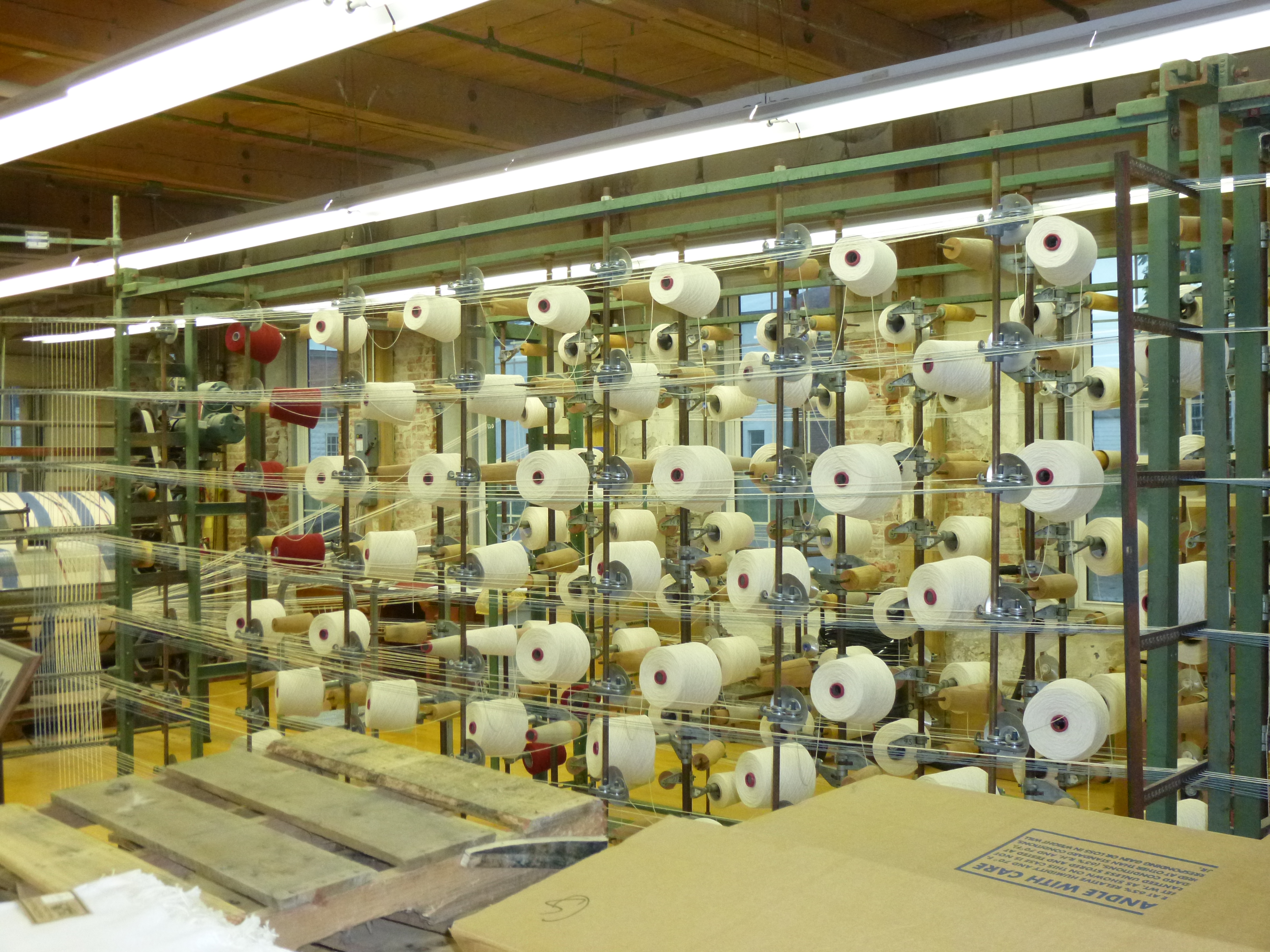
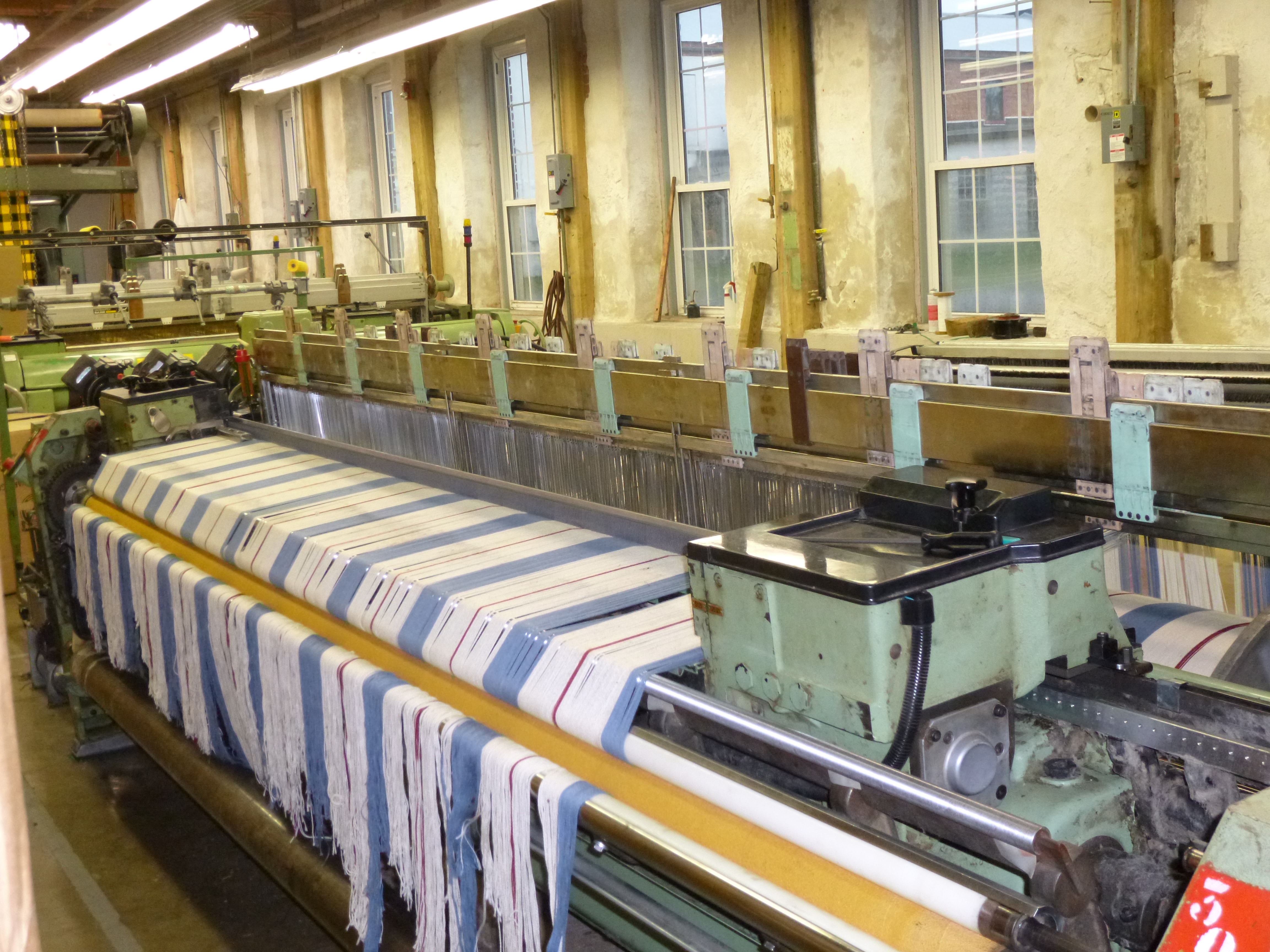
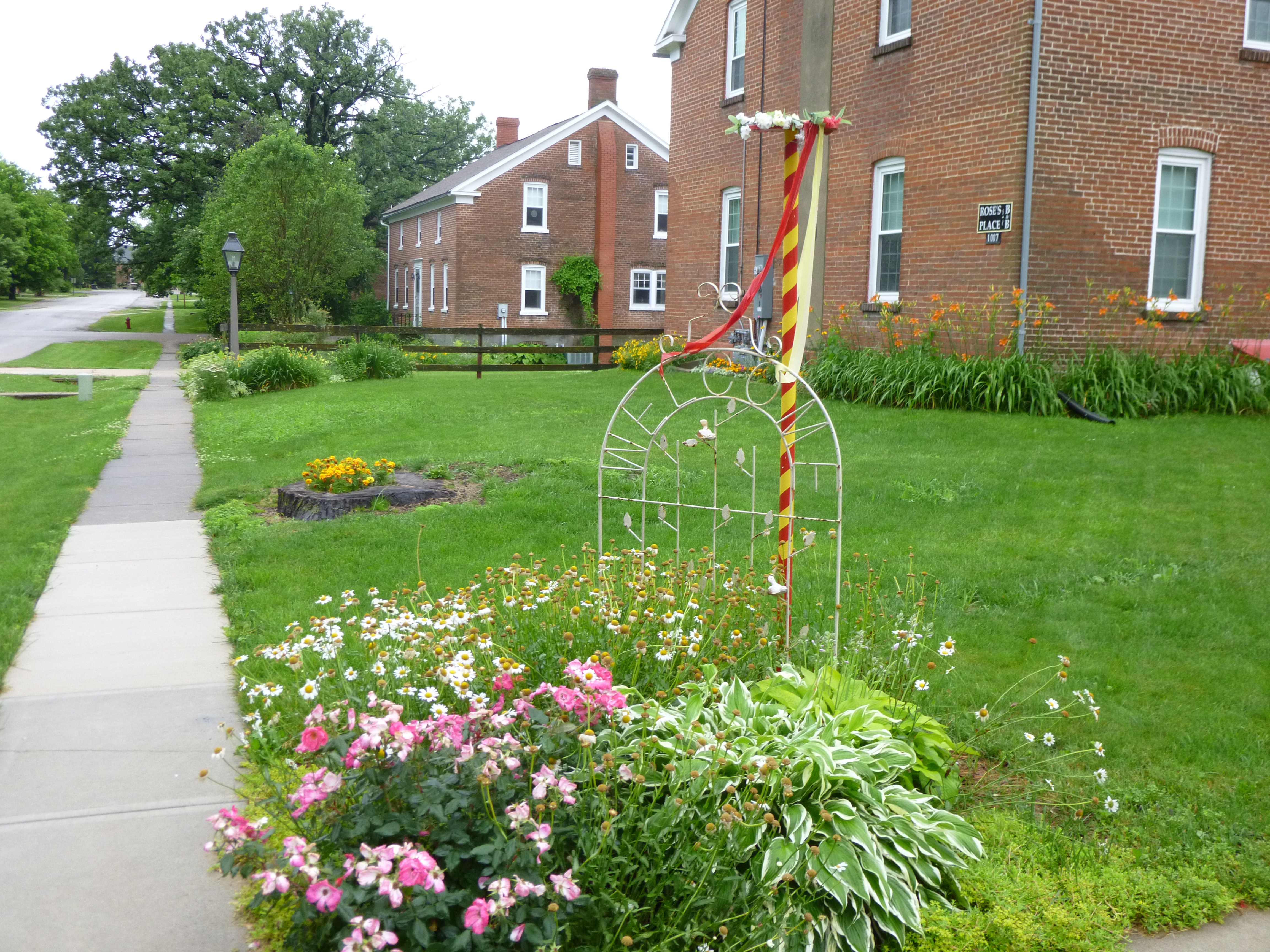
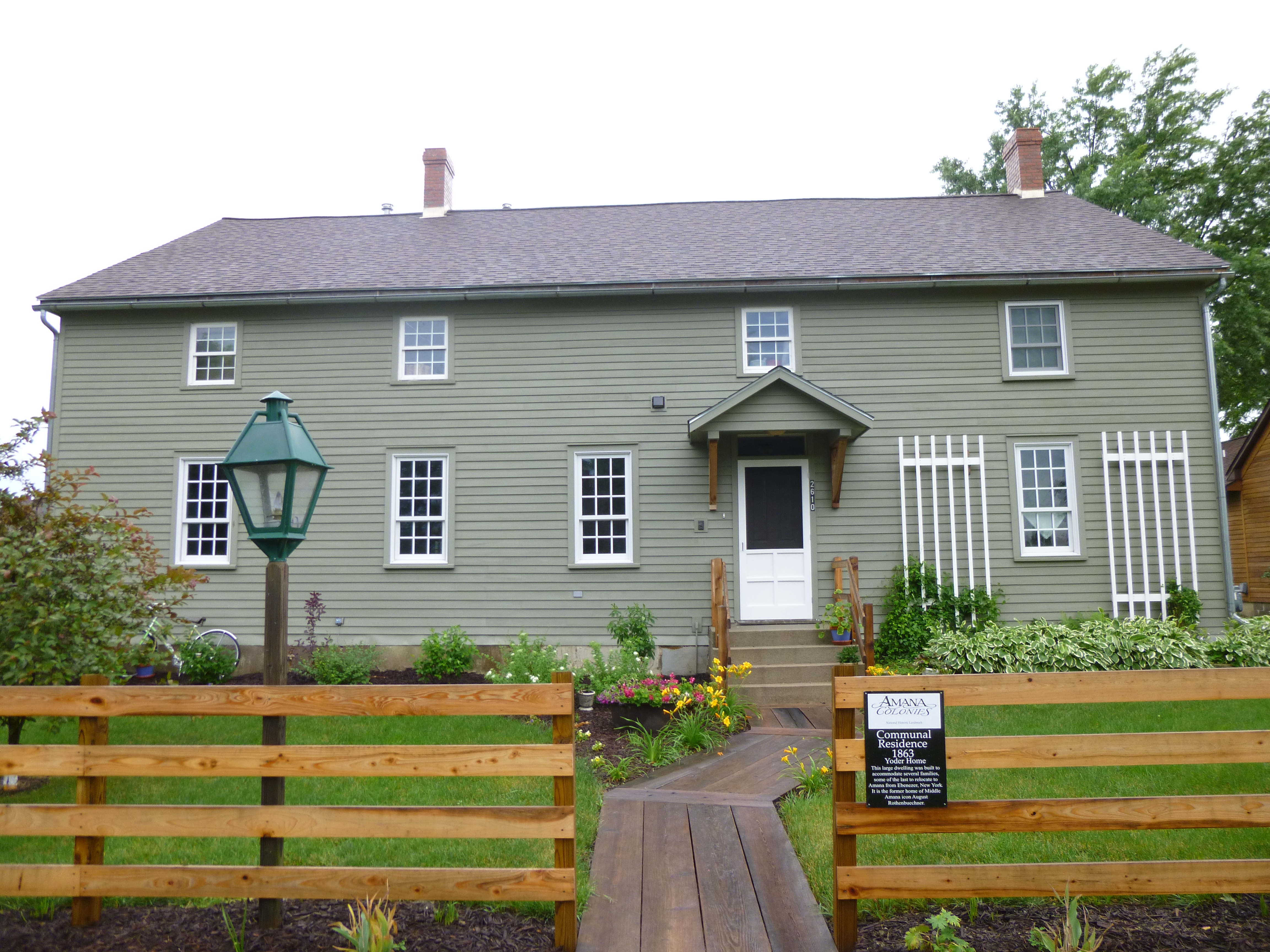
I had spent a couple hours at Miracles in Motion, and it was time to get some walking done. I headed back into Cedar Rapids to the Czech Village part of town, and was only to get about a mile and a quarter of walking in before it started to rain again. So I decided to get in the car and start driving to the Amana Colony villages. But I had to stop along the way at one point because it was raining so hard I couldn’t see a thing. Other motorists pulled over too, and we all waited for the deluge to let up a bit. The farm fields were already so wet that they ended up with pond-sized puddles on them. I got to Amana and did some walking with an umbrella – by then the strong weather had moved off, but it was still wet. In fact, I heard that there were tornado warnings in some neighboring vicinities, but all of that was moving off. I went inside a couple shops in the biggest of the Amana villages, and especially enjoyed the woolen mill, where they weave a lot of blankets and stuff right on the property. The Amana people lived in large homes – several families in each home, but the houses didn’t have kitchens or dining rooms, because food preparation and eating took place in communal buildings. Back in 1932 they voted to move away from the communal sort of lifestyle. I also visited a couple of the other smaller Amana villages, and found a pretty walkway by a lake where I could get Tula out too, so I was able to do almost 4 miles of walking in those different areas despite the weather.
As it continued to clear, I drove on to the town of Grinnell, where my sister-in-law Mickey and her family had lived many years ago. Grinnell was a really pretty town for walking, and it had turned into a pleasant evening, and Tula and I not only finished our 8 miles for the day, but I did an extra mile and a half too. With all the rain and storms, I didn’t think I’d get all my walking done today, but I ended up with extra! It was pretty late at this point, so I just stayed in Grinnell for the night.









Iowa – Sunday, June 23
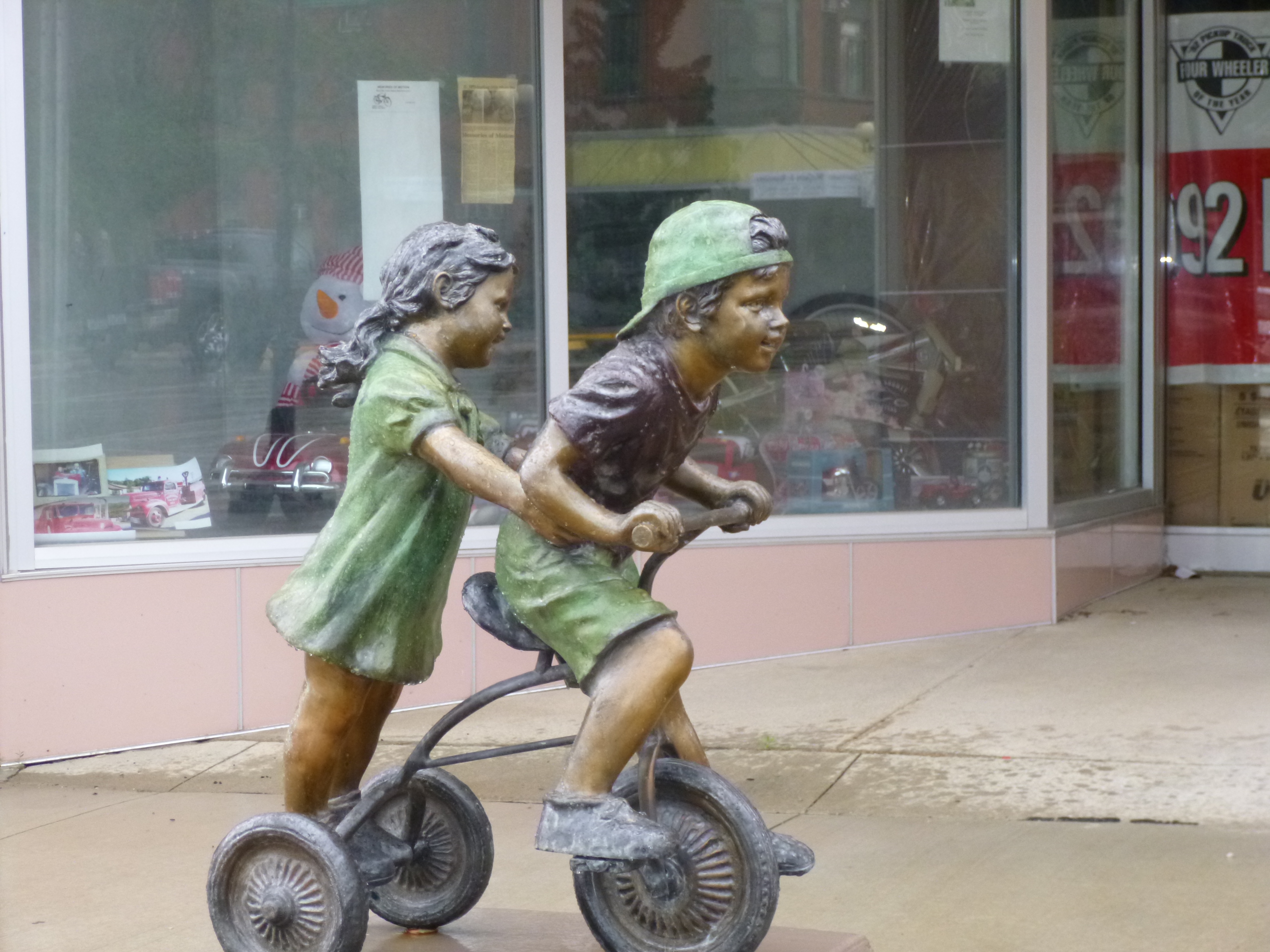
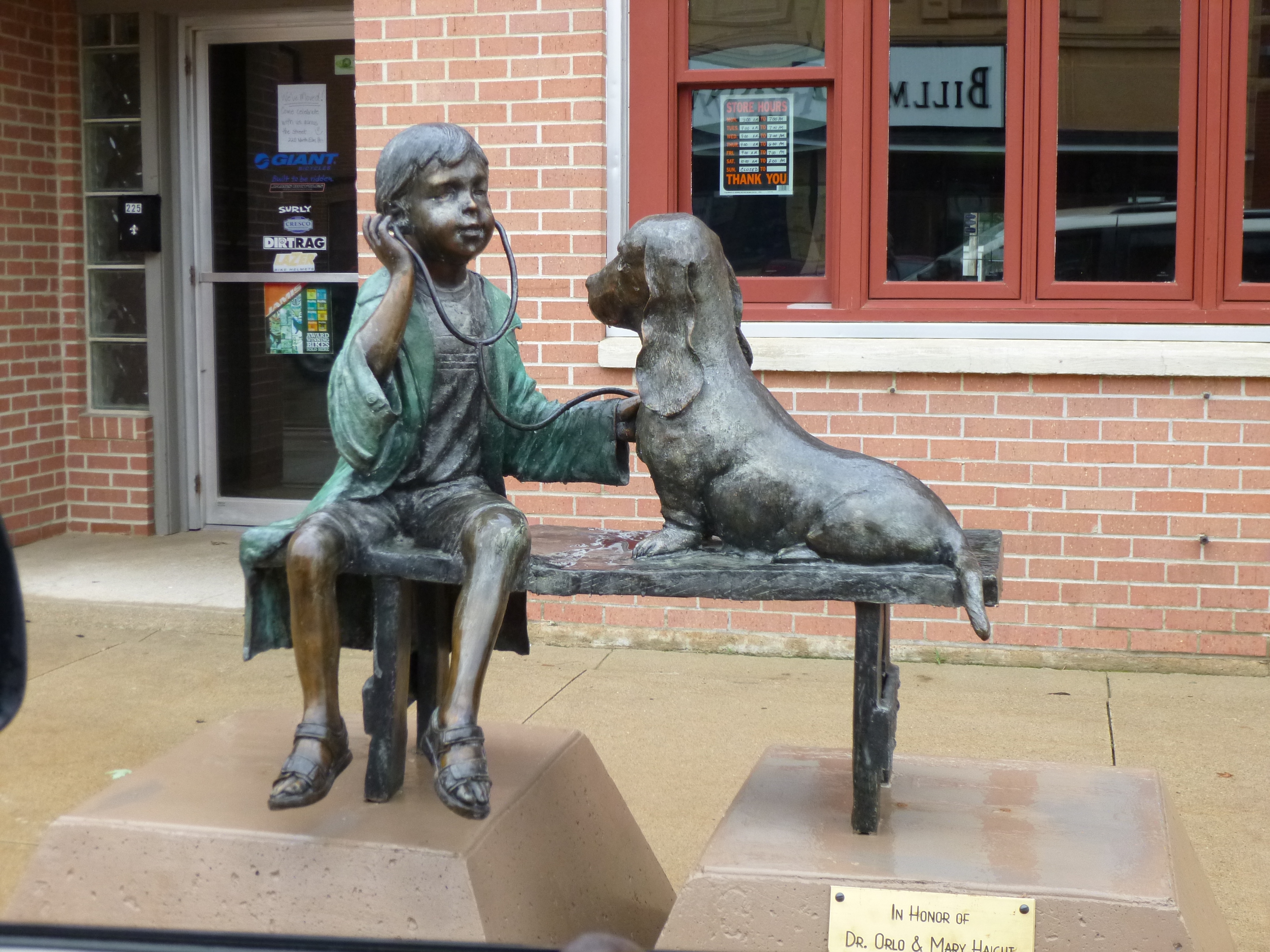
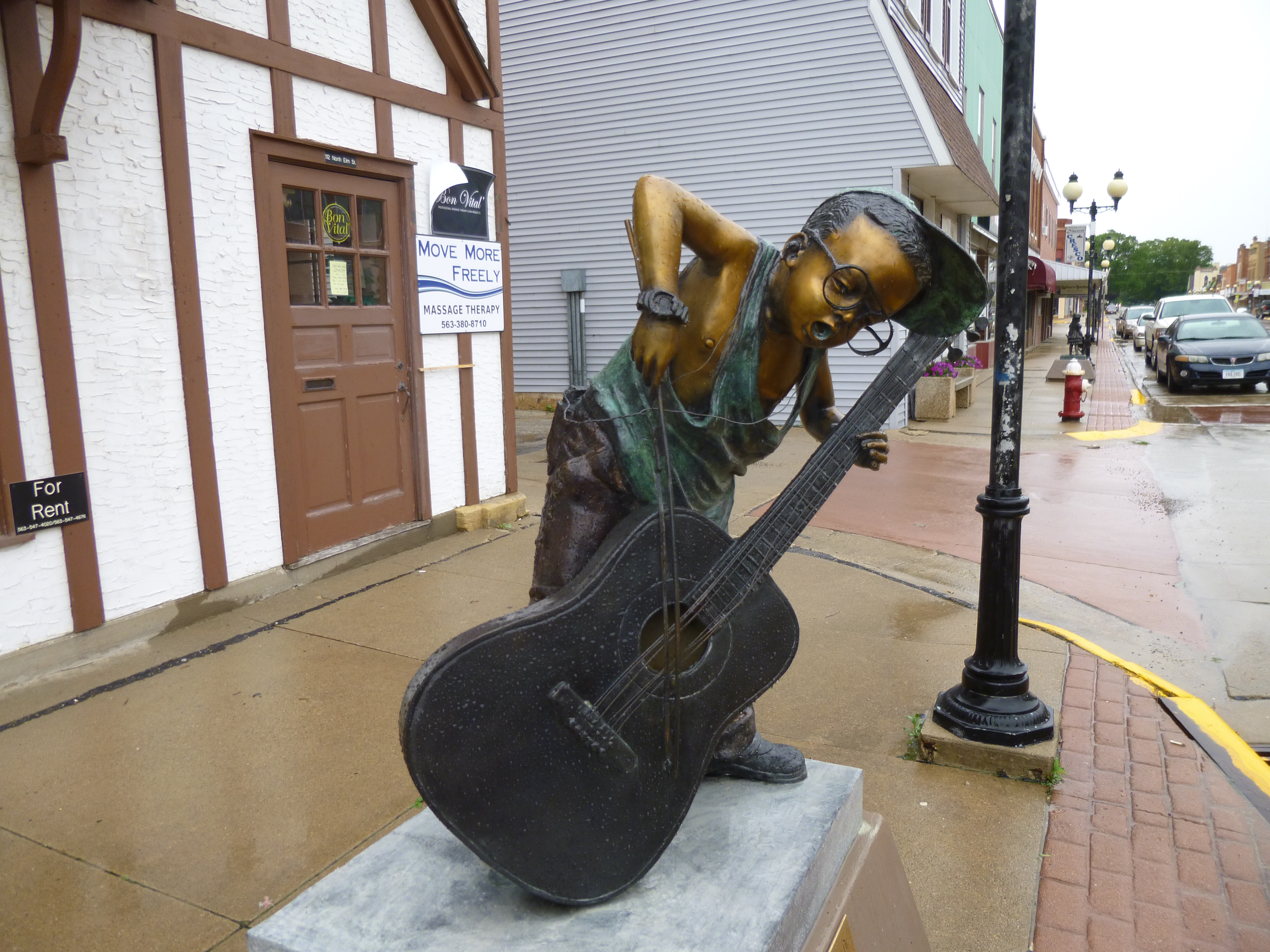
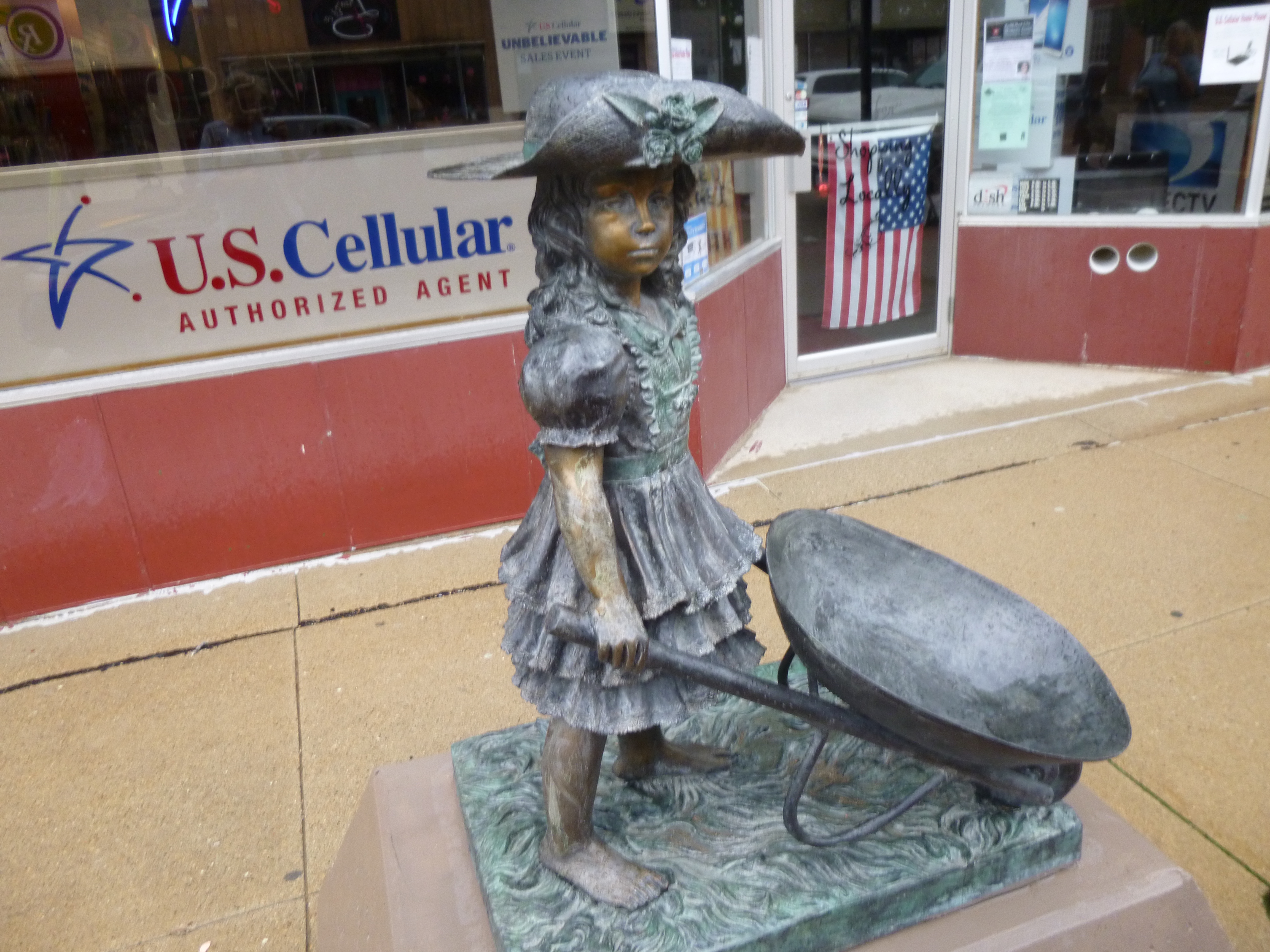
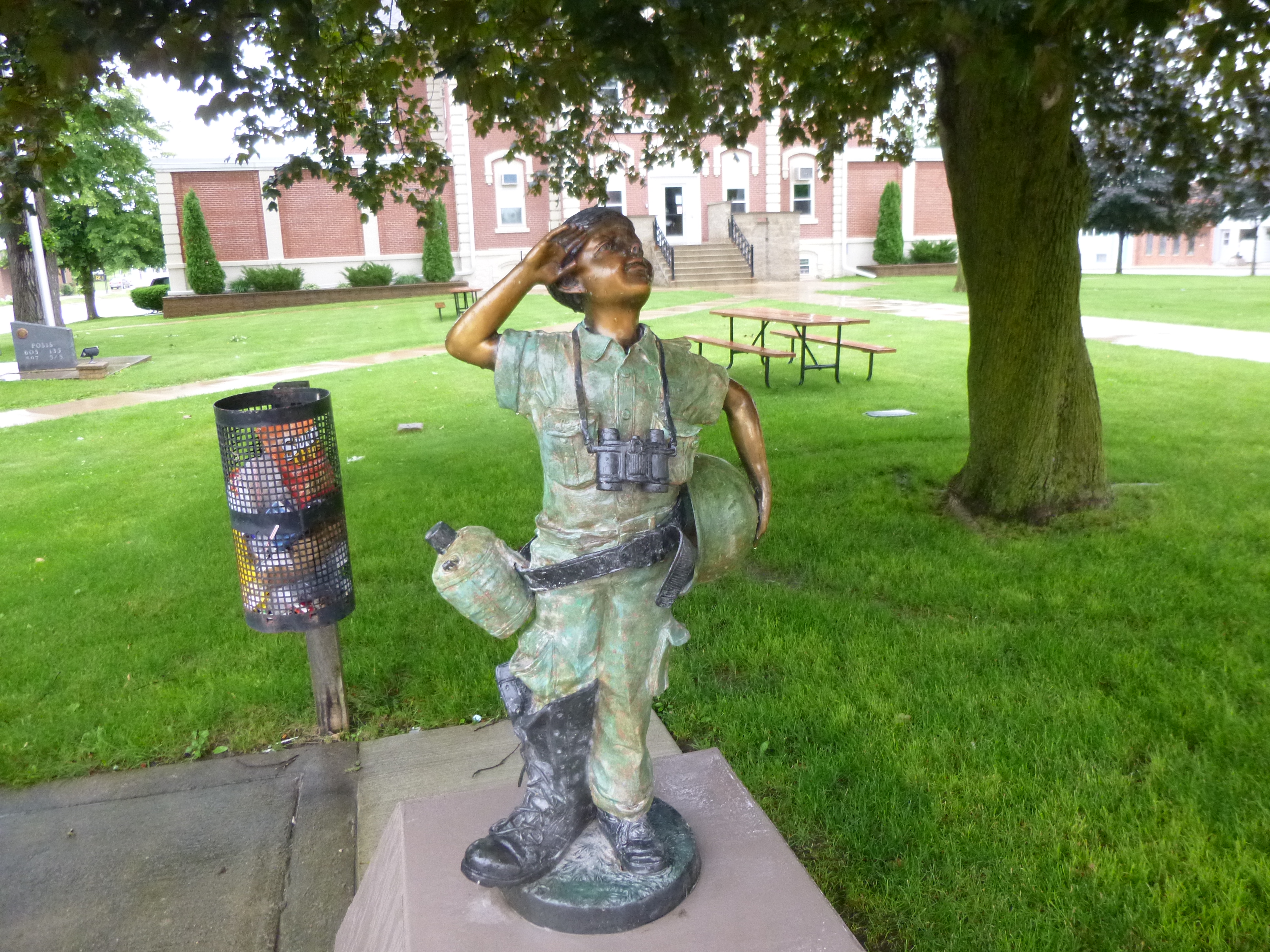
It rained a lot last night, and the forecast wasn’t very promising for today, but since it was quiet out when I got up, I decided to head out for some walking even before I packed up and checked out. It was only a hop, skip and a jump to the town of Cresco, so Tula and I did some walking right in town and started to walk through one of the neighborhoods, but then it started to rain a bit, and I didn’t want Tula to get soaked. So she went back into the van, and I got my umbrella and continued on. The rain came and went and was never too bad, so I ended up getting 3 1/2 miles of walking done. Cresco was a good town for walking, and the downtown area had about 10 cute statues of kids from the 50s/60s that were really well-done. They looked as though a puff of fresh air could breathe life into them! Then I had to head back to the motel to pack up and check out. It began to look as though the day would clear up a bit after all.
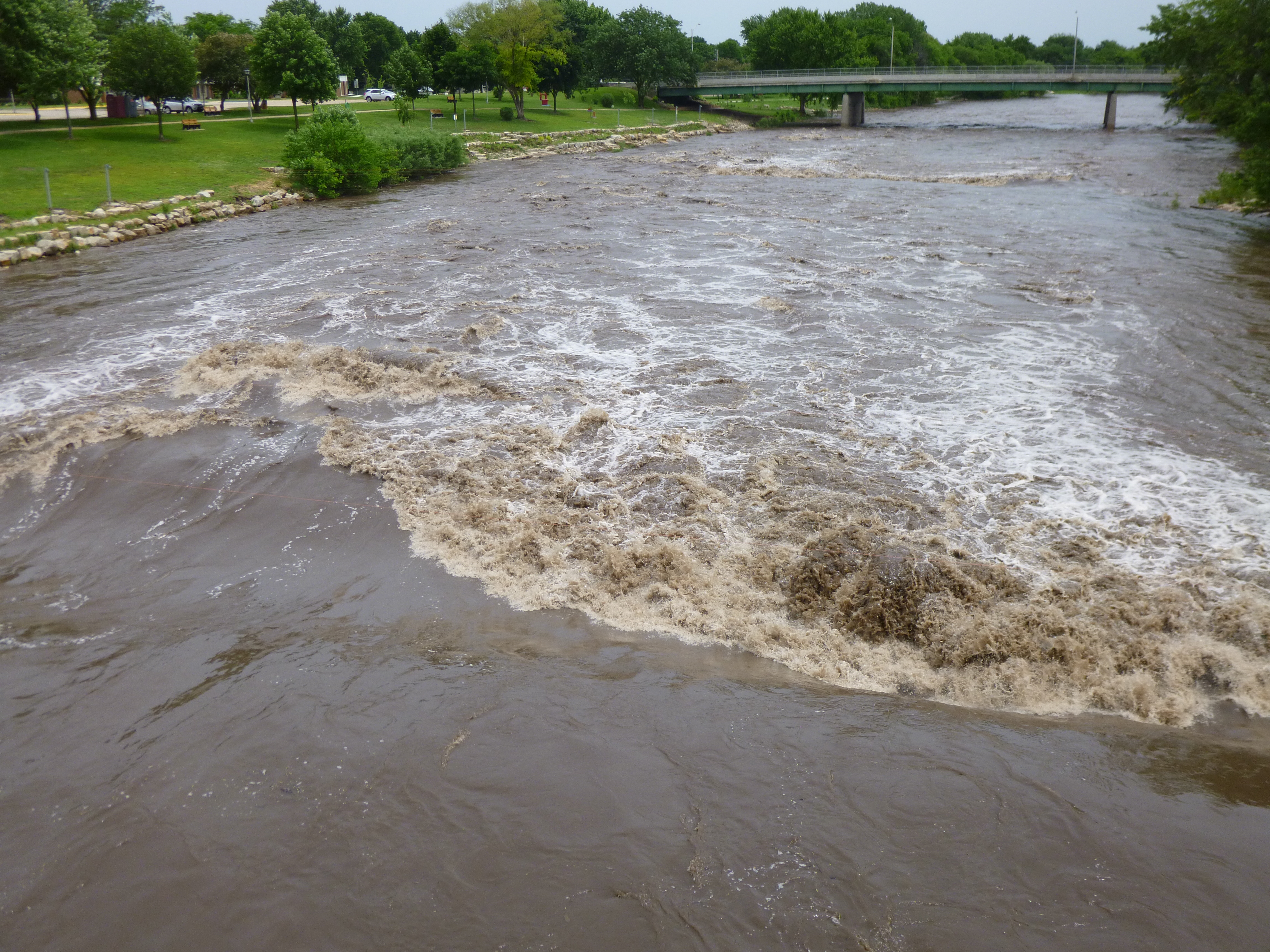
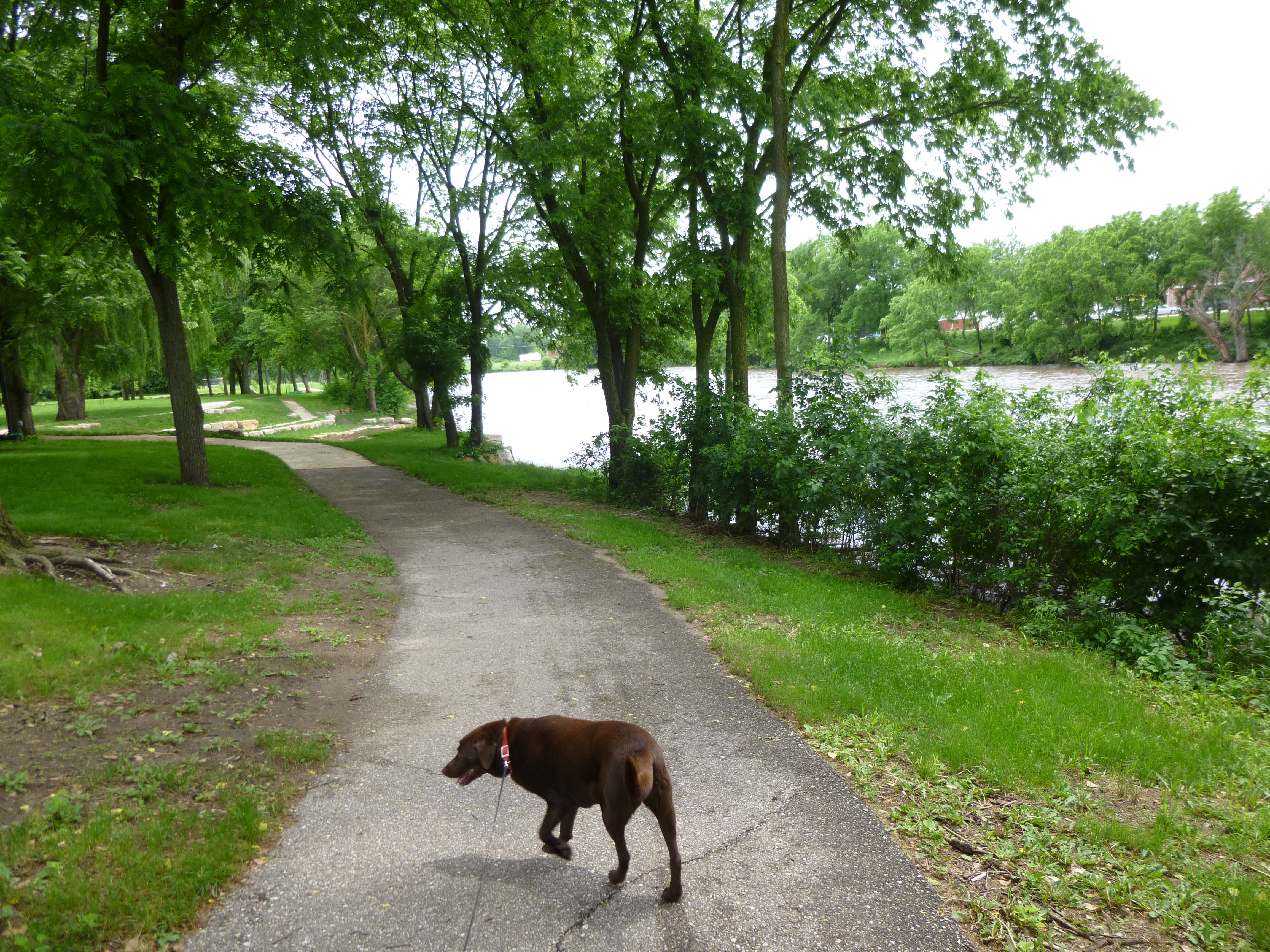
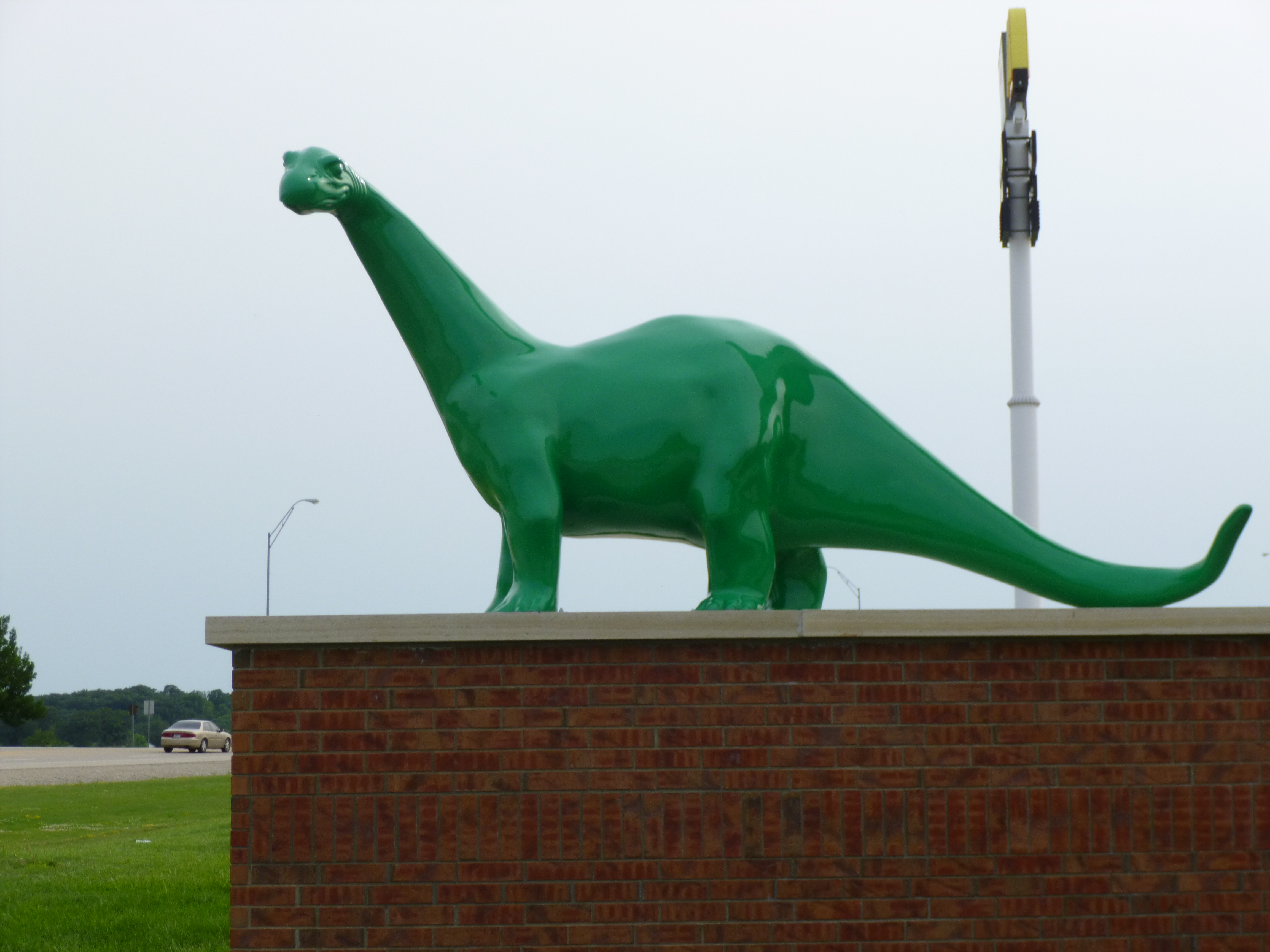
I started driving south, and stopped in New Hampton for another couple miles of walking. Then I drove on to Charles City, where Tula and I got another 2 1/2 miles in – partly along the Cedar River, which was high and flowing fast. There were a bunch of strings (kind of like kite strings) across the river and spools of the strings were attached to poles on each side – I couldn’t figure out what they were for. I learned the word “tractor” was coined here many years ago by a company that manufactured traction motors (whatever those are). I stopped for gas at a Sinclair station – I don’t see many of those, and I always liked the dinosaur – they remind me of road trips when I was young!
Then I passed by Waterloo, where the Sullivan Hartough Davis Honor Flights originate from. This was my military related donation-of-the-day. Last Tuesday I had read about the Honor Flights originating in Iowa. Honor Flight volunteers fly WWII vets (and they’re now starting to take Korean War vets) from different hubs around the country to Washington DC, so they can see “their” memorials. This started in May of 2005, not too long after the WWII Memorial was dedicated in 2004, and I imagine it’s a very moving experience for everyone involved. I had heard of this before; in fact, back in West Virginia I was telling the lady at the veteran’s home about a program that flies veterans out to Washington DC at no charge, but I couldn’t think of the name of it. And then Linda, my friend in Tennessee, told me about her dad going on an Honor Flight out of Nashville. From what I read, by the end of 2012 more than 98,500 veterans have been able to get to Washington DC over the years to visit the memorials – there are 121 hubs in 41 states, so it’s a big program. The day I read about the Honor Flight program in Iowa was the day that the 2nd of 3 planned trips for this year took place from the Waterloo area. I called the County Supervisor since he was listed as the contact person for this hub, and he told me the full trip on Tuesday had been a success, and the September trip is filling up too. He was happy to be able to get a donation – they are always working on raising funds to keep this program going. I wasn’t sure of my timing as far as getting to the Waterloo area, but he told me to give him a call once I knew my schedule and he would meet up with me if possible. But since I came through on a Sunday afternoon, he had other family plans, which didn’t surprise me, so I just mailed in the donation. I’m happy to have “found” this group to support.
The town of Cedar Falls was right by Waterloo, and I ran across the Cedar Valley Nature Trail, which is pretty extensive, as I drove into town. Even though my walking for the day was done, it was a pretty evening out and Tula and I walked an extra mile and a half to store up for later. Then I drove down to Cedar Rapids for the night.

Iowa – Saturday, June 22
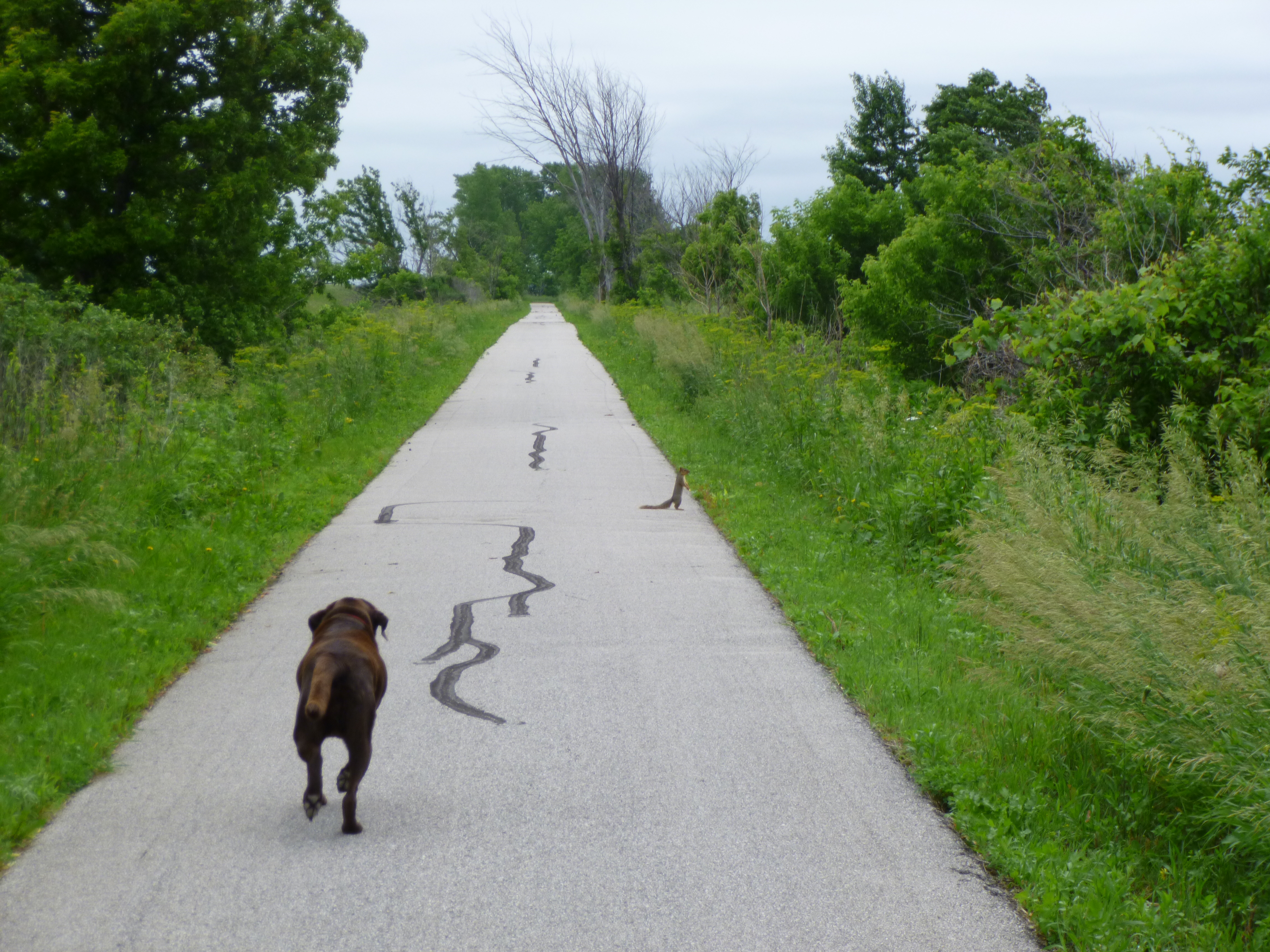
I had stayed in a neighboring town last night since it was significantly less expensive than staying in Decorah. On my way back into town, I saw the Prairie Farmer Recreation Trail, and Tula and I got out for a couple miles of walking. The trail mostly went along farmland, which used to be prairie. Tula discovered prairie dogs are as tempting to chase as squirrels, and seemed a bit bewildered when one vanished into the ground instead of up a tree! (There’s a picture and her and the prairie dog below.) When we were done with that walk, I finished driving back into Decorah and did a little more walking in town and even popped into a few shops. I found some more lefse, and even a dish of rommegrot to put in the cooler for a little treat later. Then I found another pretty neighborhood to walk in, so I was up to 3 1/2 miles for the day.
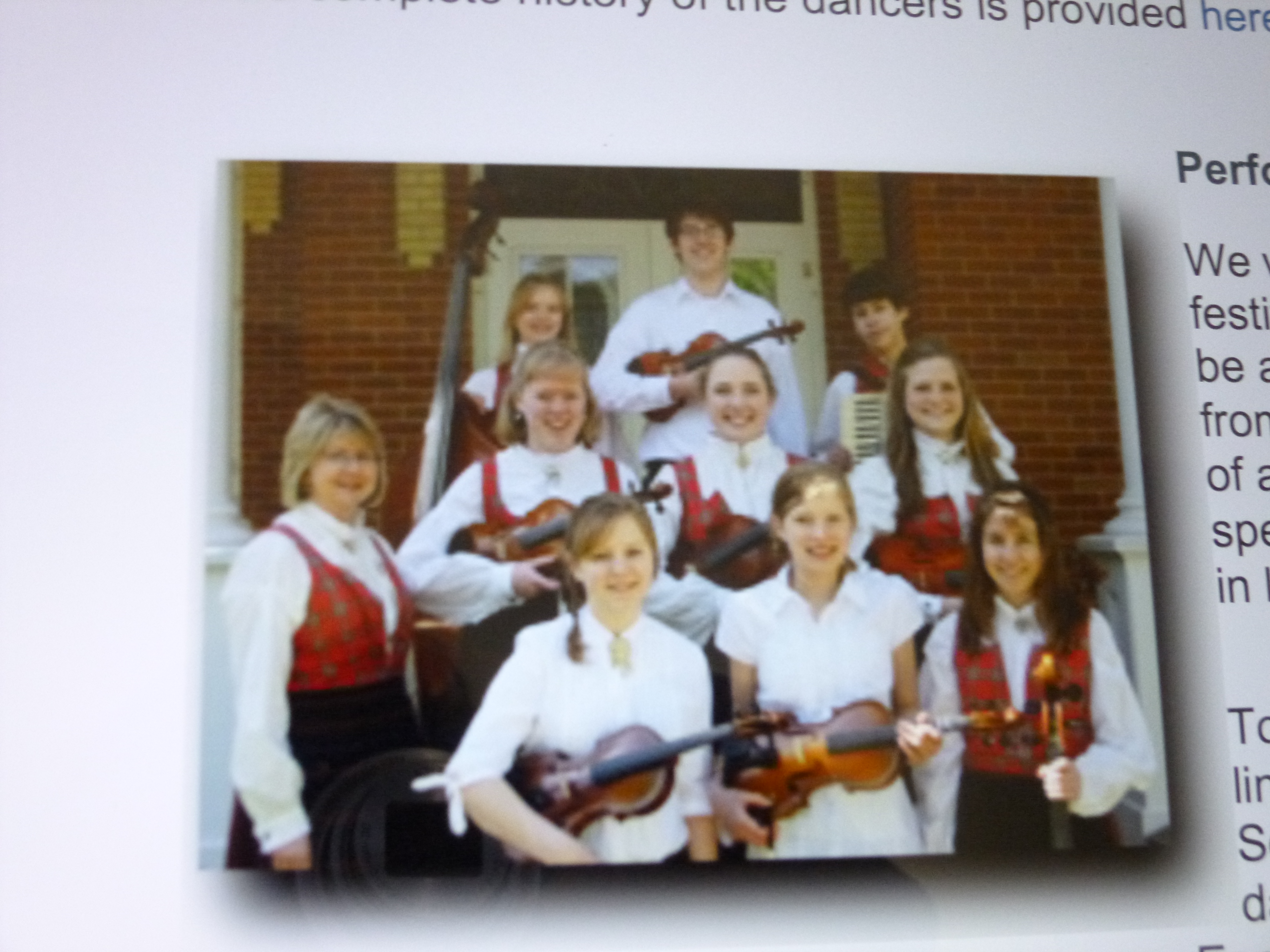
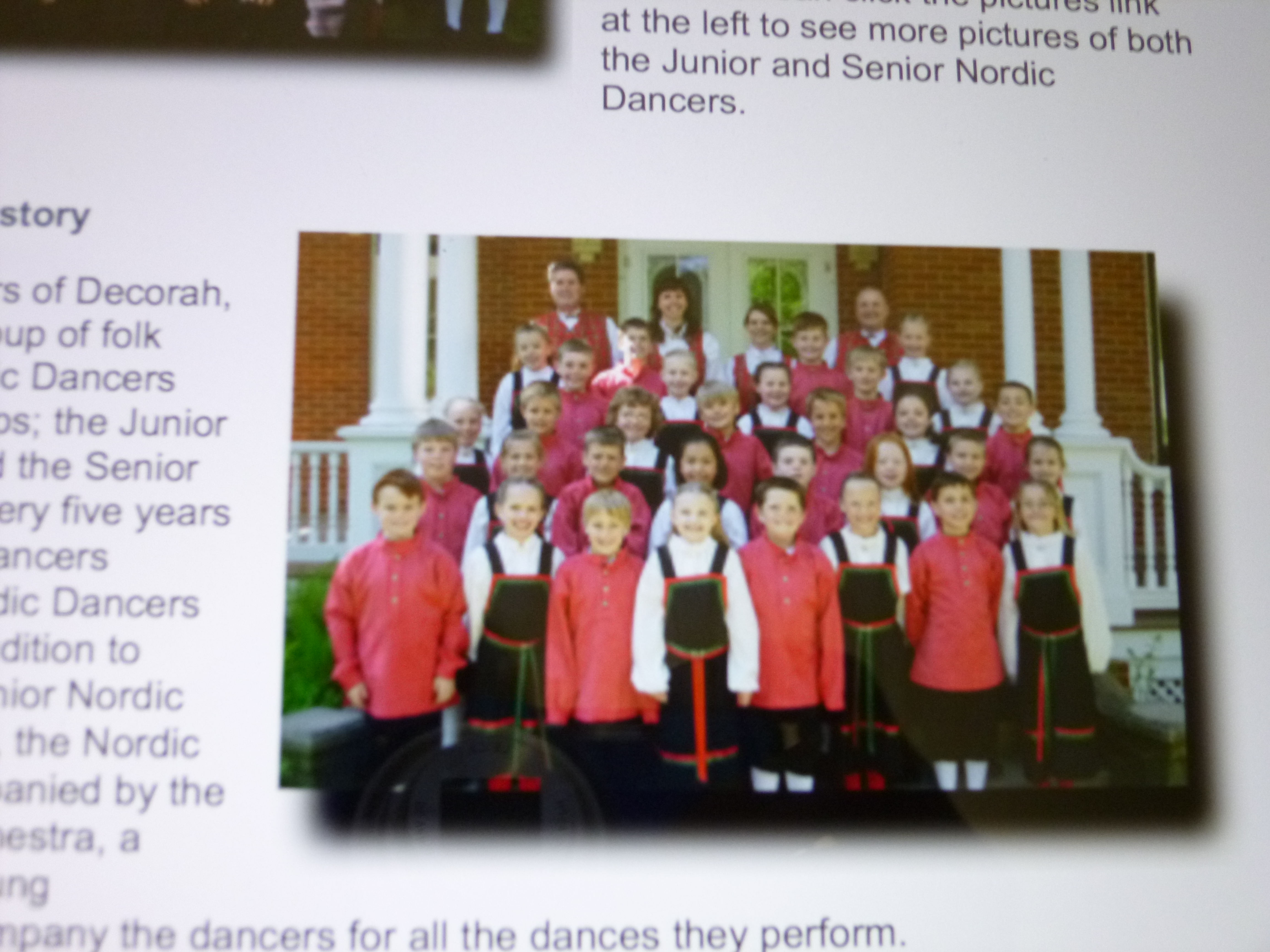
My donation today was going to be mailed in to the Nordic Dancers – a group of students ages 8-18 who spend many years together learning dozens of traditional Norwegian dances, and they travel around and perform at different events. They’ve been to Norway, and they dance every summer at the annual Nordic Fest. I had exchanged several emails with one of their directors, and she welcomed the donation, and said it would probably be easiest to just mail it in. I had several questions and she answered all of them. The Nordic Dancers consist of a senior group and a junior group, and the dancers in each group dance together for 10 years. Auditions are held just once every 5 years for incoming 3rd graders (and this is an audition year); at which time the current junior group (now turning 13) will become the senior group, and a new junior group will be chosen. It’s quite a commitment to become one of the Nordic Dancers! There are often about 45 girls who audition for 16 spots, and rumor has it some families even try to time the births of their children to coincide with an audition year! They also have 20+ boys who audition for the 16 spots. It was interesting to hear about them, and to read about the group, and I was happy to make a donation to them – it helps preserve my heritage, and I’m always happy to help a dance group!
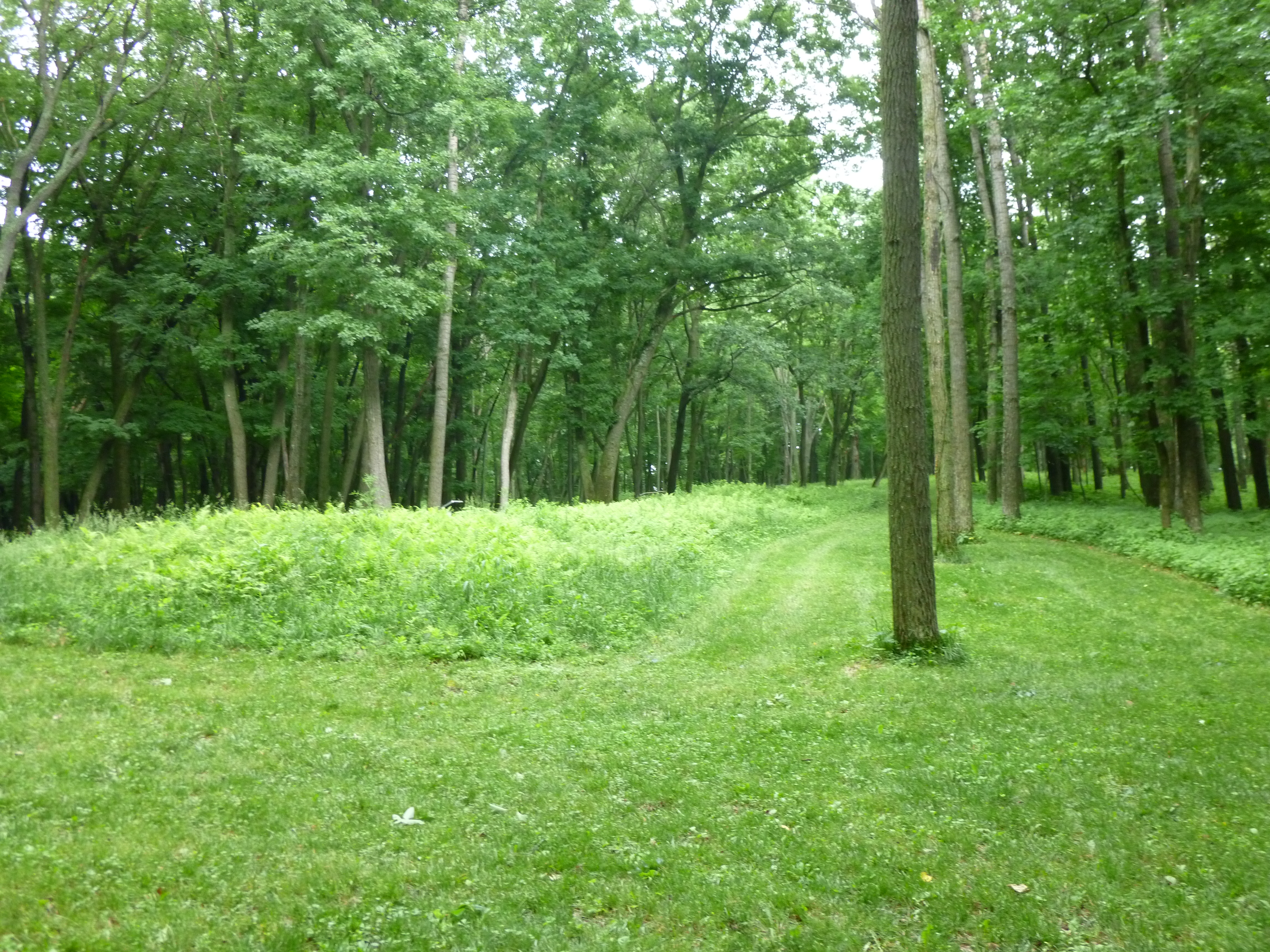
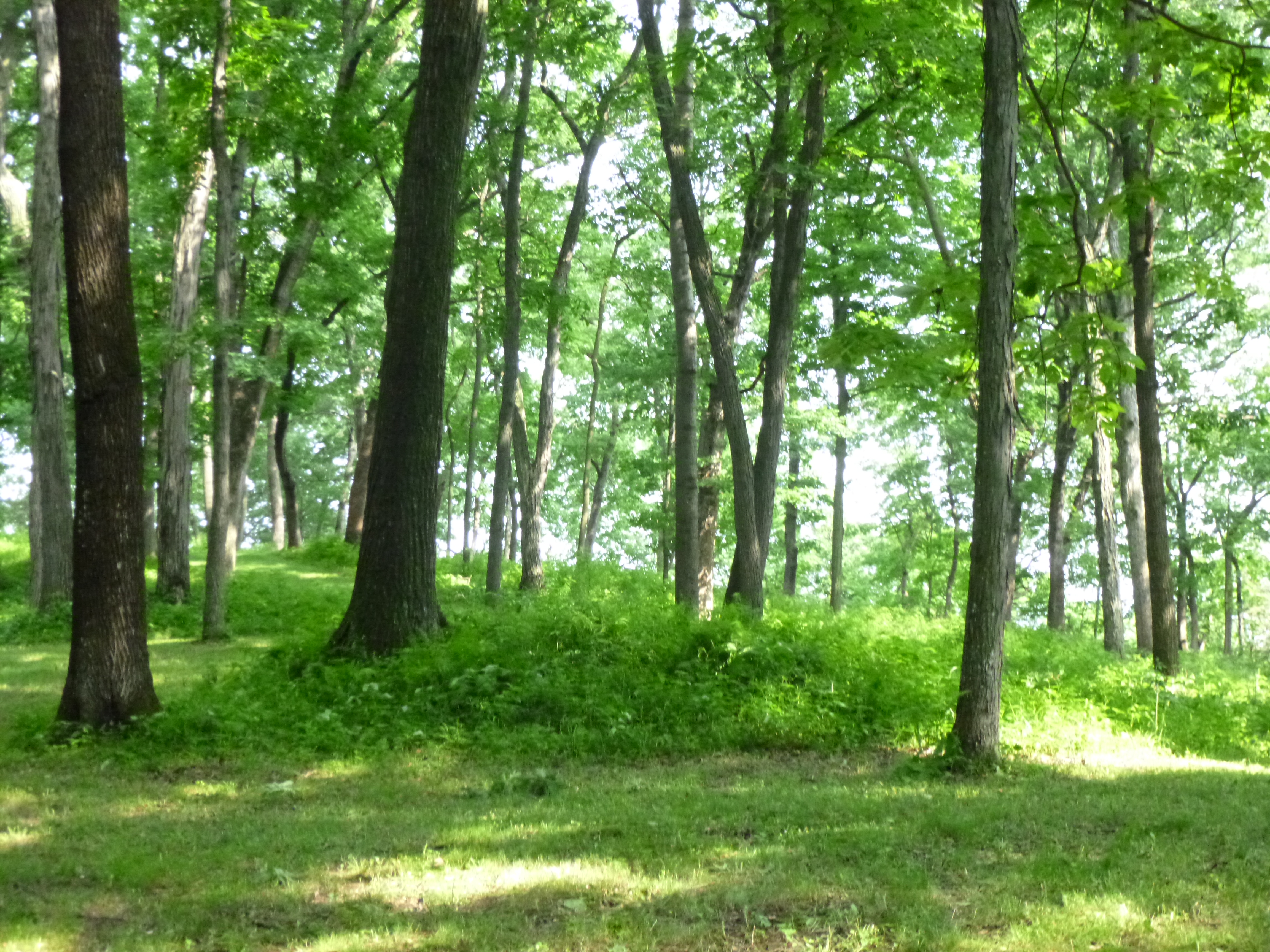
Since I’m a national park fan, my destination today was the Effigy Mounds National Monument, which was along the bluffs of the Mississippi River. There are about 200 mounds in the area, which is where Native Americans and some of their artifacts were buried 1000-2500 years ago. Many of the mounds are in shapes of birds or bears, and some are so big it was almost like they were meant to be seen from above. This is similar to the Hopewell Mounds that I visited in Ohio, where different layers of the mounds contained different things. I went into the visitor center and watched the video about the place, then Tula and I set out for a walk where we would see the small bear and large bear mounds, and a lot of round ones. We had to take a kind of steep switchback trail up to the top of the bluffs, and then we began to see the different mounds. Before the mounds were discovered, I’m sure if I had just been hiking out in the woods, I would never have known there was anything unusual about the ground – I would have just thought it was part of the rolling hills of the terrain. It’s a good thing I’m not an archeologist! The rangers keep the grass cut around the mounds, but they don’t take the lawn mowers onto them. These mounds were not very high, and the difference in grass height made it easy to see the shapes. The consensus is that the Native Americans respected the birds and bears, and that’s why the mounds were made in those shapes. I also had a beautiful view of the Mississippi River from the bluffs, and it was a really pretty hike. It was a hot muggy day, but we were in the shade of the woods, and Tula did well too.
It was beginning to cloud up again, and it started to rain as I made my way back to Decorah. I was hoping to walk on another bike trail on the outskirts of town, but thunder was rumbling and there was more lightening. When I stopped in Decorah for gas, the clouds burst and a torrential rainstorm started. It was raining so hard that I didn’t want to drive in it, and there was a family diner near the gas station, so I headed over there for a bite to eat. But I just had to sit in the car for a while because of the downpour. I finally made a dash for the door along with some other people, and had dinner (beer battered cod since I couldn’t get lutefisk!) while the storm raged. I’m glad Tula has never been bothered by storms. Once the storm moved on, I went back outside and resumed my drive west to Cresco. The further west I got the more clear it was, and since I couldn’t finish my walking on the bike path in Decorah, I stopped at another section of the Prairie Farmer Trail where Tula and I walked the last couple miles for the day. Then we got settled back into the same motel we had been in last night – just in time, because another storm came through. I was happy to be able to finish my walking between storms!







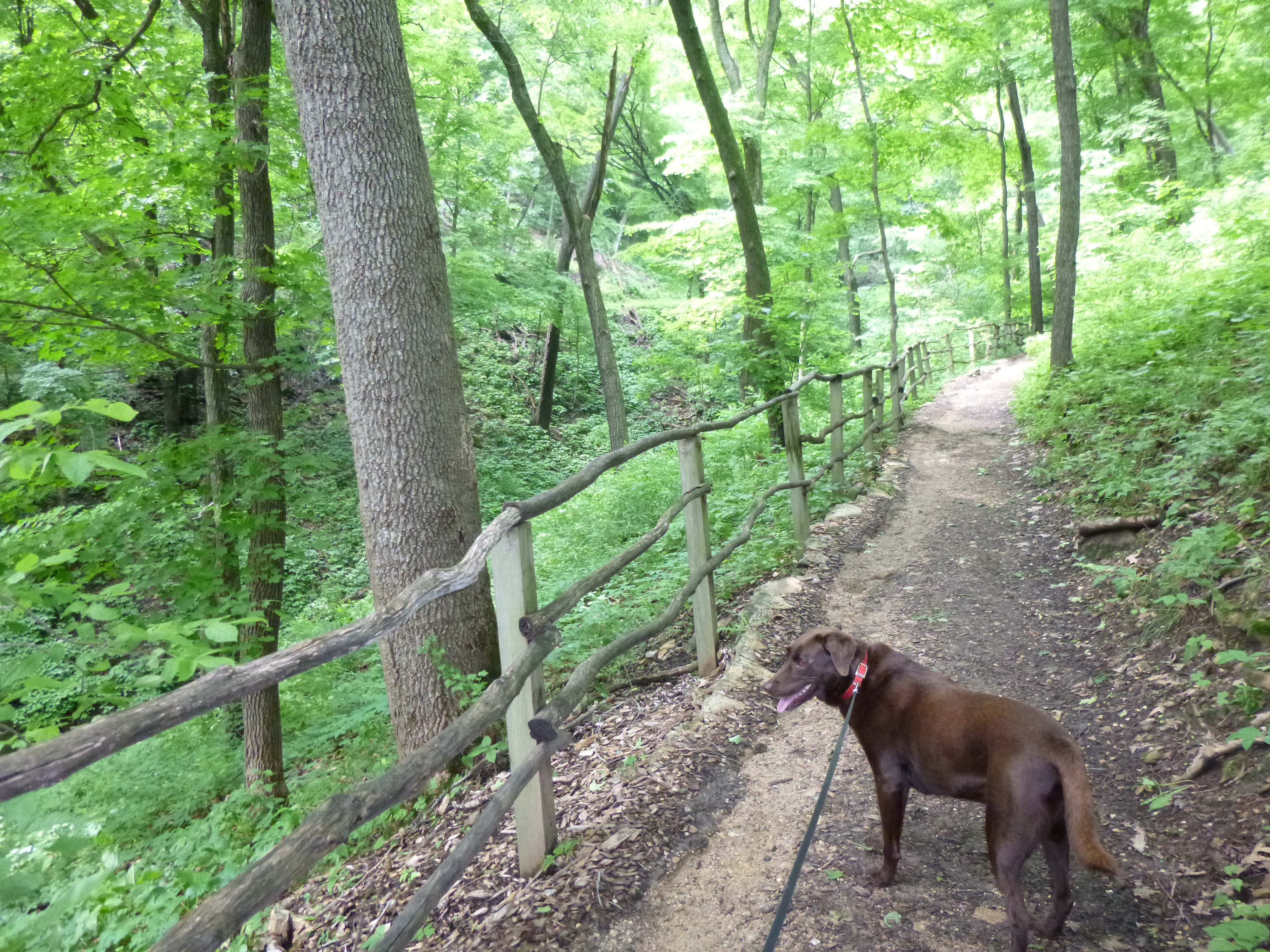



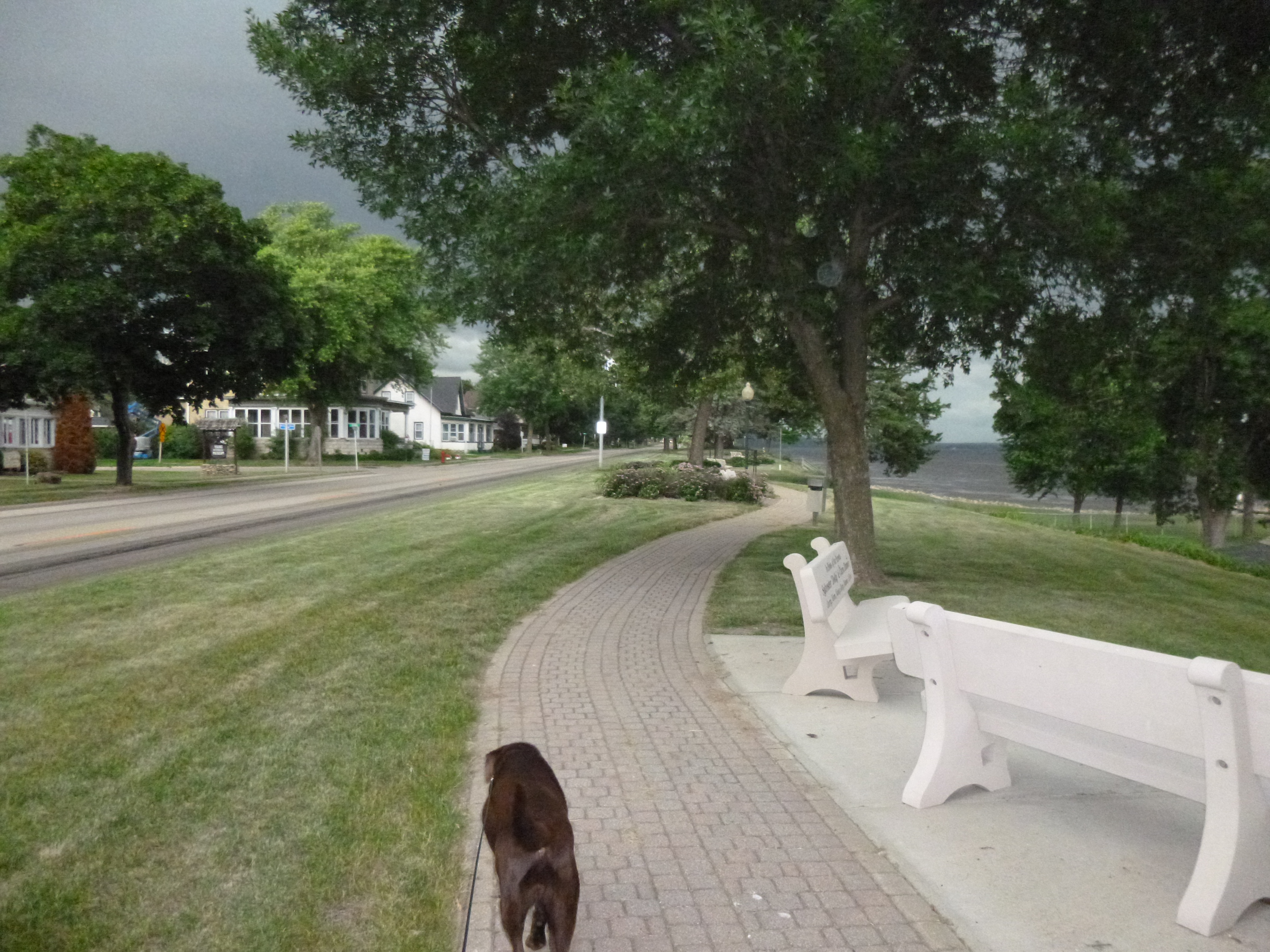
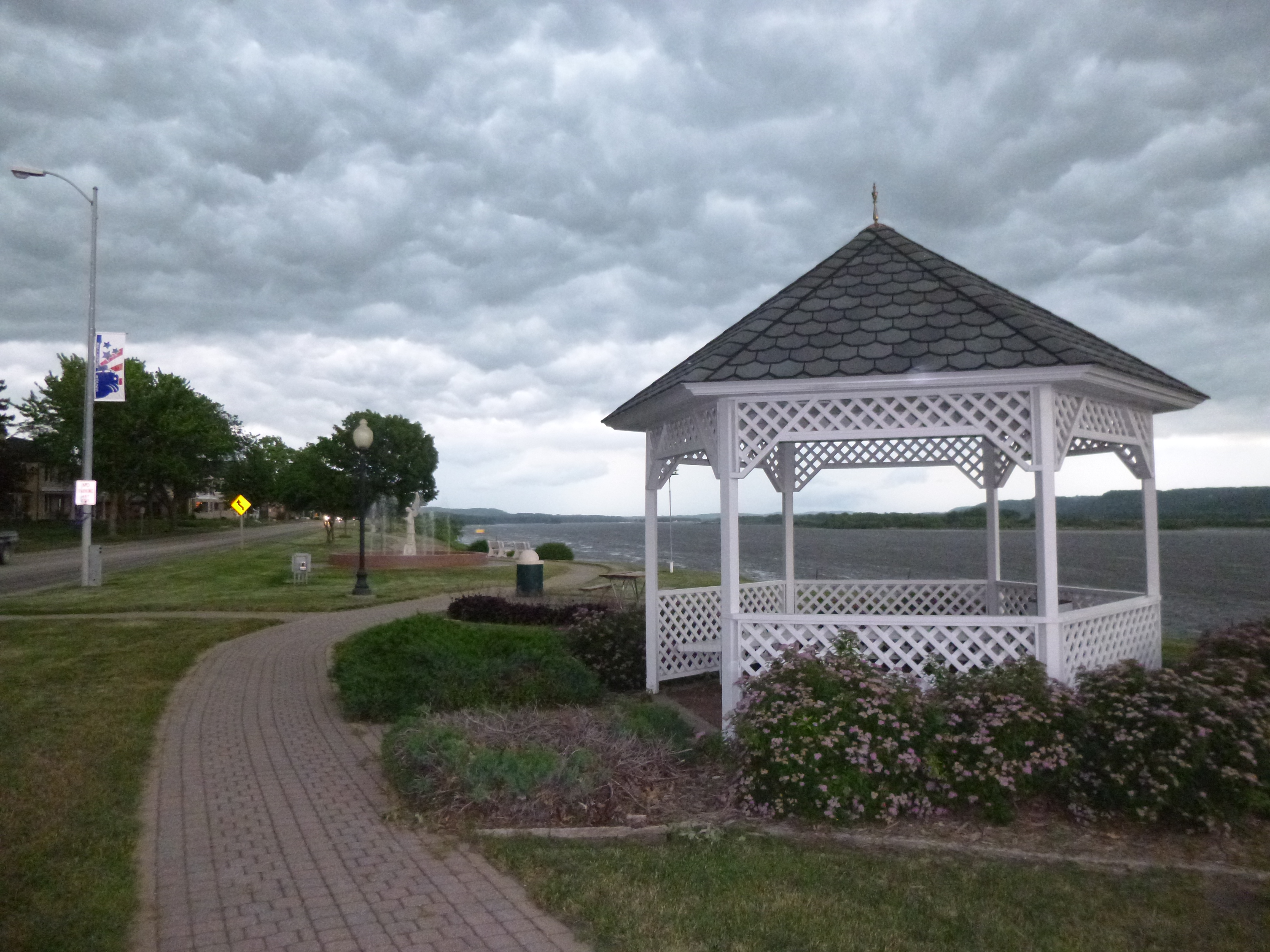
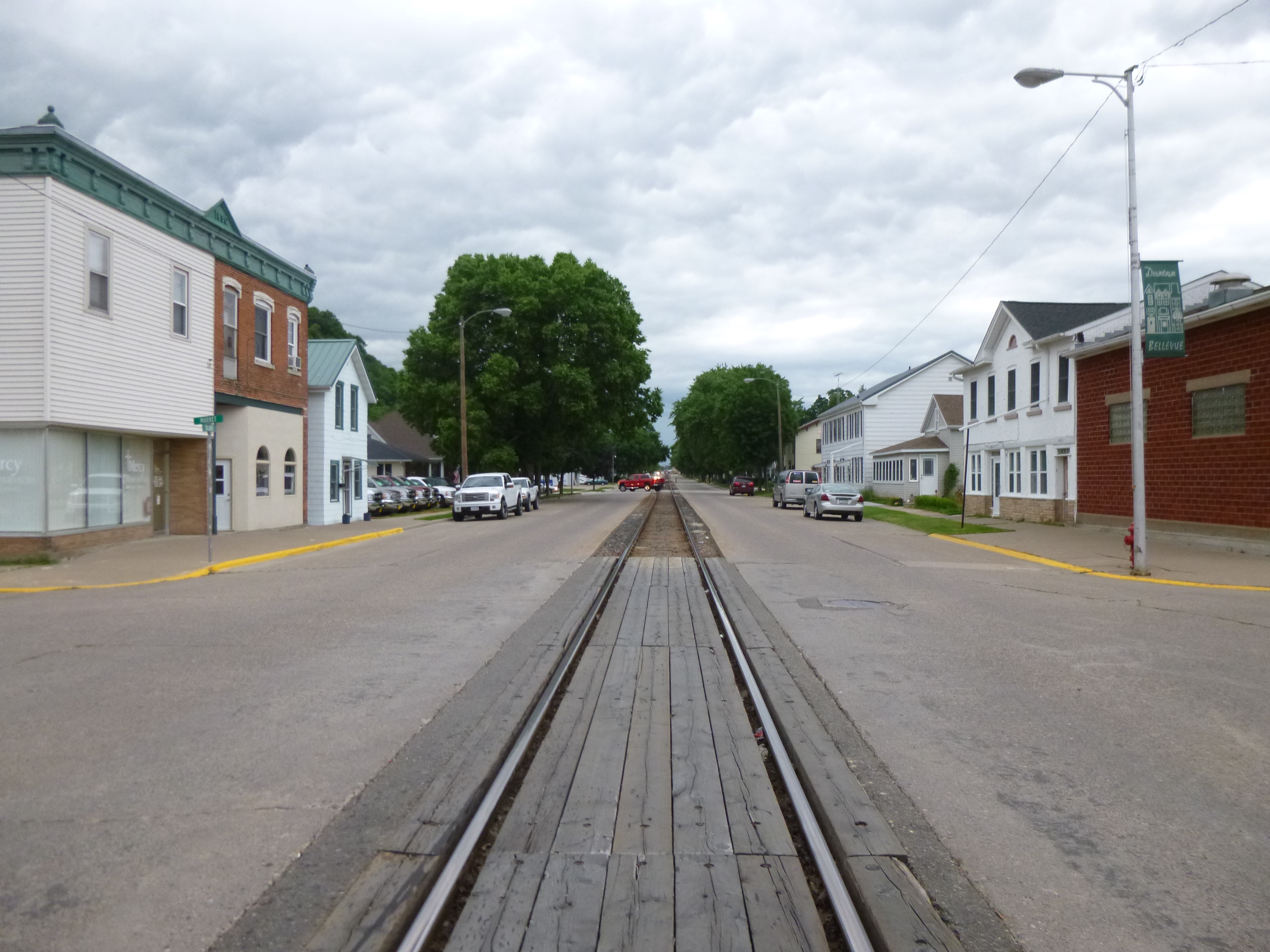
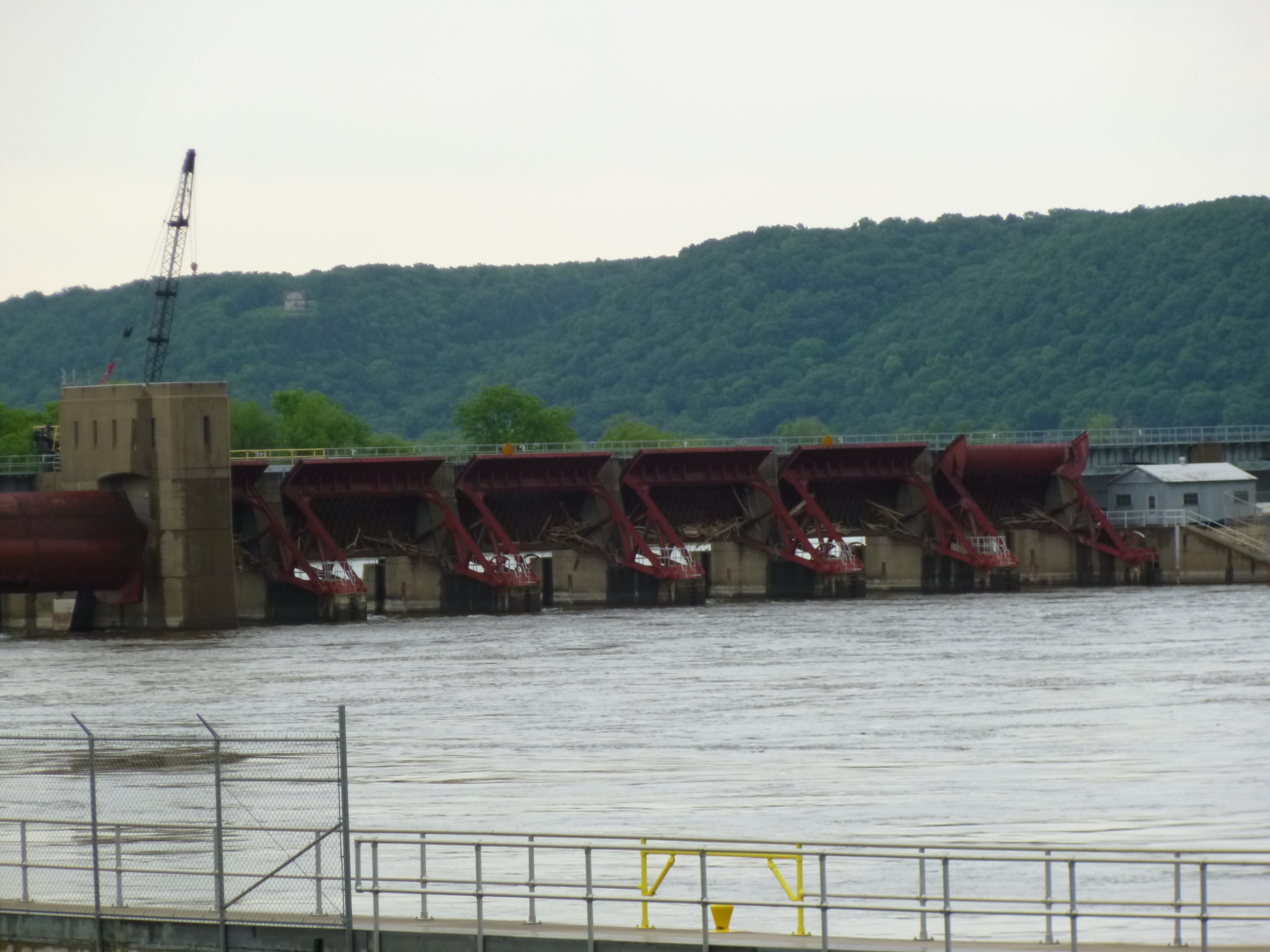
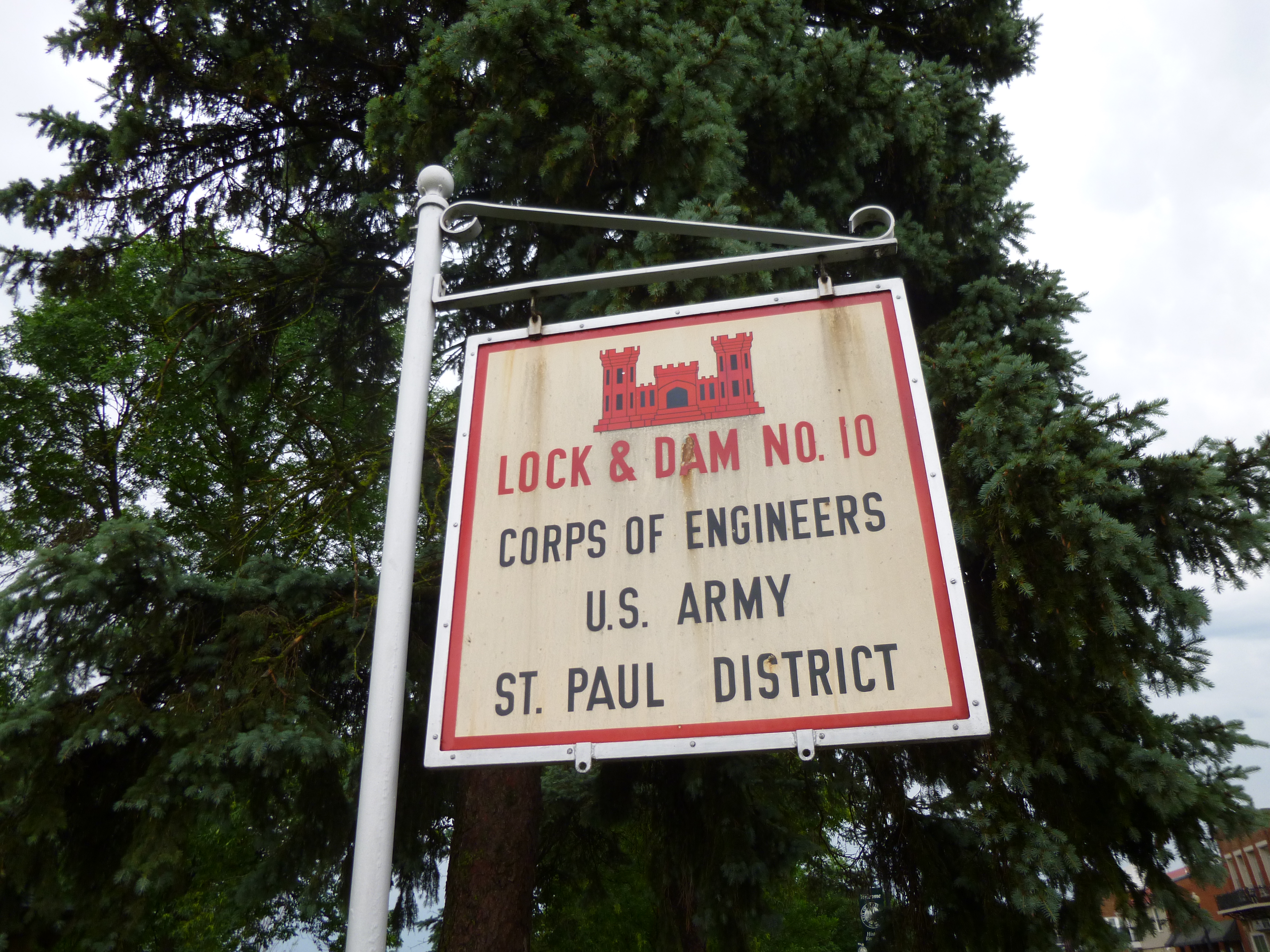
It had rained a bit during the night, which sounds pretty when we’re camping, but I was glad it had stopped long enough so I could get packed up. And the clouds were heavy and gray, so I wanted to get some walking in as soon as possible to beat the rain. We had camped close to the town of Bellevue, so that’s where I got out to walk – along the Mississippi River. Tula and I walked almost 2 miles before it started raining, and I was happy to get that in. One of the main streets through town had railroad tracks running right down the middle of the street – I was wishing a train would go by! The road is wide enough for a full lane of traffic on each side of the tracks, but that’s awfully close to be driving next to a moving train.
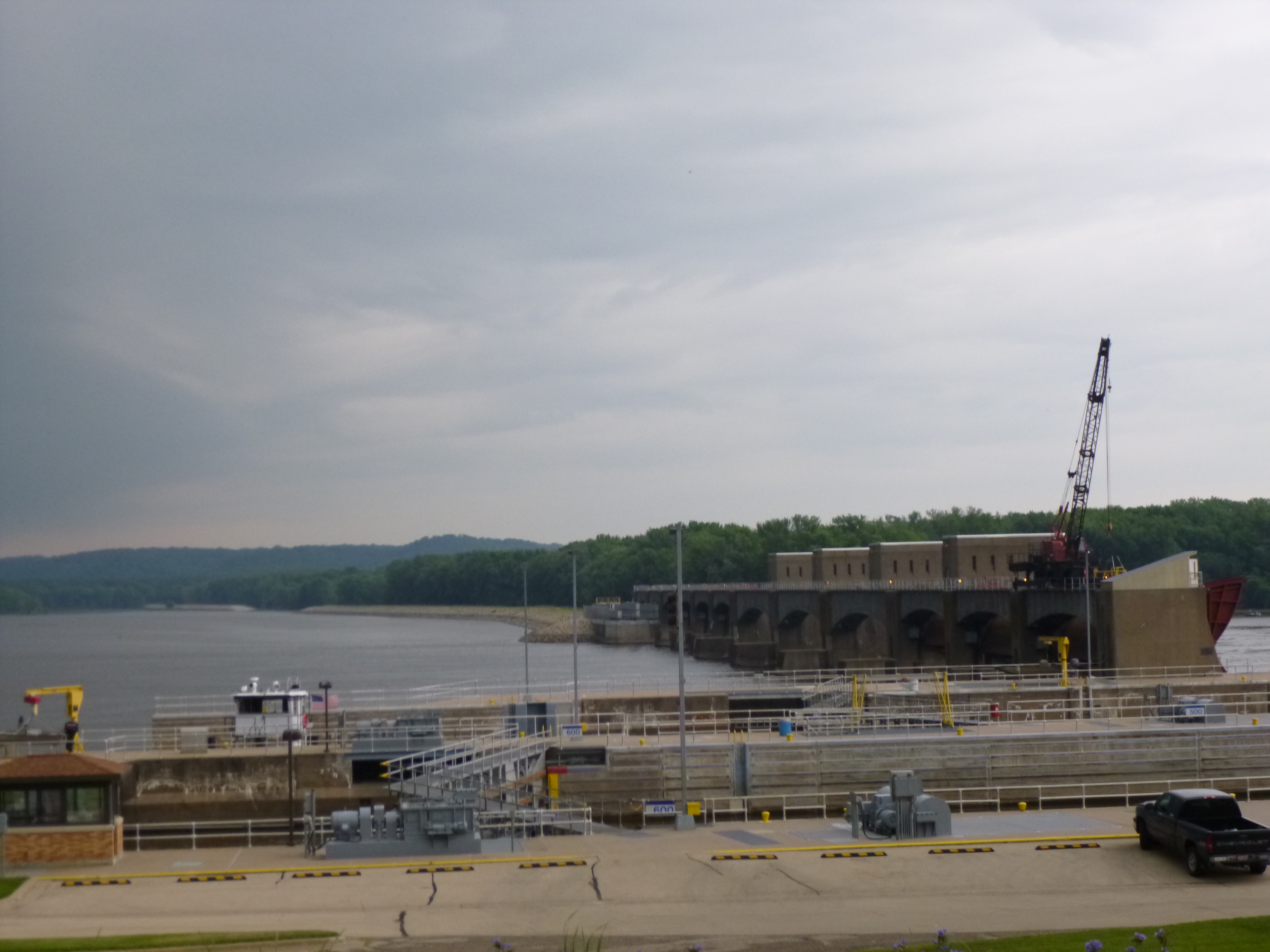
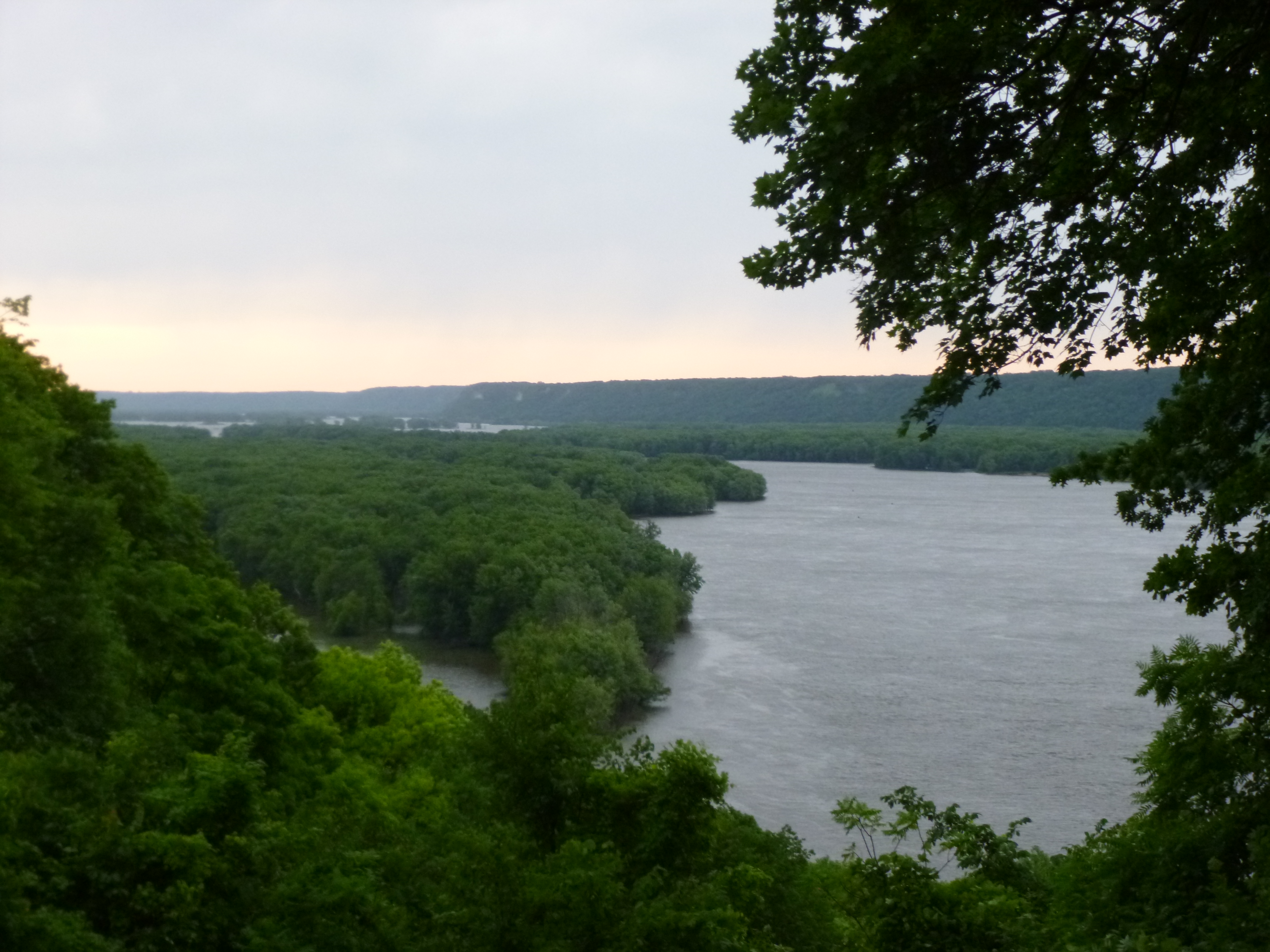
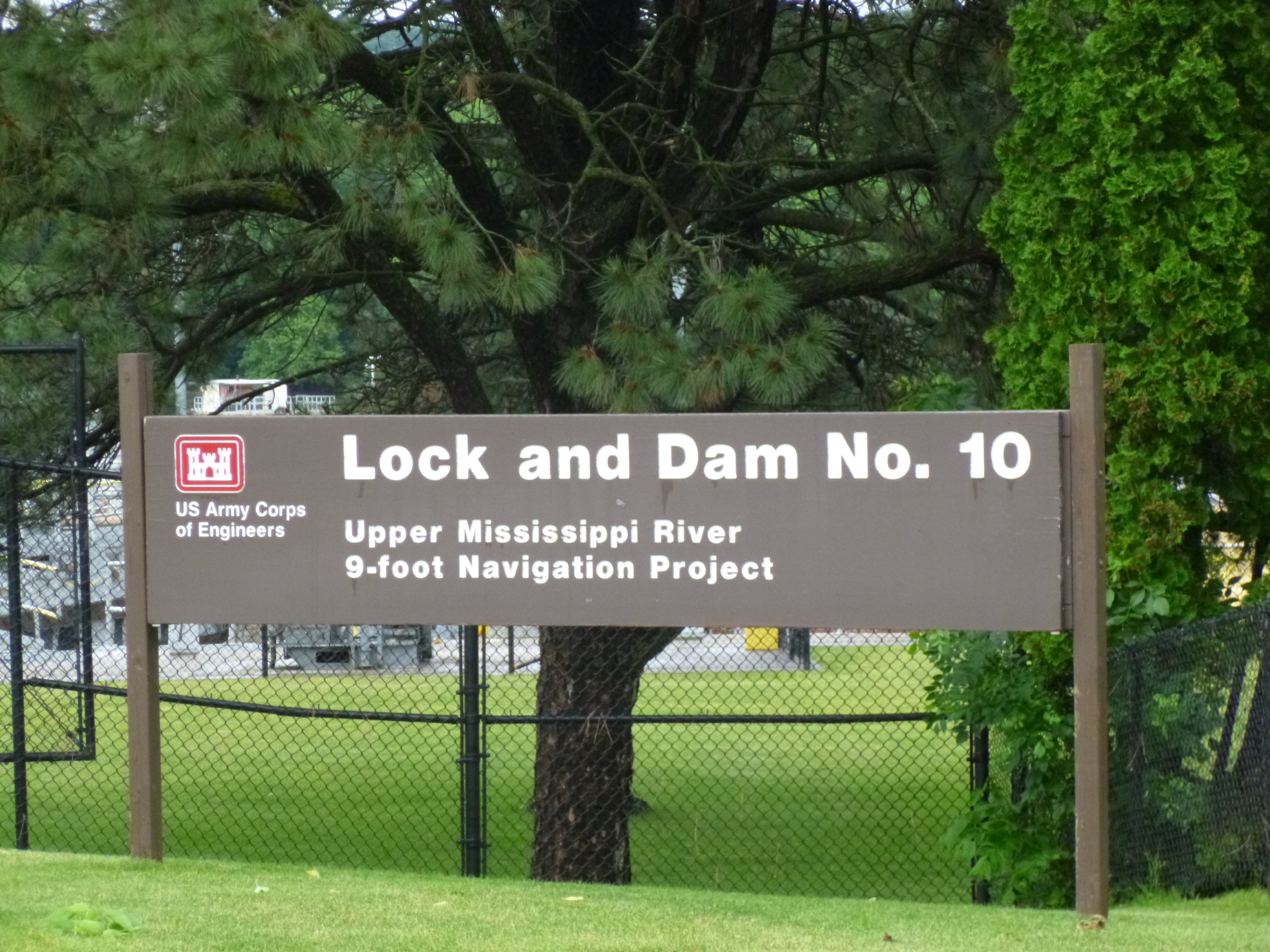
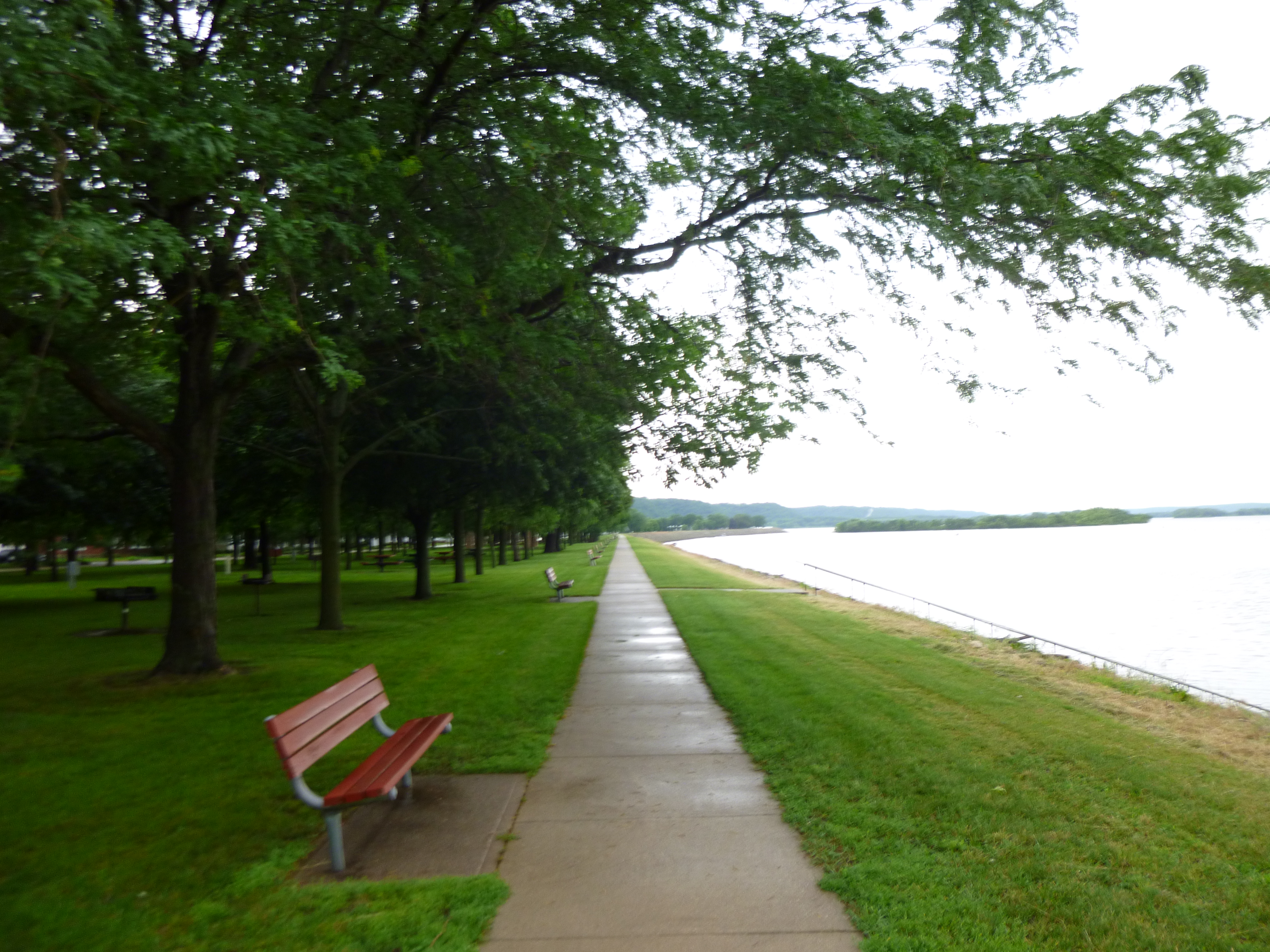
I continued north along the river, and was going to stop in Dubuque, but there was so much thunder and lightning along with the rain that I knew it wasn’t a safe place to get out. I drove around town a little bit and saw the old opera house and an old jail and a bit of the waterfront. Then I pushed on along the scenic road to Guttenburg, where we were able to get out and walk some more. There’s actually a copy of the Guttenburg Bible in the library here, but I didn’t go in and see it – I figured I better walk while the rain had temporarily stopped. There was another pretty walkway along the river, and it turned out this was one of the places where eagles thrived as they made their way up out of the endangered species list. There are a lot of small islands in the river here, and it’s good habitat for eagles, and they count at least 200 nests in the area. Even though I walked nearly 3 1/2 miles from one end of the river walk to the other and back again, I didn’t see any eagles. They might have still been hunkered down after the big storms. There were also more locks for the barges to go through, both here and back in Bellevue, but I didn’t see many boats out on the river today.
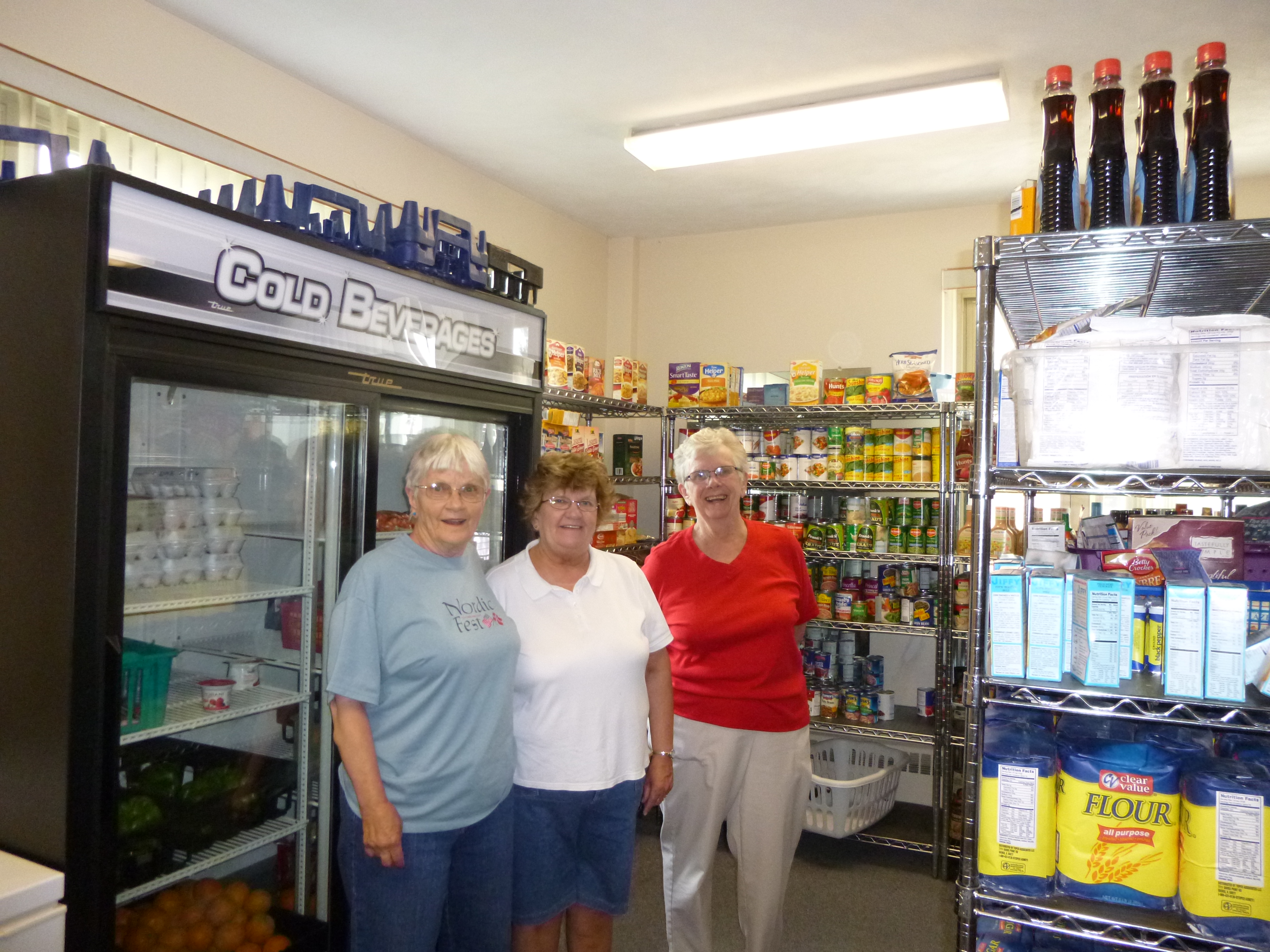
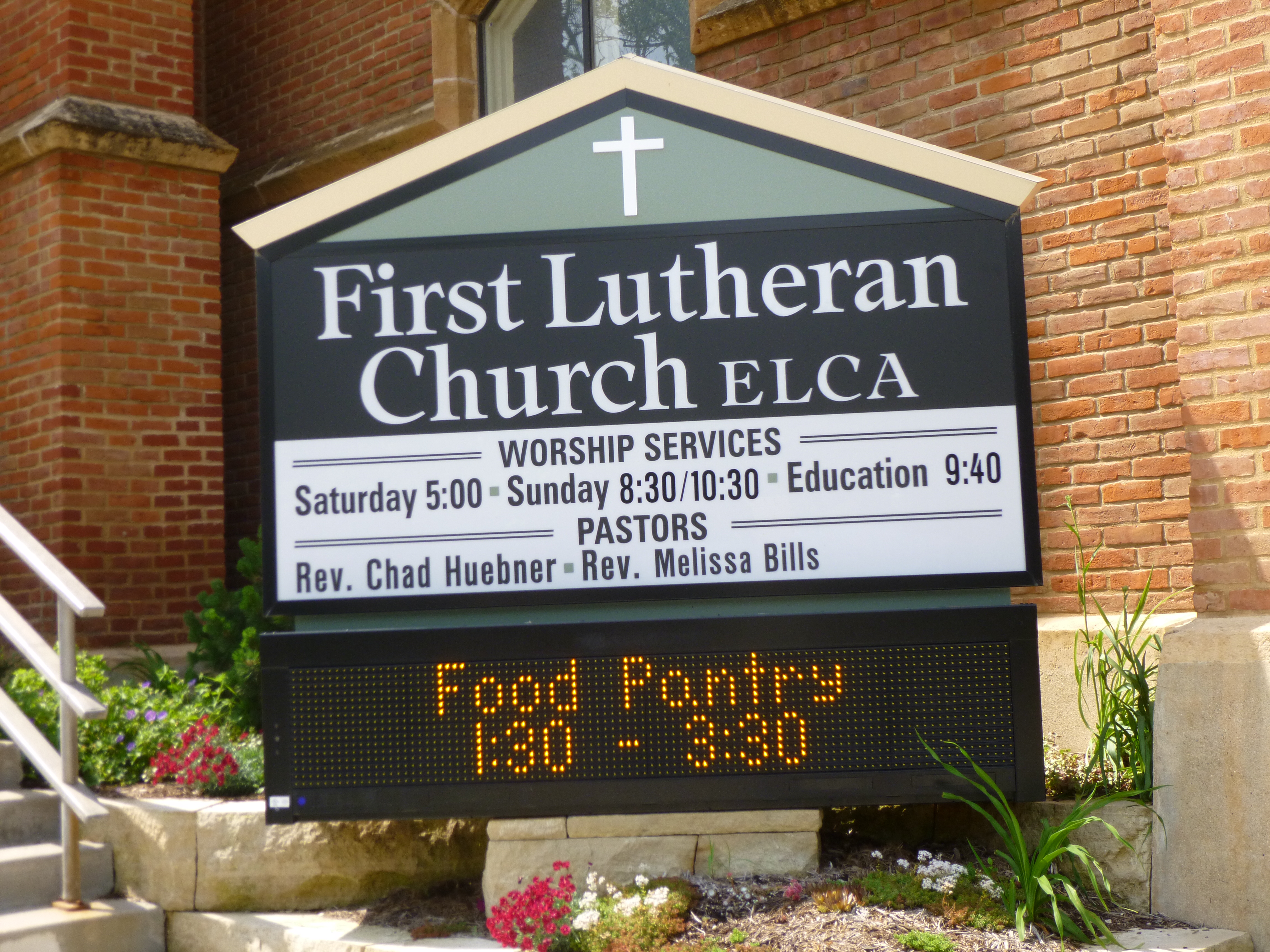
I really enjoyed driving along the river these last couple days, but it was time to start making my way inland. My destination for today was Decorah – a town settled by Norwegian pioneers. There was a food pantry that operated out of a Lutheran church, and I called to see if there were any particular items they were in need of. They said they could really use canned pineapple, canned tuna and canned chicken, and some produce. So I stopped and shopped for potatoes, carrots and a lot of the canned goods that they asked for. I had to finish the drive to Decorah, and was running a little late, so I called and they said they would still be there. The groceries had been packed in a couple boxes since it was kind of a heavy load, so we got that carried in and chatted for a while. They told me this was the biggest food pantry in Decorah, and they’re open every weekday. They help about 500 families a month.
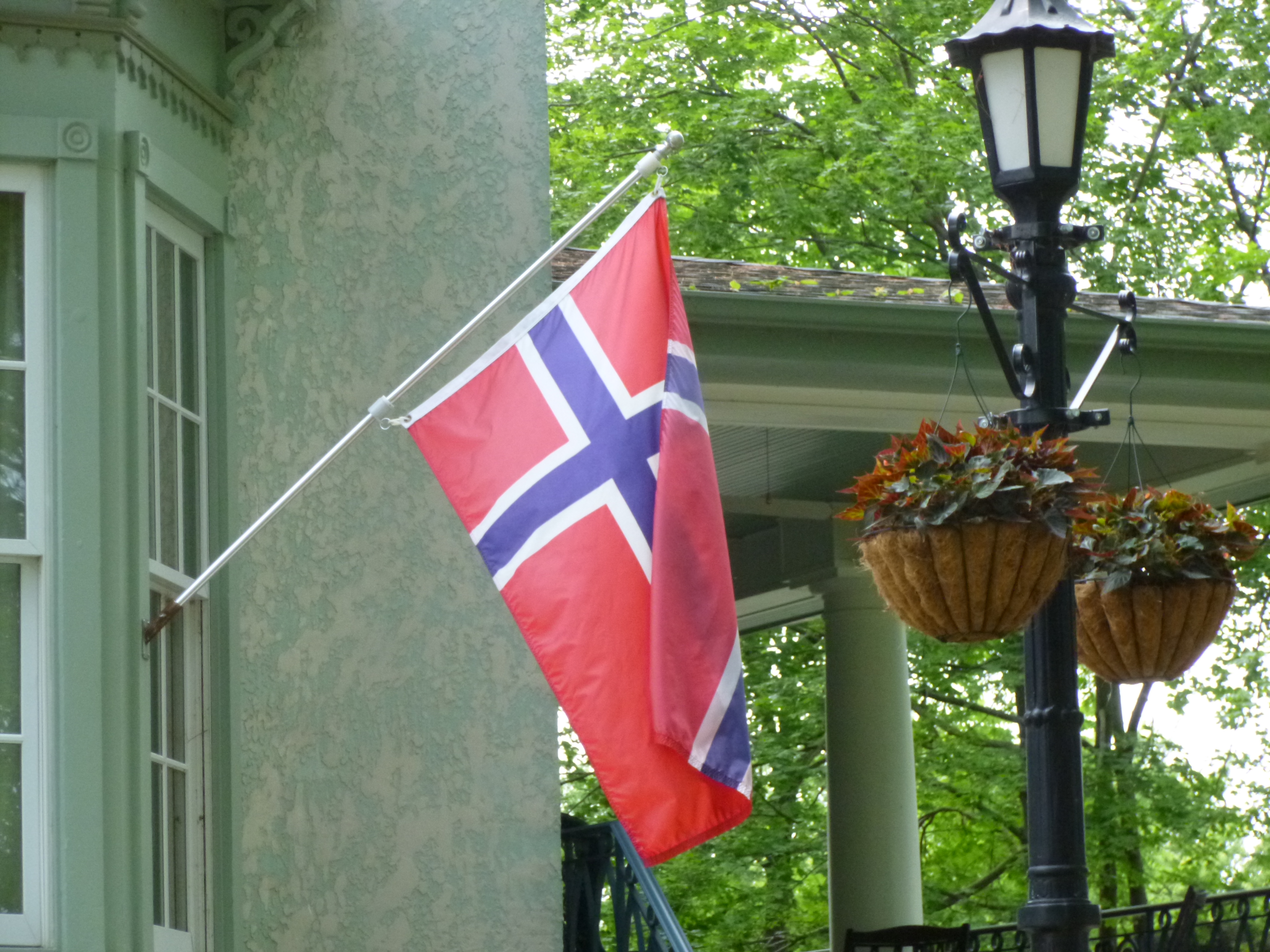
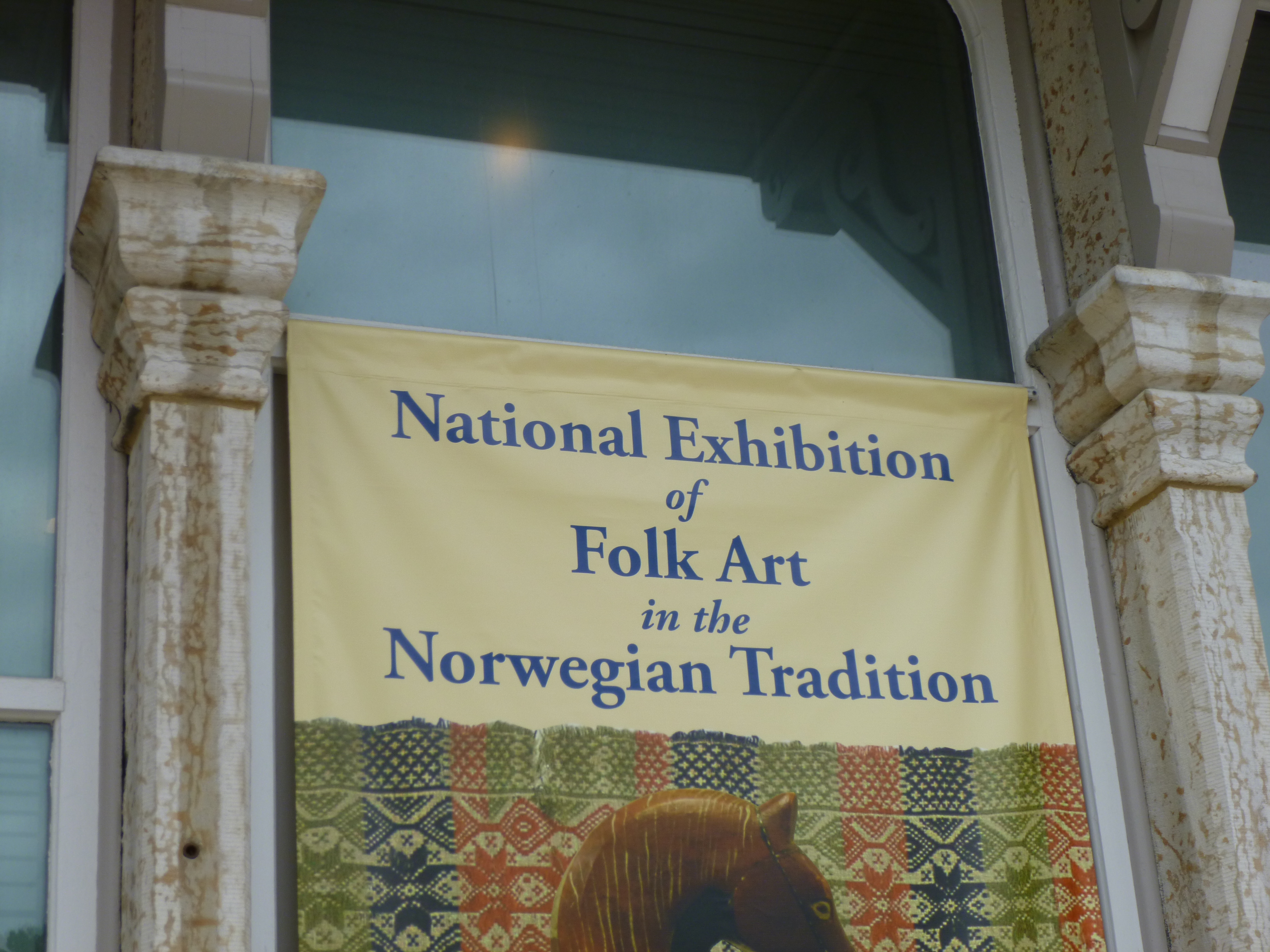
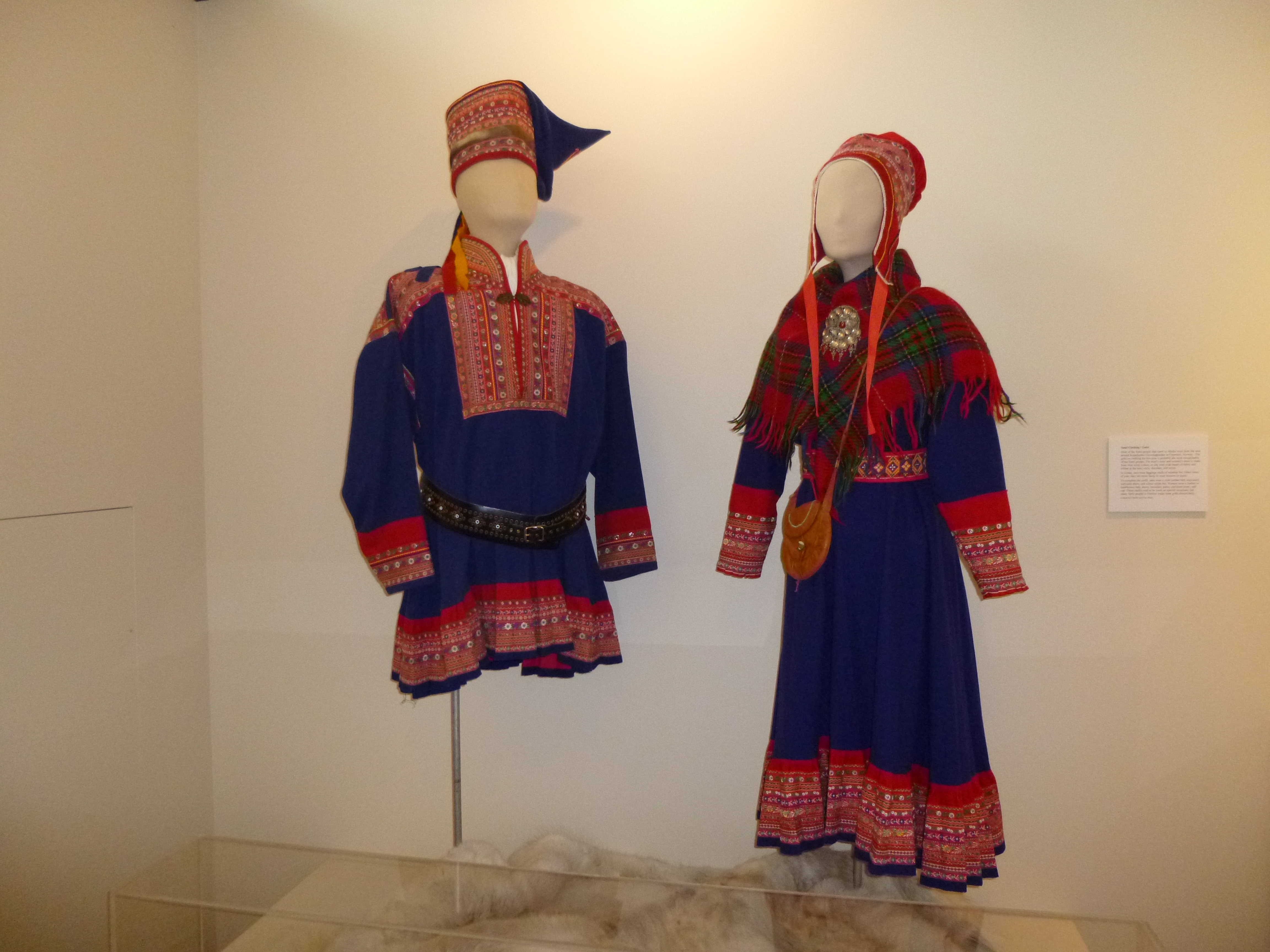
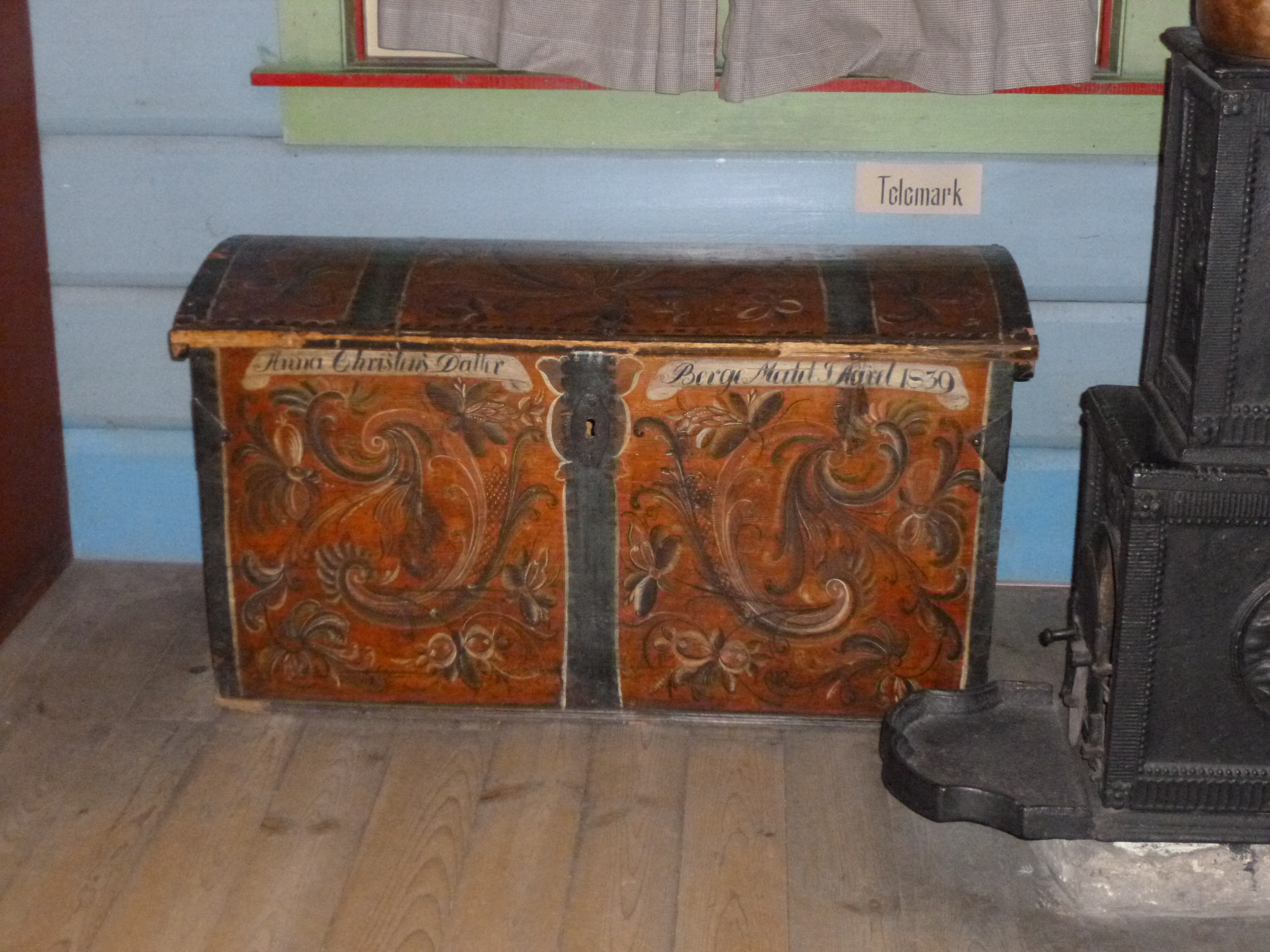
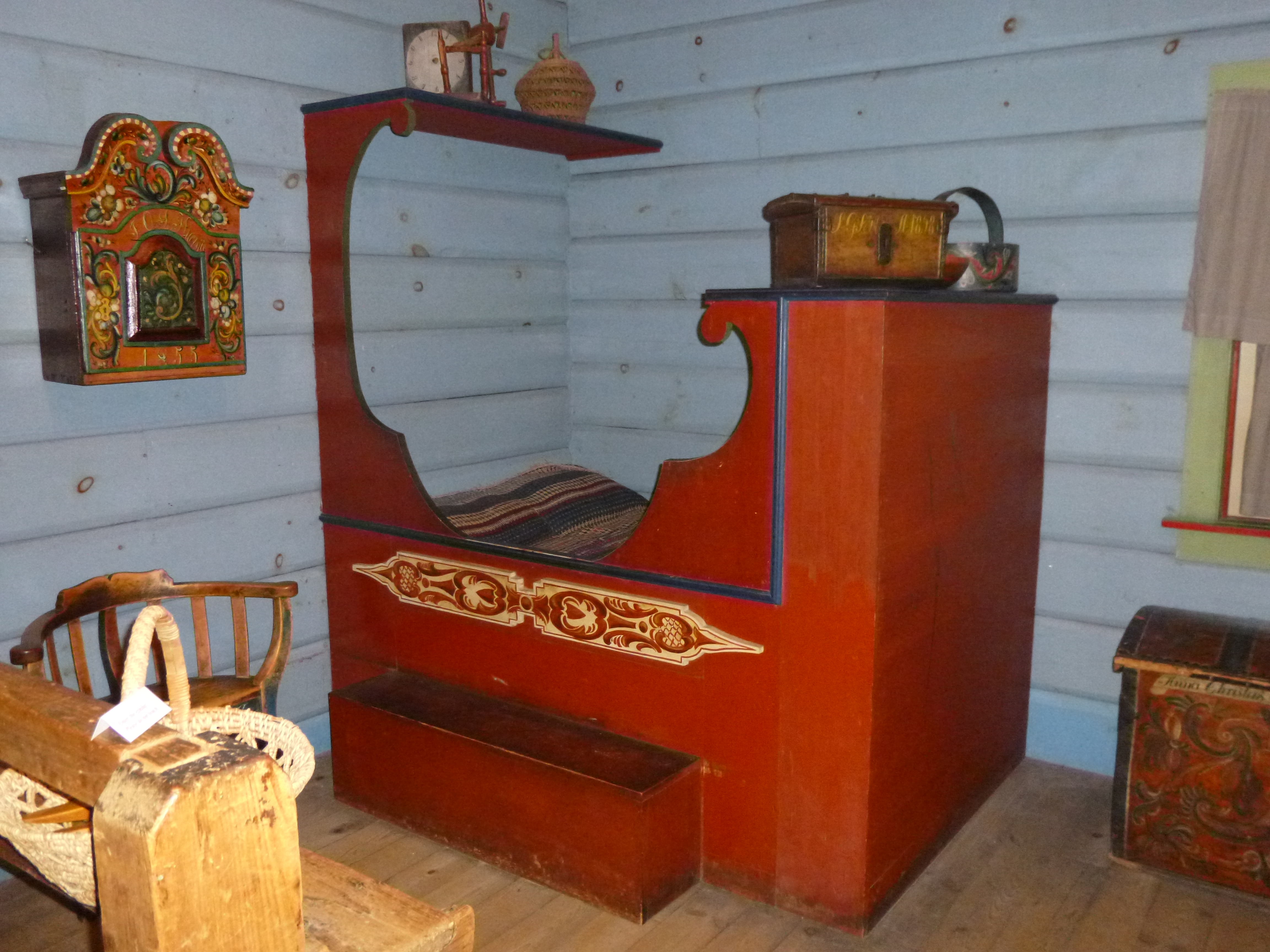
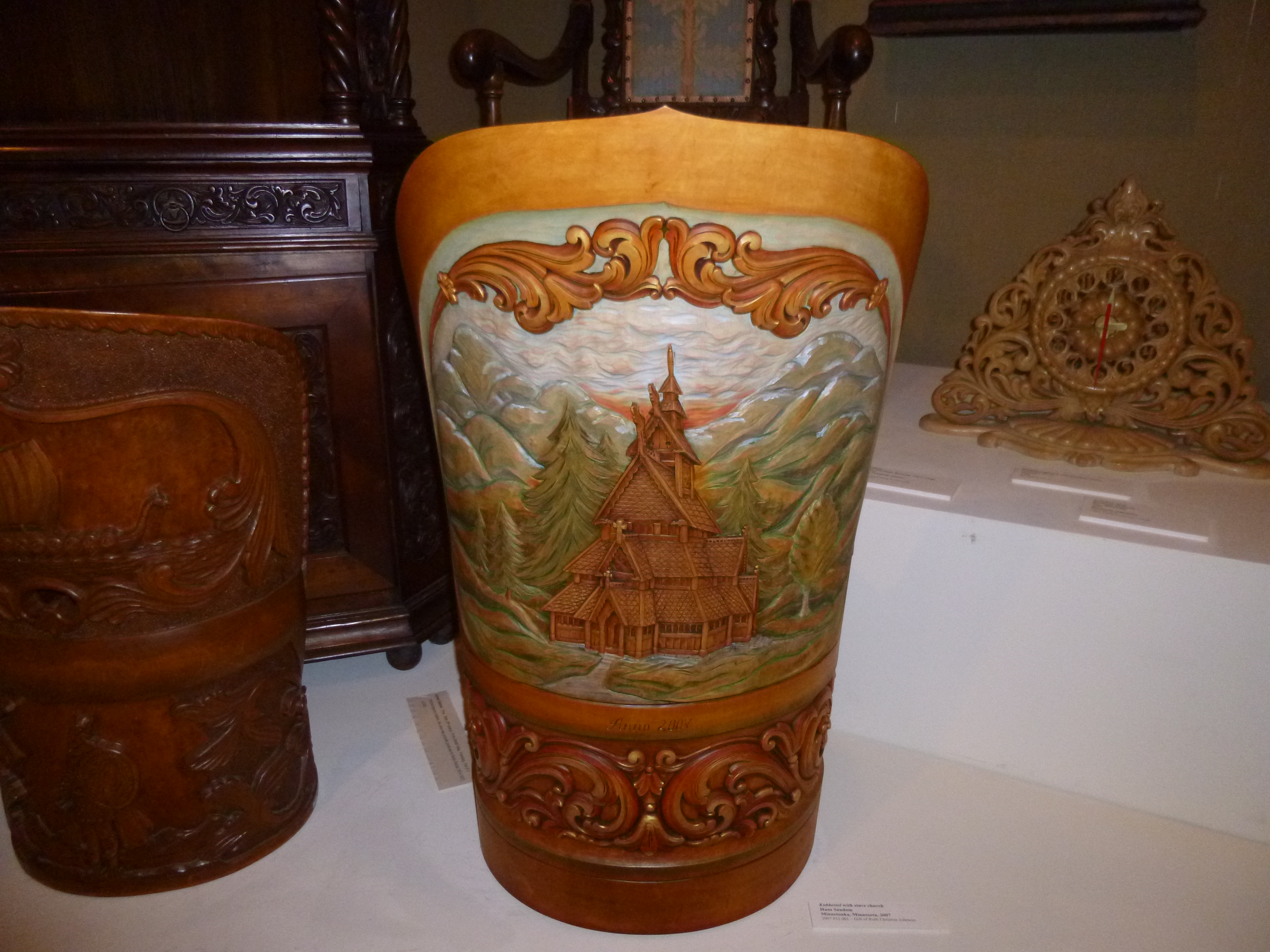
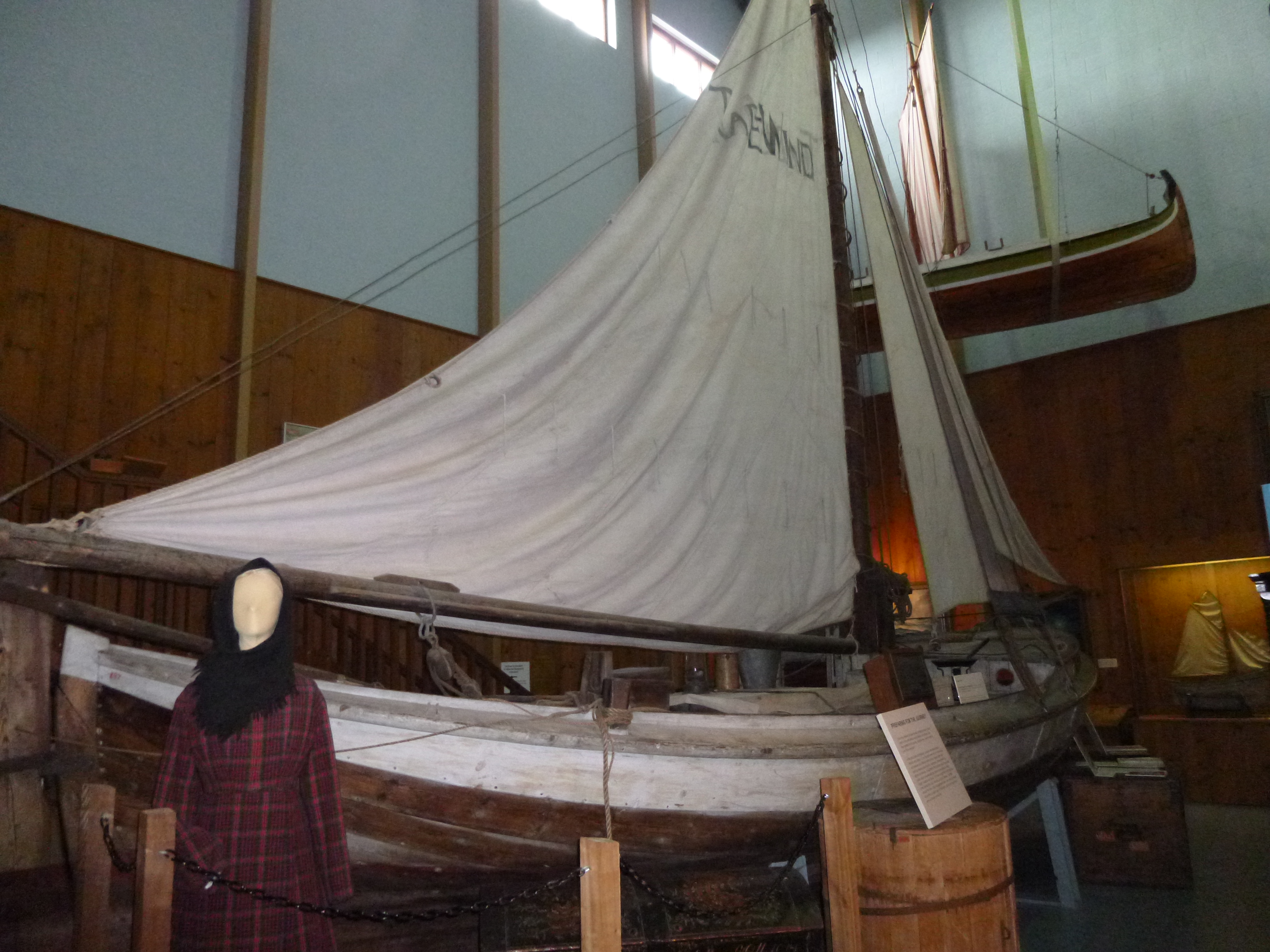
After I made the donation, I went downtown to the Vesterheim Norwegian-American Museum. The entry fee was reasonable, and it was a wonderful little museum. Wikipedia says it’s the oldest and most comprehensive museum in the US devoted to a single immigrant ethnic group. There was a lot of the painted Norwegian furniture and traditional clothing, and a nice Sami display (the Sami people used to be called Lapps, but they consider that to be derogatory). The museum also had the actual 25′ boat that was the smallest boat ever to cross the Atlantic Ocean unassisted. I’m not sure I’d want to go out on a big lake in that little boat, much less cross the Atlantic, but a couple brothers did that in 1933. There were example of traditional Norwegian folk art like rosemaling, chip carving and weaving, and old skis and skates, and other household items. Vesterheim means “western home” and it chronicled the Norwegian lifestyle as they began to adapt to life in America. I only had an hour in the museum, but it was enough time to get a good look at most of the things, and was a really interesting stop.
Tula and I still had a little over 2 1/2 miles of walking, so we did a couple miles of walking in one of the neighborhoods, a park and downtown. This is such a hilly town that they need steps in the sidewalk by a lot of the intersections – anyone who thinks Iowa is just a flat cornfield hasn’t visited the northeast part of the state! I had worked up a good appetite by then, and I had asked the lady at the museum if there were any Norwegian restaurants in town, and she said no, which I thought was kind of strange. She did mention a cafe that sometimes has a couple Norwegian things, but they were closed. So I stopped in at the local BBQ place instead, then called it a day.

 expedition56